
By University of Pittsburgh January 19, 2026
Collected at: https://scitechdaily.com/ancient-galaxy-with-a-stellar-bar-challenges-timelines-of-cosmic-evolution/
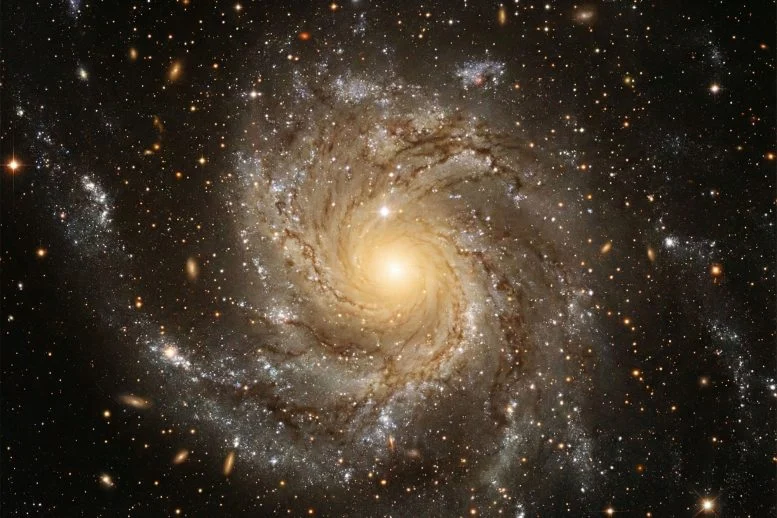
Astronomers believe this barred spiral galaxy could be the oldest example of its kind ever observed.
Research led by Daniel Ivanov, a graduate student in physics and astronomy at the Kenneth P. Dietrich School of Arts and Sciences at the University of Pittsburgh, has identified a strong candidate for one of the oldest known spiral galaxies to host a stellar bar. These central structures can be visually prominent and are thought to play a key role in shaping how galaxies grow and change over time. The Milky Way also contains a stellar bar at its center.
The discovery narrows the window for when stellar bars may have first formed in the universe. By examining light from the distant galaxy, known as COSMOS-74706, the research team determined that it is being observed as it appeared roughly 11.5 billion years ago.
“This galaxy was developing bars 2 billion years after the birth of the universe,” Ivanov said. “Two billion years after the big bang.”
An Early Glimpse of Galactic Structure
The results were recently presented at the 247th meeting of the American Astronomical Society on Thursday, Jan. 8, 2026.
The defining feature of these galaxies is right in the name: “A stellar bar is a linear feature at the center of the galaxy,” Ivanov said. The bar isn’t an object itself, but a dense collection of stars and gas that is aligned in such a way that in images taken perpendicular to a galactic plane, there appears to be a bright line bisecting the galaxy.
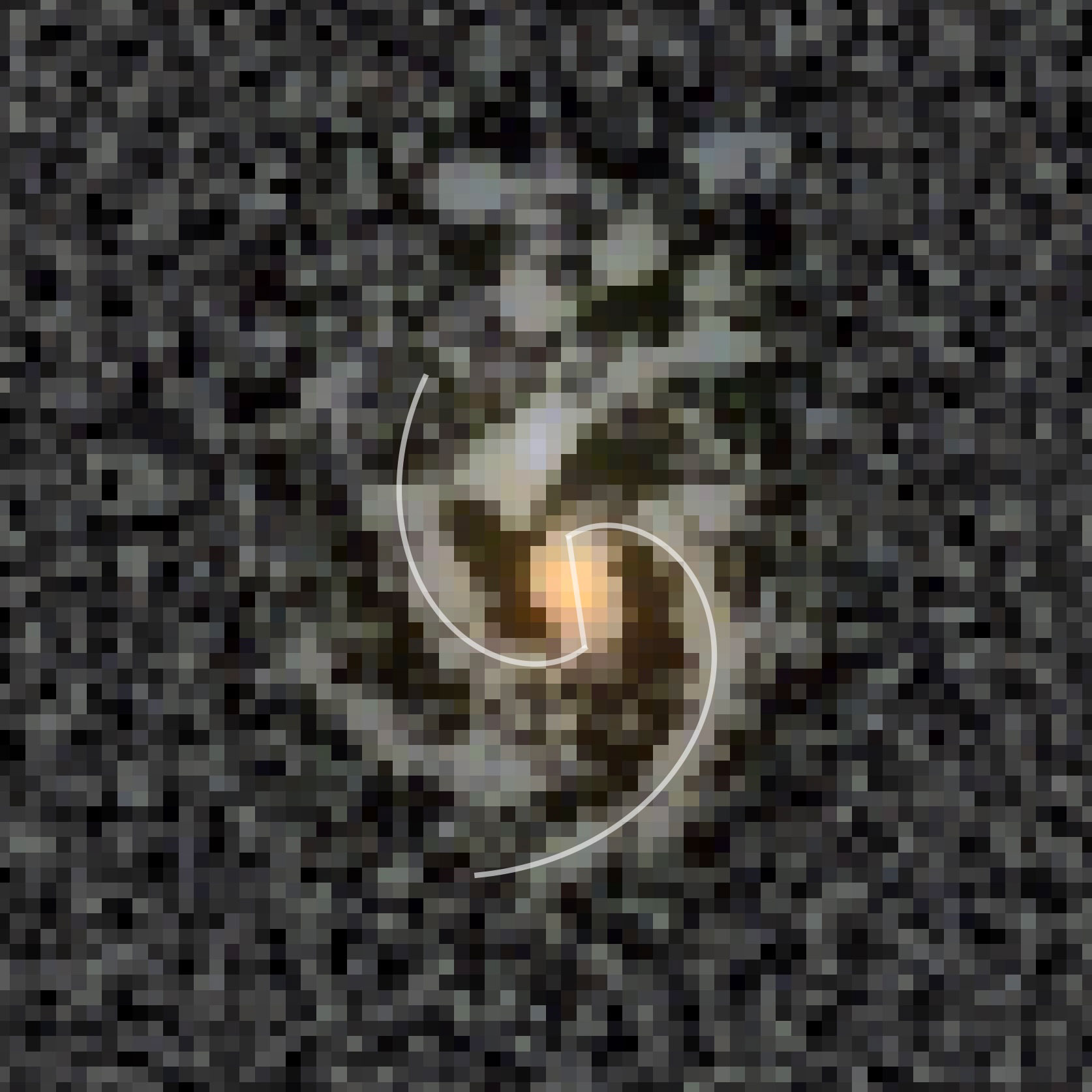
Stellar bars can influence how a galaxy changes over time by drawing gas from its outer regions toward the center. This inward flow can supply material to the supermassive black hole at the galaxy’s core while also reducing the rate of new star formation across the galaxy’s disk.
Why This Galaxy Stands Out
Other researchers have reported earlier barred spiral galaxies, but the analyses of those are less conclusive because the methods used to analyze the lights’ redshifts are not as definitive as spectroscopy, which was used to validate COSMOS-74706. In other cases, the galaxy’s light was distorted as it passed by a massive object, a phenomenon known as gravitational lensing.
In essence, Ivanov said, “It’s the highest redshift, spectroscopically confirmed, unlensed barred spiral galaxy.”
He wasn’t necessarily surprised to find a barred spiral galaxy so early in the universe’s evolution. In fact, some simulations suggest bars forming at redshift 5, or about 12.5 billion years ago. But, Ivanov said, “In principle, I think that this is not an epoch in which you expect to find many of these objects. It helps to constrain the timescales of bar formation. And it’s just really interesting.”
Meeting: 247th meeting of the American Astronomical Society
This work is based in part on observations made with the NASA/ESA/CSA James Webb Space Telescope with data from Space Telescope Science Institute, which is operated by the Association of Universities for Research in Astronomy, Inc., under NASA contract NAS 5-03127, which is supported by NASA. Work was also supported by the Brinson Foundation.
Leave a Reply