
January 23, 2026 by Sungkyunkwan University
Collected at: https://techxplore.com/news/2026-01-grid-filtration-technology-nanoplastics-smaller.html
Professor Jeong-Min Baik’s research group of the SKKU School of Advanced Materials Science and Engineering has developed a reusable electrokinetic filtration platform capable of filtering more than 99% of ultrafine nanoplastic particles smaller than 50 nm even under commercial-level high-flow conditions.
Plastic pollution, which has surged in recent years through industrialization and the pandemic era, poses a direct threat to human health. In particular, nanoplastics smaller than 100 nm—thousands of times thinner than a human hair—can readily pass through biological membranes in the body and trigger serious diseases such as immune dysregulation and carcinogenicity.
However, conventional water purification systems have struggled to effectively remove nanoplastics of such small sizes, highlighting technological limitations; studies have even reported the presence of hundreds of thousands of particles in a single bottle of bottled water.
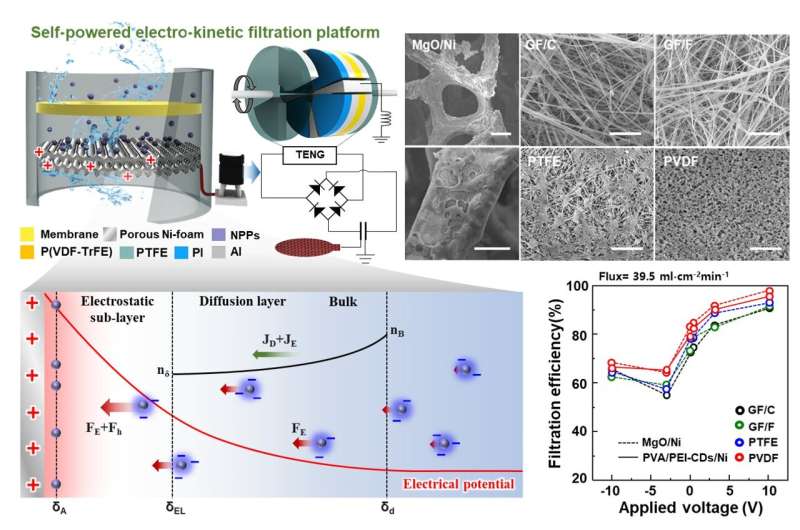
To overcome these limitations, Professor Baik’s research group introduced a strategy that electrokinetically activates a porous metallic filter. The work is published in Materials Today.
By coating the filter surface with magnesium oxide (MgO) and a cationic engineered polymer compound and applying an external potential, the research team implemented a filter that strongly attracts negatively charged nanoplastics within water. The platform achieved over 99% removal of 50 nm nanoplastics even under commercial-level high-throughput flux.
One noteworthy aspect of this study is that the system can operate without an external battery or power supply. The platform was integrated with a triboelectric generator, which converts mechanical energy directly into electricity, thereby realizing energy self-sufficiency. In addition, by reversing the direction of the electric field, the plastic particles captured by the filter can be detached, enabling filter regeneration.
The system maintained performance even after the filter was reused more than 20 times, demonstrating strong economic feasibility.
The system also showed consistent performance across diverse real-world water conditions, including tap water and river water, and demonstrated purification capability that meets World Health Organization (WHO) drinking-water standards.
Professor Baik stated, “This study is academically significant in that it mathematically clarifies the combined electrokinetic filtration mechanism of underwater nanoplastics. Going forward, the technology can be extended to various water purification applications, including bacterial removal and selective capture of valuable metal resources.”
The research group has completed a domestic patent application for the technology and is accelerating follow-up studies toward commercialization.
More information: Do-Heon Kim et al, High-efficiency, reusable electrokinetic filtration platform for high-Flux nanoplastic sequestration and self-powered operation, Materials Today (2025). DOI: 10.1016/j.mattod.2025.12.008
Journal information: Materials Today
Leave a Reply