
January 21, 2026 by Seoul National University of Science and Technology
Collected at: https://techxplore.com/news/2026-01-sodium-based-nanorods-enable-smart.html
Thermal management is essential for reducing future heating and cooling energy consumption. Notably, the near-infrared (NIR) component of sunlight is closely associated with heat absorption.
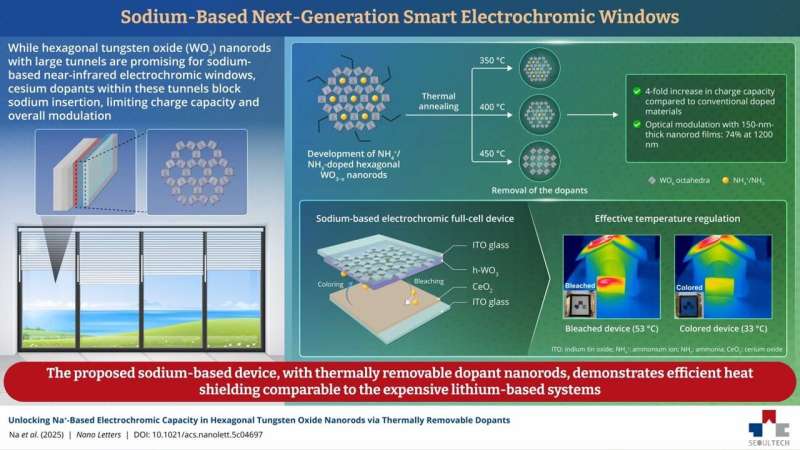
Hexagonal tungsten oxide nanorods are promising NIR-blocking electrochromic materials that change their color, transparency, and opacity upon the application of a small electric voltage. Their hexagonal tunnels, known as optically active sites, can effectively accommodate electrolyte ions and enable dynamic NIR modulation. However, maintaining the hexagonal structure requires dopants inside these tunnels for structural integrity.
Although small lithium ions can easily access the hexagonal tunnels, larger sodium ions, despite being more abundant and cost-effective, are considered as limitations due to steric hindrance from dopants inside the tunnels.
Breakthrough in sodium-ion electrochromic materials
In an innovative breakthrough, a team of researchers led by Assistant Professor Sungyeon Heo, along with Mr. Janghan Na, both from Seoul National University of Science and Technology, Republic of Korea, has overcome this dopant-blocking limitation by introducing thermally removable dopants that can be easily eliminated through simple heat treatment.
The study is published in Nano Letters.
“Our strategy allows effective utilization of the hexagonal tunnels for sodium-ion insertion. Consequently, we demonstrate that low-cost sodium electrolytes can achieve large NIR modulation, comparable to that of a lithium-based system. This leads to efficient heat-shielding performance without relying on expensive lithium-based systems even with an ultrathin film thickness of 150 nm,” says Dr. Heo.
Scalability and broader application potential
The nanomaterials developed in this research have strong potential for large-scale production. All synthesis procedures are conducted within a single reactor batch, with precise control over reaction pressure and temperature.
This simplicity enables scale-up production, particularly when equipped with integrated systems that automatically monitor and control reaction temperature and pressure. Moreover, since the materials are synthesized in a colloidal form, they are not limited to electrochromic applications.
Colloidal nanomaterials can be readily processed into coatings, or composite systems, allowing their use in a wide range of fields beyond electrochromism.
Implications for energy efficiency and sustainability
Furthermore, this research offers a practical solution for thermal regulation under diverse climate conditions.
In extremely hot regions, such as parts of Africa and the Middle East, electrochromic materials can be maintained in a continuous heat-blocking state to effectively suppress NIR transmission, which is the primary contributor to solar heat gain.
In contrast, in regions with distinct seasonal variations, such as the Republic of Korea, the optical state can be dynamically adjusted according to user demand and climate conditions.
By selectively controlling NIR transmission, the system enables efficient thermal management throughout the year. As a result, both cooling and heating energy consumption can be significantly reduced, improving overall building energy efficiency.
Within the next five to 10 years, this progress could enable broader applicability of smart windows and adaptive buildings that automatically regulate heat and light. Such systems would reduce reliance on air conditioning and heating, leading to lower energy consumption while improving indoor comfort.
“Our study demonstrates material designs and processing strategies that are compatible with low-cost, Earth-abundant components, such as sodium electrolyte, and scalable synthesis methods, such as a single reactor batch. Ultimately, our research supports a transition toward a more sustainable environment and could finally reduce energy demand in everyday life,” concludes Dr. Heo.
More information: Janghan Na et al, Unlocking Na+-Based Electrochromic Capacity in Hexagonal Tungsten Oxide Nanorods via Thermally Removable Dopants, Nano Letters (2025). DOI: 10.1021/acs.nanolett.5c04697
Journal information: Nano Letters
Leave a Reply