
By University College London January 15, 2026
Collected at: https://scitechdaily.com/a-colossal-iron-mystery-has-been-discovered-in-the-ring-nebula/
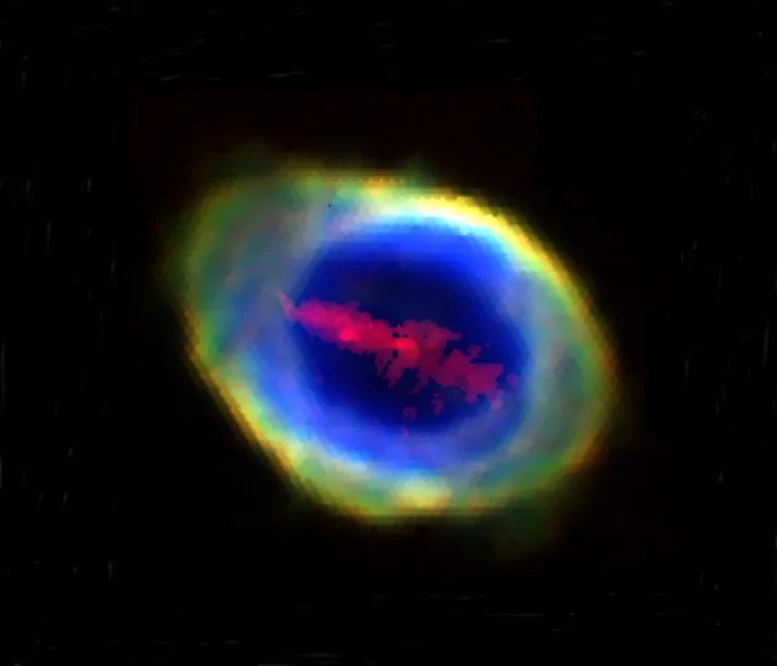
A colossal bar of iron hidden inside the Ring Nebula may be the ghostly remains of a planet destroyed by a dying star.
An international team of astronomers led by researchers at UCL (University College London) and Cardiff University has uncovered an unexpected feature inside the well-known Ring Nebula. Hidden within the glowing structure is a previously unseen cloud of iron shaped like a narrow bar.
This unusual concentration of iron atoms is being reported for the first time in Monthly Notices of the Royal Astronomical Society. The structure takes the form of a long strip that fits neatly within the nebula’s inner region, which is elliptical in shape and familiar from images captured by telescopes, including the James Webb Space Telescope at infrared wavelengths. According to the researchers, the iron bar stretches about 500 times farther than Pluto’s orbit around the Sun and contains an amount of iron comparable in mass to Mars.
What the Ring Nebula Is and How It Formed
The Ring Nebula was first identified in 1779 by French astronomer Charles Messier in the northern constellation Lyra.[2] It is a bright shell of gas created when a star reaches the end of its fuel burning life and releases its outer layers into space. In several billion years, the Sun is expected to undergo a similar transformation.[3]
How Astronomers Detected the Iron Bar
The discovery was made using data collected with the Large Integral Field Unit (LIFU) mode of a new instrument called the WHT Enhanced Area Velocity Explorer (WEAVE).[4] WEAVE is installed on the Isaac Newton Group’s 4.2-meter William Herschel Telescope.[5]
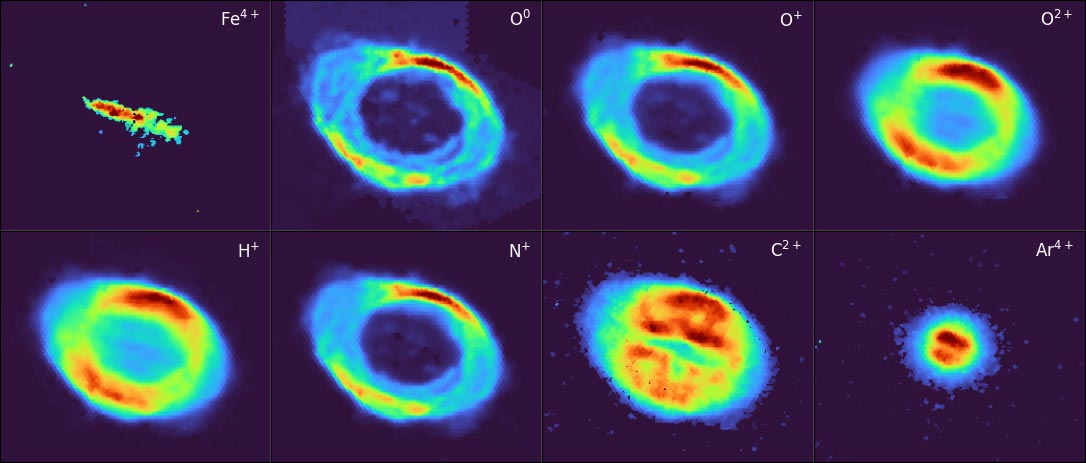
LIFU consists of hundreds of optical fibers bundled together. This setup allowed the researchers to capture spectra (where light is separated into its constituent wavelengths) across every part of the Ring Nebula and across all optical wavelengths, something that had not been achieved before.
A Hidden Feature Revealed in the Data
Lead author Dr. Roger Wesson, who holds positions at UCL’s Department of Physics & Astronomy and Cardiff University, explained how the finding emerged. “Even though the Ring Nebula has been studied using many different telescopes and instruments, WEAVE has allowed us to observe it in a new way, providing so much more detail than before. By obtaining a spectrum continuously across the whole nebula, we can create images of the nebula at any wavelength and determine its chemical composition at any position.
“When we processed the data and scrolled through the images, one thing popped out as clear as anything – this previously unknown ‘bar’ of ionized iron atoms, in the middle of the familiar and iconic ring.”
Competing Ideas About the Iron’s Origin
At present, scientists do not know how this iron bar formed. The team says additional observations will be needed to solve the puzzle. One possibility is that the structure holds new clues about how the dying star expelled its material. Another, more speculative idea suggests the iron could be a curved arc of plasma created when a rocky planet was vaporized as the star expanded earlier in its life.
Co-author Professor Janet Drew of UCL Physics & Astronomy emphasized the need for more information. “We definitely need to know more – particularly whether any other chemical elements co-exist with the newly-detected iron, as this would probably tell us the right class of model to pursue. Right now, we are missing this important information.”
What Comes Next for the Research
The team is preparing a follow-up study and plans to use WEAVE’s LIFU at higher spectral resolution. These new observations should help clarify how the iron structure formed and what it is made of.
WEAVE itself is set to run eight major surveys over the next five years, examining objects that range from nearby white dwarfs to extremely distant galaxies. One branch of the project, the Stellar, Circumstellar and Interstellar Physics survey led by Professor Drew, is already observing many additional ionized nebulae across the northern Milky Way.
Dr. Wesson noted that similar discoveries may lie ahead. “It would be very surprising if the iron bar in the Ring is unique. So hopefully, as we observe and analyse more nebulae created in the same way, we will discover more examples of this phenomenon, which will help us to understand where the iron comes from.”
Professor Scott Trager, WEAVE Project Scientist at the University of Groningen, added: “The discovery of this fascinating, previously unknown structure in a night-sky jewel, beloved by sky watchers across the Northern Hemisphere, demonstrates the amazing capabilities of WEAVE. We look forward to many more discoveries from this new instrument.”
Notes
- The Ring Nebula is also known as M 57 – the 57th listing in Messier’s catalogue of ‘Nebulae and Star Clusters’. John L E Dreyer also included it in his New General Catalogue, first published in 1888 by the Royal Astronomical Society, where it appears as NGC 6720.
- Once a star like the Sun runs out of hydrogen fuel, it expands to become an extreme red giant and sheds its outer layers, which then coast out to form a glowing shell. A shell created in this way is known in astronomy as a planetary nebula. The leftover stellar core becomes a white dwarf, which, though no longer burning any fuel, continues to shine as it slowly cools over billions of years. The Ring Nebula is a planetary nebula located 2,600 light-years (or 787 parsecs) away, that is thought to have formed about 4,000 years ago. Planetary nebula ejection returns matter forged in a star to interstellar space and is the source of much of the Universe’s carbon and nitrogen – key building blocks of life on Earth. Stars more than about eight times the mass of the Sun age differently, ending life abruptly in a powerful explosion called a supernova as they collapse to form a black hole or neutron star.
- Funding for the WEAVE facility has been provided by UKRI STFC, the University of Oxford, NOVA, NWO, Instituto de Astrofísica de Canarias (IAC), the Isaac Newton Group partners (STFC, NWO, and Spain, led by the IAC), INAF, CNRS-INSU, the Observatoire de Paris, Région Île-de-France, CONACYT through INAOE, the Ministry of Education, Science and Sports of the Republic of Lithuania, Konkoly Observatory (CSFK), Max-Planck-Institut für Astronomie (MPIA Heidelberg), Lund University, the Leibniz Institute for Astrophysics Potsdam (AIP), the Swedish Research Council, the European Commission, and the University of Pennsylvania. The WEAVE Survey Consortium consists of the ING, its three partners, represented by UKRI STFC, NWO, and the IAC, NOVA, INAF, GEPI, INAOE, Vilnius University, FTMC – Center for Physical Sciences and Technology (Vilnius), and individual WEAVE Participants.
- The William Herschel Telescope is the leading telescope of the Isaac Newton Group (ING), which in turn is part of the Roque de los Muchachos Observatory on La Palma, in the Canary Islands. The ING is jointly operated by the United Kingdom (STFC-UKRI), the Netherlands (NWO) and Spain (IAC, funded by the Spanish Ministry of Science, Innovation and Universities).
Reference: “WEAVE imaging spectroscopy of NGC 6720: an iron bar in the Ring” by R Wesson, J E Drew, M J Barlow, J García-Rojas, R Greimel, D Jones, A Manchado, R A H Morris, A Zijlstra, P J Storey, J A L Aguerri, S R Berlanas, E Carrasco, G B Dalton, E Gafton, R García-Benito, A L González-Morán, B T Gänsicke, S Hughes, S Jin, R Raddi, R Sánchez-Janssen, E Schallig, D J B Smith, S C Trager and N A Walton, 16 January 2026, Monthly Notices of the Royal Astronomical Society.
DOI: 10.1093/mnras/staf2139
Leave a Reply