
January 15, 2026 by Elhuyar Fundazioa
Collected at: https://phys.org/news/2026-01-symmetry-limits-photovoltaics-surface.html
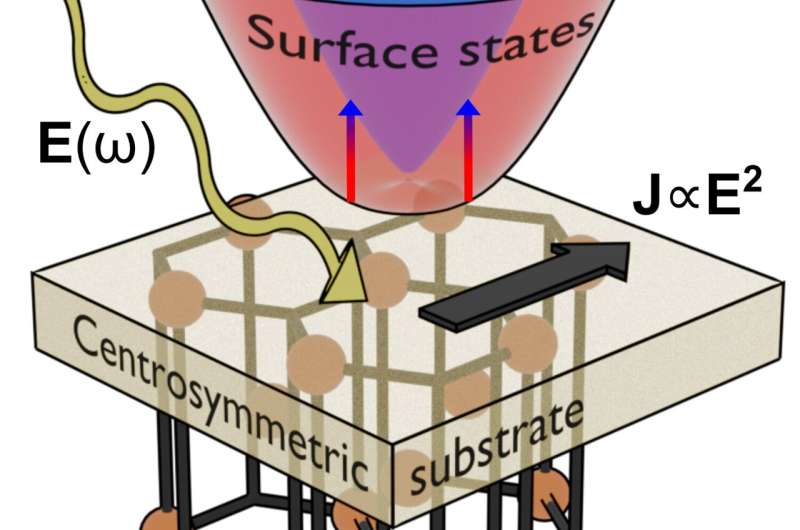
A recent study carried out by researchers from EHU, the Materials Physics Center, nanoGUNE, and DIPC introduces a novel approach to solar energy conversion and spintronics. The work tackles a long-standing limitation in the bulk photovoltaic effect—the need for non-centrosymmetric crystals—by demonstrating that even perfectly symmetric materials can generate significant photocurrents through engineered surface electronic states. This discovery opens new pathways for designing efficient light-to-electricity conversion systems and ultrafast spintronic devices.
The work is published in the journal Physical Review Letters.
Conventional solar cells rely on carefully engineered interfaces, such as p–n junctions, to turn light into electricity. A more exotic mechanism—the bulk photovoltaic effect—can generate electrical current directly in a material without such junctions, but only if its crystal structure lacks inversion symmetry. This strict requirement has long restricted the search for practical materials.
In this new study, a group of researchers demonstrates that this limitation can be overcome: even perfectly symmetric materials can produce sizable photocurrents thanks to the special electronic states that naturally form at their surfaces.
Using first-principles calculations, the researchers show that the surfaces of metals and semiconductors with strong relativistic spin–orbit interaction can host electronic states that behave very differently from those in the bulk. These surface states break inversion symmetry locally and respond nonlinearly to light, giving rise to robust charge currents and, remarkably, pure spin-polarized currents flowing along the surface.
After benchmarking the mechanism on the well-known Au(111) surface, they identified Tl/Si(111) as an ideal material platform, predicting photocurrents comparable to those of leading ferroelectrics along with clear experimental signatures for detection.
The findings reveal a new strategy for light-to-electricity conversion: rather than searching for complex non-centrosymmetric crystals, scientists can engineer photocurrents by tailoring the surface electronic structure of otherwise symmetric materials. Beyond energy harvesting, the ability to generate and control spin currents with light—without magnets or applied voltages—opens promising opportunities for ultrafast, low-power spintronic devices.
Publication details
Javier Sivianes et al, Surface-State Engineering for Generation of Nonlinear Charge and Spin Photocurrents, Physical Review Letters (2025). DOI: 10.1103/h8rp-rtn8. On arXiv: DOI: 10.48550/arxiv.2503.14360
Journal information: Physical Review Letters , arXiv
Leave a Reply