
January 13, 2026 by Jason Major, ARC Centre of Excellence for Carbon Science and Innovation
Collected at: https://techxplore.com/news/2026-01-smart-gate-paves-reliable-hydrogen.html
Researchers have developed a simple, scalable way to reliably generate hydrogen with impure water, such as seawater or industrial wastewater.
Hydrogen is crucial to carbon-intensive industries such as steel making and fertilizer production. Use of green hydrogen, produced using renewable energy to split water via electrocatalysis, is considered a way to help such industries decarbonize. The Australian government also considers its potential to replace fossil fuels and decarbonize our electricity system.
At the moment, hydrogen generated via electrocatalysis requires pure water. In a dry country like Australia, the problem is access to that water.
In impure water, especially seawater, contaminants such as magnesium, chloride and calcium ions quickly destroy the electrocatalytic system.
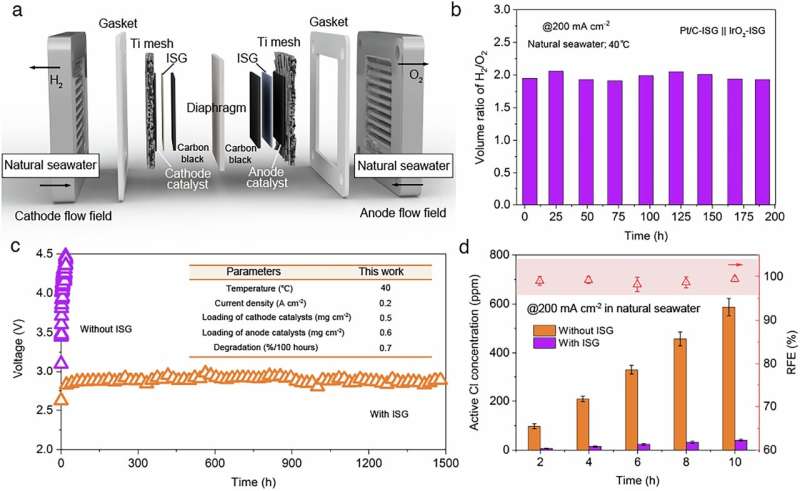
Adelaide University-based researchers from the ARC Center of Excellence for Carbon Science and Innovation (COECSI) have developed a protective coating for the catalysts in electrocatalytic systems that act like a smart gate. The coating, a type of polymer called an ionomer, lets through the ions needed for the electrolysis of water, but blocks the harmful ions that attack and destroy the catalysts and the electrocatalytic system.
The research is published in Nature Communications.
“The coolest part is that this approach lets seawater-fed electrolyzers run for over 1,500 hours with durability comparable to pure-water systems,” says Dr. Feiyue Gao, lead author and Center research fellow.
“This is a significant shift from the rapid failure normally seen.
“We have gone beyond proof of concept. Our system works. The remaining challenges are to optimize long-term stability, scalability and system integration to meet commercial requirements.
“At the same time, our results highlight an opportunity for the field to develop next-generation ionomers with even better selectivity and durability,” he says.
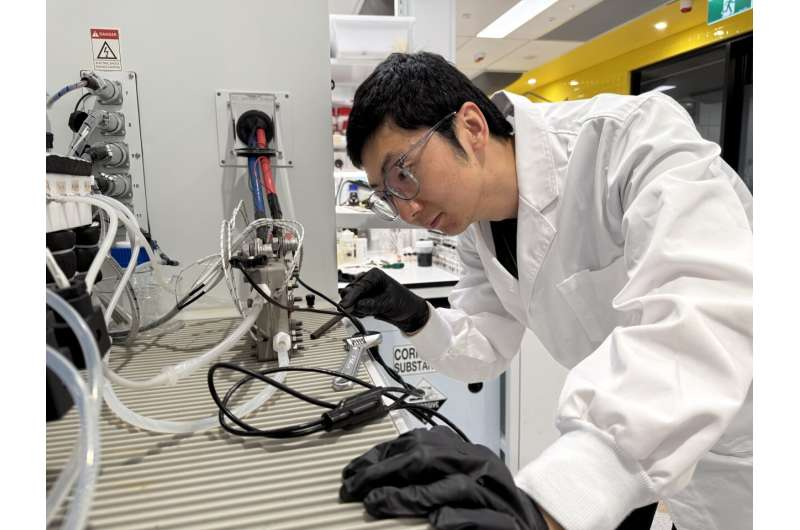
Dr Feiyue Gao setting up and testing the electrolysis system used to produce hydrogen from seawater. Credit: ARC Centre of Excellence for Carbon Science and Innovation
The ionomer
The ionomer is an ion-conducting polymer typically used as a binder or glue to hold catalyst particles together or to improve mechanical contact within the electrode.
“What is fundamentally different in our work is that we deliberately exploit the ion selectivity of ionomers. We design the ionomer coatings to control which ions can reach the catalyst surface,” says Center Chief Investigator, Prof Yao Zheng.
At the cathode, the ionomer helps block calcium and magnesium ions that cause scaling and clog the surface. At the anode, it suppresses chloride transport and stabilizes the local pH.
In principle, the same ionomer approach can be applied to any catalyst operating in impure or seawater environments, including carbon-based and carbon-supported catalysts, which are the focus of COECSI’s research and particularly vulnerable to fouling and degradation in such electrocatalysis systems.
Green hydrogen in Australia
The Australian Government has selected hydrogen as a new export industry mapped out via its National Hydrogen Strategy. According to the Strategy, the global hydrogen market is forecast to reach US$1.4 trillion in 2050.
More information: Fei-Yue Gao et al, Ion-selective interface engineering for durable electrolysis of impure water, Nature Communications (2025). DOI: 10.1038/s41467-025-66711-x
Journal information: Nature Communications
Leave a Reply