
Tanya Weaver Mon 12 Jan 2026
Collected at: https://eandt.theiet.org/2026/01/12/perovskite-solar-cells-made-significantly-more-stable-new-study
New perovskite solar cells are able to retain around 95% of their performance after extended heat testing, according to a new study.
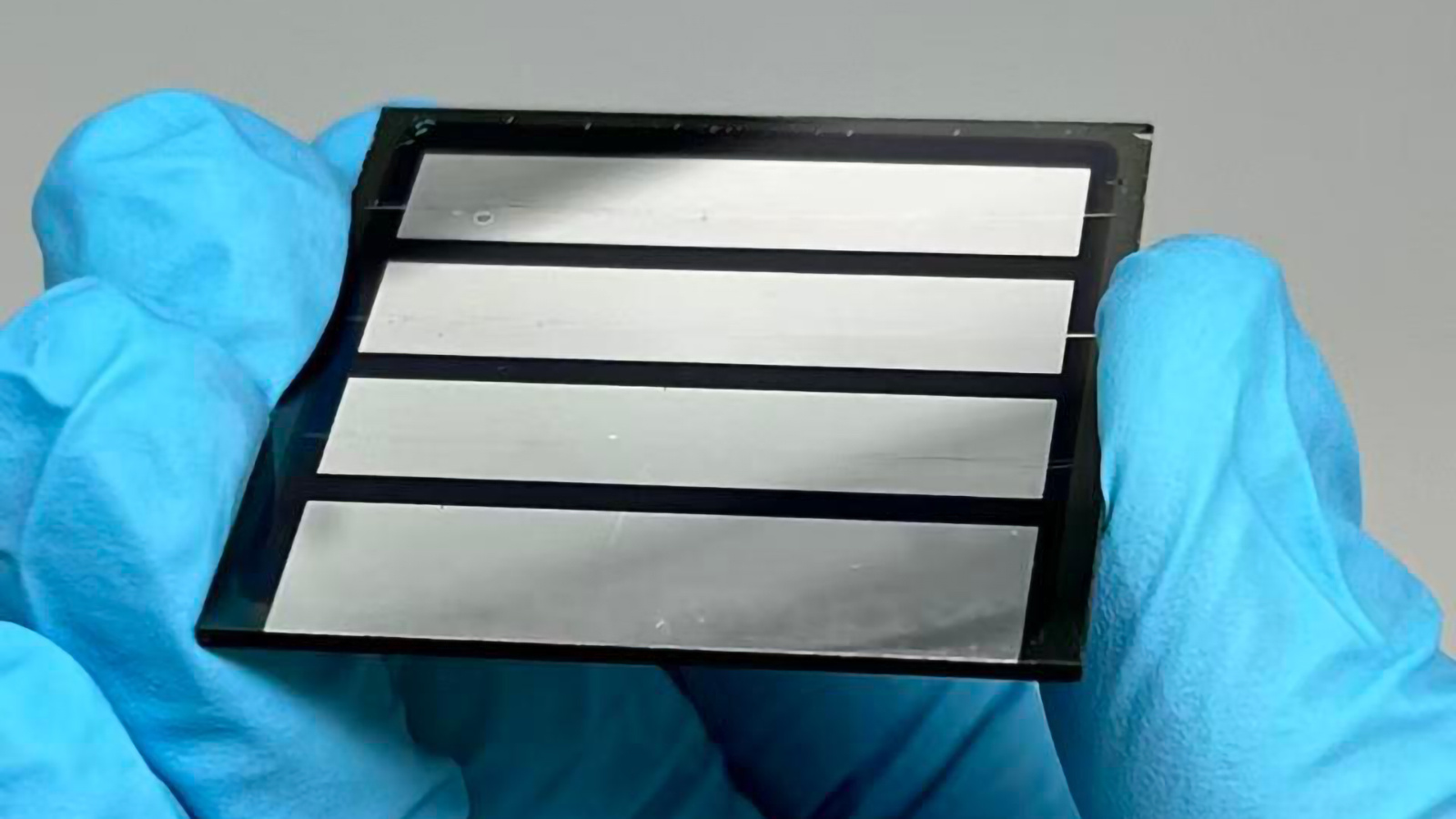
A research team at the University of Manchester has enhanced the stability of perovskite solar cells by fine-tuning the small molecules that coat their surface. These molecules, known as amidinium ligands, effectively ‘glue’ the perovskite structure together.
Professor Thomas Anthopoulos, professor of emerging optoelectronics at the University of Manchester, who led the research, said: “This could overcome one of the last major hurdles facing perovskite solar cell technology and ensure it lasts long enough for large-scale deployment.’
Perovskite has long been hailed as a game-changer for the next generation of solar power. Solar cells featuring a perovskite-structured crystal compound are excellent at absorbing sunlight and converting it into electricity. However, while they are very efficient, compared with traditional silicon cells, they lack stability and degrade far more quickly. This is because the materials in perovskite cells are sensitive to heat, moisture and sunlight.
To overcome these challenges, the research team focused their study on understanding the chemical structure of the small molecules, or amidinium ligands, coating the surface of the solar cells. Acting as a ‘molecular glue’, these molecules control the formation of highly stable, low-dimensional layers that act as a protective shield on the conventional three-dimensional perovskite.
According to the researchers, these protective layers help prevent tiny defects from forming, allowing electrical charges to flow more efficiently and preventing the devices from degrading under heat or light.
Using this approach, the team developed their solar cells and put them to the test. During testing, the cells achieved a power conversion efficiency of 25.4%, while maintaining over 95% of performance after 1,100 hours of continuous operation at 85°C under full sunlight.
Anthopoulos said: “Perovskite solar cells are seen as a cheaper, lightweight and flexible alternative to traditional silicon panels, but they have faced challenges with long-term stability. Current state-of-the-art perovskite materials are known to be unstable under heat or light, causing the cells to degrade faster.
“The amidinium ligands we’ve developed, and the new knowledge gained, allow the controlled growth of high-quality, stable perovskite layers. This could overcome one of the last major hurdles facing perovskite solar cell technology and ensure it lasts long enough for large-scale deployment.”
The study – ‘Multivalent ligands regulate dimensional engineering for inverted perovskite solar modules’ – has been published in the journal Science.
Leave a Reply