
January 12, 2026 by David Bradley, Inderscience
Collected at: https://techxplore.com/news/2026-01-algorithm-captures-nonlinear-climate-dynamics.html
Researchers have developed a new algorithmic model that can improve predictions of cooling demand for greener buildings. This kind of control will be a key factor in energy efficiency, allowing interior climate control systems to optimize cooling periods and so reduce energy demands.
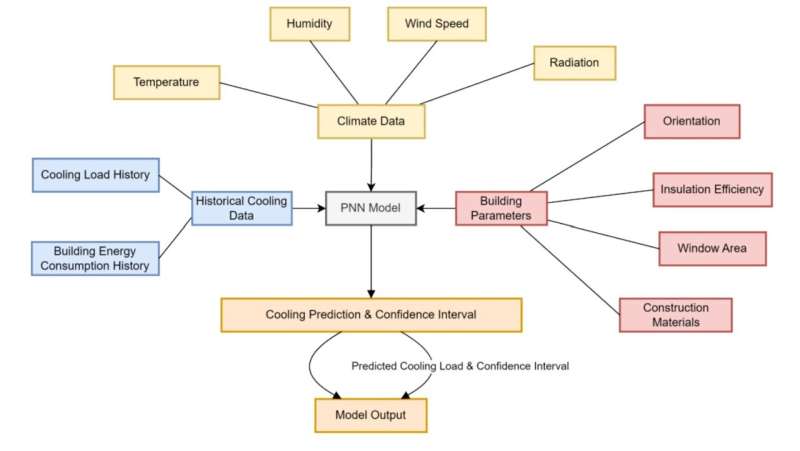
The framework for the new model is based on a probabilistic neural network (PNN), which has been tested across varied climatic conditions. According to the research published in the International Journal of Environment and Pollution, it delivers accurate forecasts and quantifies the uncertainty in a way that conventional models do not.
Cooling systems account for a substantial proportion of a building’s energy consumption in the hottest parts of the world. Their operation is dependent on outside temperature, humidity, building characteristics, and occupant behavior. The standard control models usually assume linear relationships and so cannot capture the nonlinear dynamics of climatic variability and requirements.
The PNN approach overcomes this problem by modeling the nonlinear relationships. This allows the system to understand the intricacies of the building-specific data and to provide better predictions to optimize climate control. The team was able to demonstrate almost 97% reliable control across various scenarios.
Such a system could be used by policymakers, developers, and energy managers hoping to optimize cooling in hot climates and to reduce the carbon footprint of air-conditioning systems. By providing a more subtle understanding of cooling load variability, the PNN allows for accurate data-driven decisions regarding system design, operational scheduling, and regulatory compliance. The team explains that plans can be put in place for both typical and extreme conditions with greater assurance, reducing energy waste while maintaining occupant comfort.
The same framework might have broader energy management use, allowing for short-term control as well as long-term planning of infrastructure in low-carbon developments. The construction industry must incorporate green systems, and such tools as PNN-managed climate control could play an important role in the development of sustainable buildings.
More information: Pengming Wang et al, Predicting the cooling capacity of green buildings using probabilistic neural network models, International Journal of Environment and Pollution (2025). DOI: 10.1504/ijep.2025.10072094
Leave a Reply