
By Jeongsu Ha, Institute for Basic Science January 5, 2026
Collected at: https://scitechdaily.com/physicists-discover-a-new-nuclear-island-where-magic-numbers-collapse/
Researchers identify an “Island of Inversion” in proton-neutron symmetric nuclei for the first time.
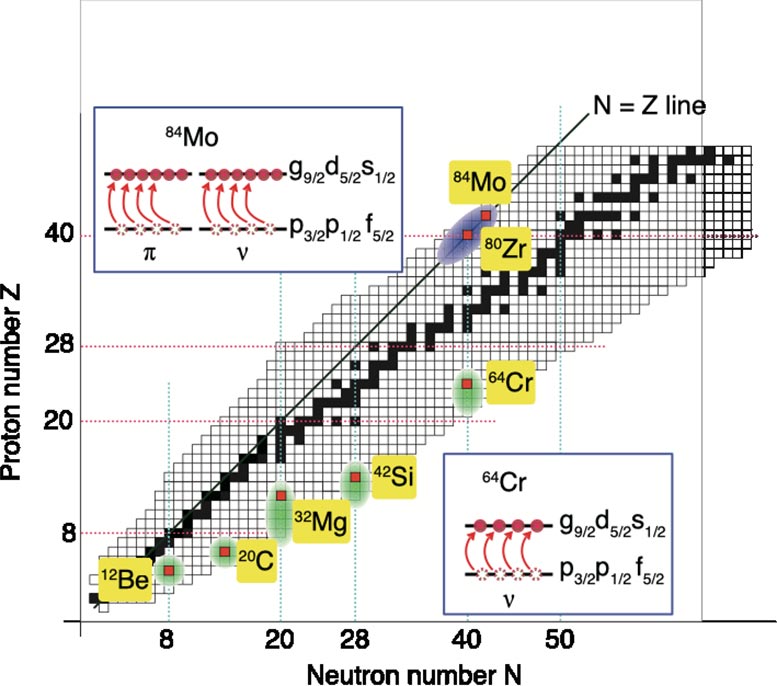
For many years, nuclear physicists thought that “Islands of Inversion” existed mainly in neutron-rich nuclei. These are regions of the nuclear chart where the usual rules of nuclear structure stop working. In these rare cases, familiar magic numbers no longer apply, spherical shapes give way to distorted forms, and nuclei take on unexpectedly strong deformations.
Until now, every known example involved highly exotic systems, including beryllium 12 (N = 8), magnesium 32 (N = 20), and chromium 64 (N = 40), all far removed from the stable nuclei found in nature.
A new study by an international collaboration involving the Center for Exotic Nuclear Studies, the Institute for Basic Science (IBS), the University of Padova, Michigan State University, the University of Strasbourg, and other institutions has now revealed something entirely unexpected. The researchers identified an Island of Inversion in one of the most symmetric regions of the nuclear chart, where the number of protons and neutrons is the same.
Testing symmetry at the N = Z line
The team focused on two isotopes of molybdenum, molybdenum 84 (Z = N = 42) and molybdenum 86 (Z = 42, N = 44). These nuclei sit along the N = Z line, a scientifically important but technically challenging region because such isotopes are difficult to produce in the laboratory. Using rare isotope beams at Michigan State University together with extremely sensitive gamma ray detectors, the researchers measured the lifetimes of excited nuclear states with picosecond level precision.
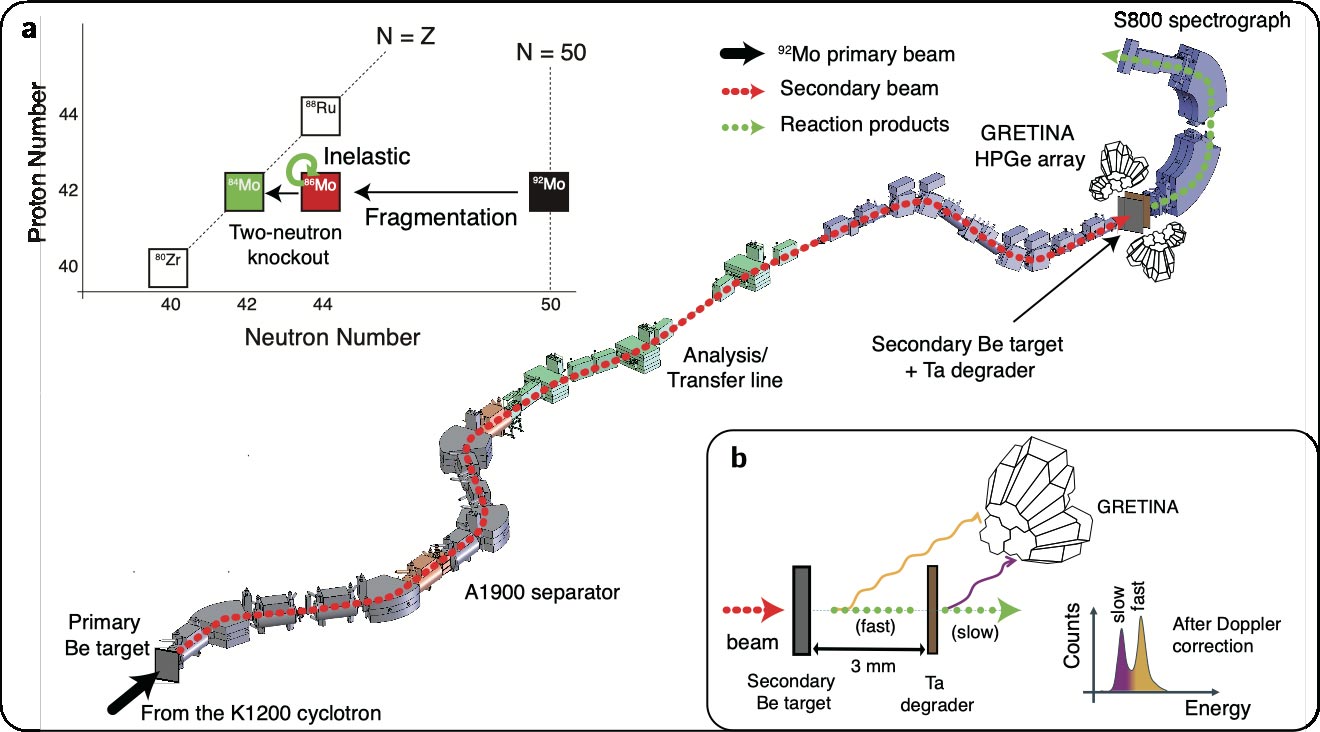
To generate the beams, the scientists created fast-moving Mo 86 nuclei by striking a beryllium target with accelerated Mo 92 ions. An A1900 separator was then used to isolate the desired fragments from the many products created in the collision.
The selected Mo 86 nuclei were directed onto a second target, where some became excited, and others were transformed into Mo 84 by losing two neutrons. As these nuclei relaxed back to their ground states, they emitted gamma rays that carried detailed information about their internal structure.
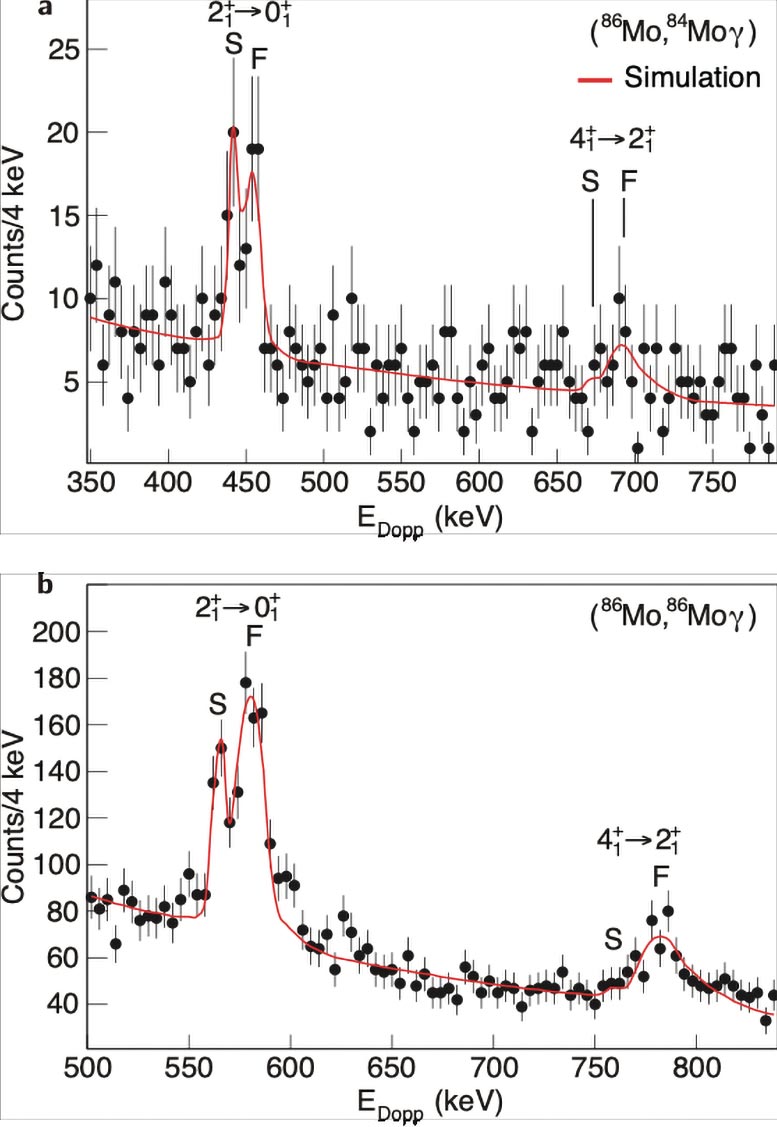
The emitted gamma rays were recorded using GRETINA, a high resolution germanium detector array capable of tracking individual gamma ray interactions, along with TRIPLEX, an instrument designed to measure extremely short lifetimes on the scale of trillionths of a second. By comparing the experimental data with GEANT4 Monte Carlo simulations, the researchers were able to determine the lifetimes of the first excited states and infer how strongly the nuclei were deformed.
Nearly identical nuclei behave very differently
The measurements revealed that Mo-84 behaves very differently from Mo-86, even though the two isotopes differ by only two neutrons. Mo-84 showed an exceptionally large degree of collective motion — a sign that many protons and neutrons are being promoted together across a major shell gap. Nuclear physicists describe this process as a “particle–hole excitation”: some nucleons jump to higher-energy orbitals (particles), leaving vacancies in the lower-energy orbitals (holes). The more nucleons that participate in these coordinated jumps, the more strongly deformed a nucleus becomes.
Advanced calculations performed by the team explain this striking contrast. In Mo-84, both protons and neutrons undergo very large simultaneous particle-hole excitations — effectively an 8-particle-8-hole rearrangement — which produces a strongly deformed shape.
This behavior arises from a special interplay between proton–neutron symmetry and the narrowing of the shell gap at N = Z = 40, making such coordinated excitations unusually easy. Importantly, the models show that this deformation cannot be reproduced without including three-nucleon forces, interactions in which three nucleons act together. Models that include only the traditional two-nucleon interaction fail to generate the observed structure.
In contrast, Mo-86 shows modest 4p-4h excitations and therefore remains much less deformed. These combined findings show that Mo-84 resides inside a newly identified “Island of Inversion” while Mo-86 lies outside it.
The new “Isospin-Symmetric Island of Inversion” discovered through this study on the N = Z nuclide Mo-84 is the first case of Island of Inversion that appears in proton-neutron symmetric nuclei. This discovery challenges long-held assumptions about where structural inversions can occur and provides a new window into the fundamental forces that bind matter together.
Reference: “Abrupt structural transition in exotic molybdenum isotopes unveils an isospin-symmetric island of inversion” by J. Ha, F. Recchia, S. M. Lenzi, H. Iwasaki, D. D. Dao, F. Nowacki, A. Revel, P. Aguilera, G. de Angelis, J. Ash, D. Bazin, M. A. Bentley, S. Biswas, S. Carollo, M. L. Cortes, R. Elder, R. Escudeiro, P. Farris, A. Gade, T. Ginter, M. Grinder, J. Li, D. R. Napoli, S. Noji, J. Pereira, S. Pigliapoco, A. Pompermaier, A. Poves, K. Rezynkina, A. Sanchez, R. Wadsworth and D. Weisshaar, 27 November 2025, Nature Communications.
DOI: 10.1038/s41467-025-65621-2
This work was supported by the Institute for Basic Science (IBS-R031-Y3); IRI-I002619N of the FWO Research Foundation—Flanders. A.P. acknowledges support of the grant nos. CEX2020-001007-S funded by MCIN/AEI/10.13039/501100011033 and PID2021-127890NB-I00.
Leave a Reply