
January 5, 2026 by Filip Strubbe
Collected at: https://phys.org/news/2026-01-quantum-gravity-dimensions.html
Quantum theory and Einstein’s theory of general relativity are two of the greatest successes in modern physics. Each works extremely well in its own domain: Quantum theory explains how atoms and particles behave, while general relativity describes gravity and the structure of spacetime. However, despite many decades of effort, scientists still do not have a satisfying theory that combines both into one clear picture of reality.
Most common approaches assume that gravity must also be described using quantum ideas. As physicist Richard Feynman once said, “We’re in trouble if we believe in quantum mechanics but don’t quantize gravity.” Yet quantum theory itself has deep unresolved problems. It does not clearly explain how measurements lead to definite outcomes, and it relies on strange ideas that clash with everyday experience, such as objects seemingly behaving like both waves and particles, and apparent nonlocal connections between distant systems.
These puzzles become even sharper because of Bell’s theorem. This theorem shows that no theory based on ordinary ideas—such as locality, an objective reality, and freely chosen measurements—can fully match the predictions of quantum theory within our usual four-dimensional view of space and time. These quantum predictions have been repeatedly confirmed in tests of entanglement, first discussed by Einstein, Podolsky, and Rosen (EPR). As a result, simple classical explanations limited to ordinary four-dimensional spacetime cannot fully account for what we observe.
These serious conceptual issues raise a fundamental question: Do quantum experiments truly reveal a bizarre universe, or do they suggest that we are interpreting them from the wrong perspective?
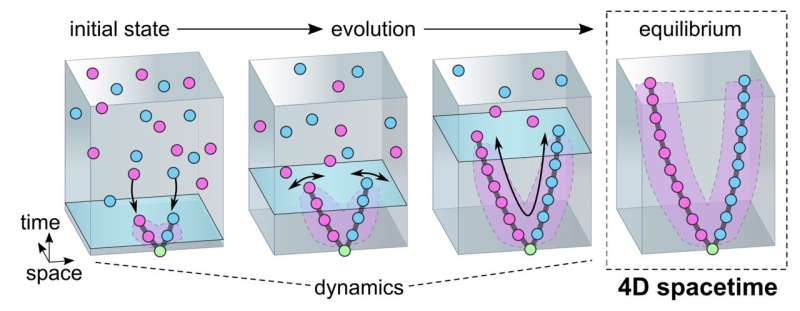
Schematic illustration of the dynamical evolution of four-dimensional spacetime as a function of an additional evolution parameter. Particle worldlines self-assemble along the forward time direction and exhibit a variety of dynamics, while gravity—sourced by these worldlines—co-evolves accordingly, before settling into equilibrium. These dynamics are essential for simultaneously reproducing quantum and gravitational phenomena in a fundamentally classical manner within a five-dimensional framework. Credit: Filip Strubbe
A classical theory beyond four dimensions
In a recent work, published in Scientific Reports, I explore a different way of thinking about quantum physics and gravity. Instead of trying to make gravity quantum, I propose that both quantum effects and gravity may arise from a deeper, classical structure that exists in more than four dimensions.
My motivation is straightforward: If Bell’s theorem tells us that intuitive, classical explanations of quantum effects cannot work within ordinary four-dimensional space and time, then perhaps the problem lies with spacetime itself. I therefore extend spacetime by adding a fifth dimension that acts as an evolution parameter. This allows familiar four-dimensional spacetime to evolve in a new way and opens up new possibilities for explaining both quantum behavior and gravity using classical ideas.
A central idea of the theory is that particles are not fixed objects from the start. Instead, they are built from paths, called “worldlines,” that gradually form as this extra parameter advances. While these worldlines may initially show a variety of dynamics, they slowly “lock in” as the evolution progresses, until a stable, classical world emerges—the world we experience in everyday life. These dynamics are crucial for producing the strange outcomes of quantum mechanics from the perspective of an observer. However, in the deeper five-dimensional picture, the underlying processes remain entirely classical.
To illustrate these concepts, I construct theoretical models that reproduce two famous quantum experiments within the proposed framework. EPR-type correlations arise because influences are now allowed to propagate along worldlines as functions of the additional evolution parameter. Although particles themselves never exceed the speed of light, these effects can appear almost instant to observers. Additionally, in a model for the double-slit experiment, a single particle is described by many interacting worldlines. Together they create wave-like patterns, while the single worldline that reaches the detector gives the particle-like outcome.
Gravity can also be included. Gravitational effects arise through the gradual relaxation of the gravitational potential in a weak-gravity regime, or more generally of spacetime curvature, with respect to the additional evolution parameter. Because both matter and gravity develop gradually in the forward direction of time, the theory also offers a natural explanation for why time seems to flow in one direction.
Implications and predictions
What I find most surprising is that key quantum phenomena, such as entanglement and double-slit interference, can be explained in such a clear, classical-like way within this five-dimensional theory. Such an intuitive understanding of quantum phenomena is commonly thought to be impossible within standard quantum frameworks. Since basic aspects of gravity also fit into the same framework, this approach may point toward a new route to quantum gravity.
The theory is designed to avoid long-standing problems in quantum physics, such as the measurement problem and the need for ideas like objects being in many states at once or influencing each other instantly at a distance. Therefore, following Ockham’s razor, I argue that such a clear five-dimensional classical description of reality may be preferable to quantum gravity theories that abandon intuitive understanding altogether.
Crucially, the theory is not just philosophical. It makes testable predictions that differ from those of standard quantum-gravity approaches. For example, effects such as gravity-induced entanglement—often expected if gravity itself is quantum—do not arise in this framework. The theory also suggests that information about which path a particle takes in a double-slit experiment could, in principle, be obtained through gravitational measurements without destroying the interference pattern. These differences offer clear opportunities for future experimental tests.
Conclusions and future directions
In summary, the new theory suggests that both quantum effects and gravity might be explained in a single, classical-like way if we are willing to move beyond the idea that reality is limited to four dimensions of space and time. From this view, the strange behavior of quantum physics may not be a property of nature itself, but rather a result of our limited perspective on a deeper, higher-dimensional classical reality.
At present, the theory is only a first step. Further work is needed to see whether it can fully reproduce the successes of quantum theory, including the Standard Model of particle physics, and whether it remains valid in extreme settings such as black holes. If it does, this approach could open a new direction in the search for a theory of quantum gravity.
This story is part of Science X Dialog, where researchers can report findings from their published research articles. Visit this page for information about Science X Dialog and how to participate.
More information: Filip Strubbe, A five-dimensional classical framework for gravitational and quantum phenomena, Scientific Reports (2025). DOI: 10.1038/s41598-025-32860-8
Journal information: Scientific Reports
Leave a Reply