
By Chinese Academy of Sciences January 1, 2026
Collected at: https://scitechdaily.com/china-advances-toward-fusion-ignition-with-major-plasma-breakthrough/
Scientists working with China’s fully superconducting Experimental Advanced Superconducting Tokamak (EAST) have reached a long-predicted state known as the “density-free regime,” where fusion plasma remains stable at densities far higher than traditional limits. The achievement marks a significant step toward solving one of fusion energy’s most persistent physical challenges. The findings were published in Science Advances on January 1.
A New High-Density Operating Strategy
The research was co-led by Prof. Ping Zhu of Huazhong University of Science and Technology and Associate Prof. Ning Yan of the Hefei Institutes of Physical Science at the Chinese Academy of Sciences. Using a newly developed high-density operating approach on EAST, the team showed that plasma density can be pushed well beyond long-accepted empirical limits without triggering the violent instabilities that typically shut down tokamak experiments.
Why Plasma Density Matters for Fusion Energy
Nuclear fusion is widely viewed as a potential source of clean, reliable energy. In deuterium-tritium fusion, the fuel must be heated to roughly 13 keV (150 million kelvin) to produce optimal reactions. At these extreme temperatures, fusion power output increases with the square of the plasma density. For decades, however, tokamak experiments have been constrained by an upper density limit. Crossing that boundary usually leads to disruptions that damage plasma confinement and threaten the stability of the device, making higher fusion performance difficult to achieve.
Plasma Wall Self-Organization Theory
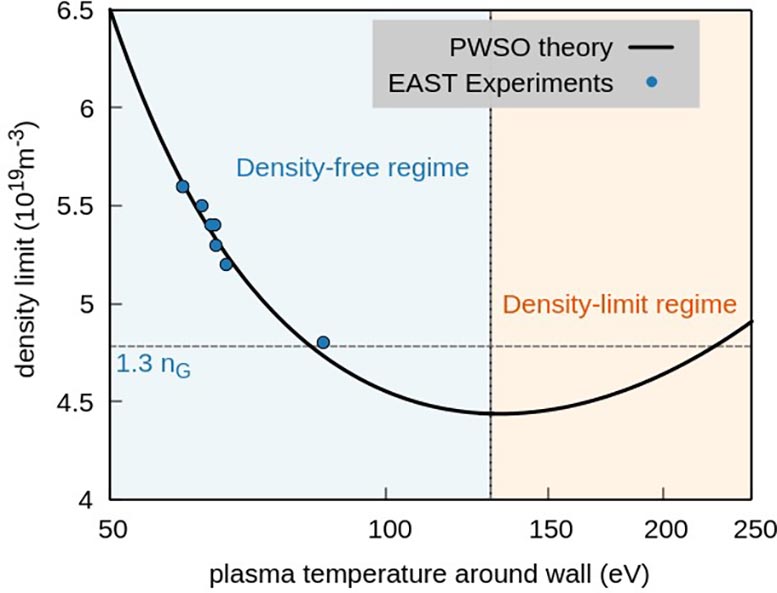
A newer theoretical framework known as plasma-wall self organization (PWSO) offers a different way to understand these limits. The concept was first proposed by D.F. Escande et al. from the French National Center for Scientific Research and Aix-Marseille University. According to the theory, a density-free regime becomes possible when the plasma and the metal walls of the reactor reach a delicate balance, particularly in systems where physical sputtering dominates plasma-wall interactions.
How EAST Reached the Density-Free Regime
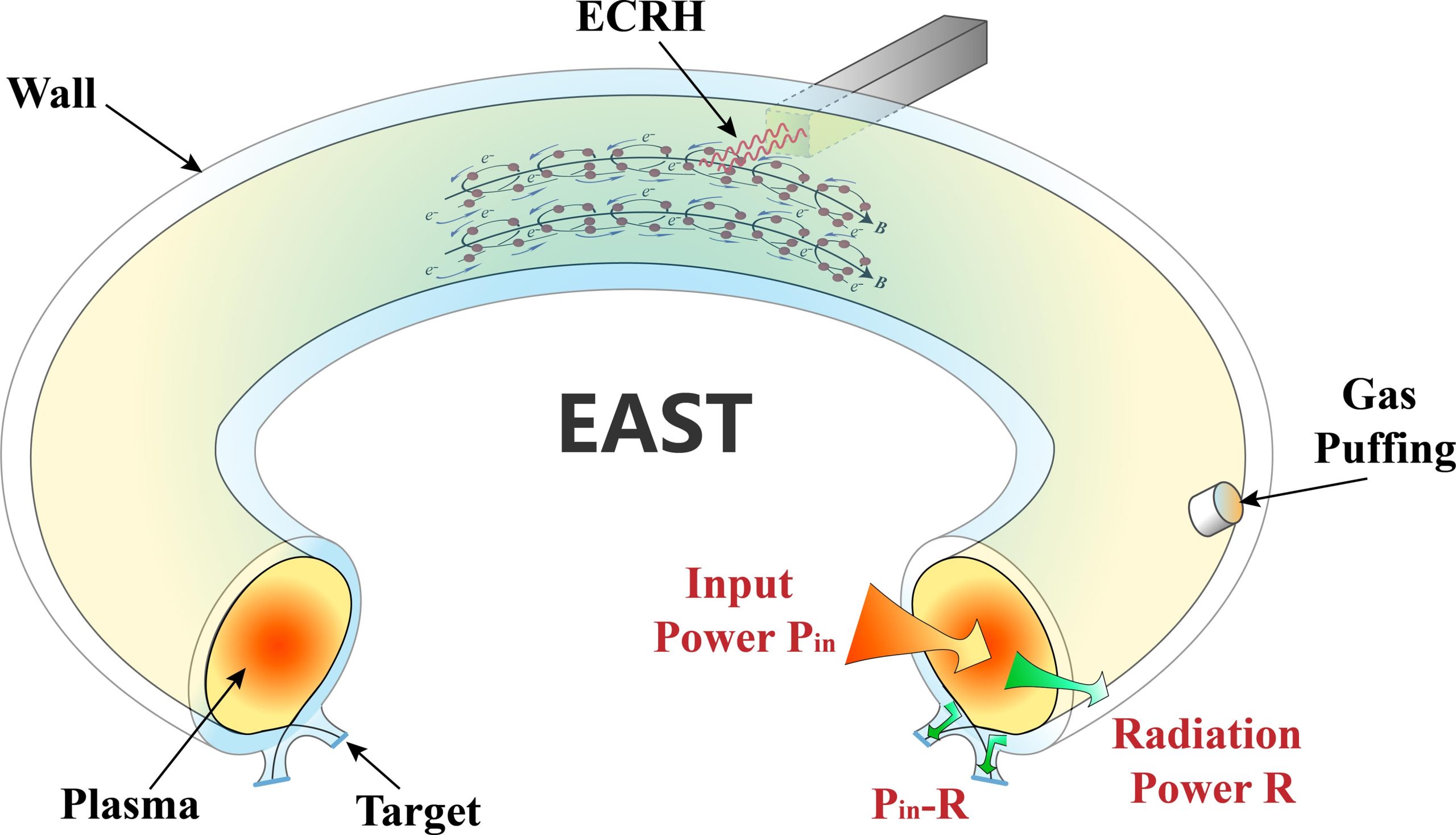
The EAST experiments provided the first experimental confirmation of this idea. Researchers carefully controlled the initial fuel gas pressure and applied electron cyclotron resonance heating during the startup phase of each plasma discharge. This early-stage control helped optimize plasma-wall interactions from the very beginning. As a result, impurity buildup and energy losses were significantly reduced, allowing the plasma density to rise steadily by the end of startup. Under these conditions, EAST successfully entered the PWSO-predicted density-free regime, where stable operation was maintained even at densities far above conventional limits.
Implications for Fusion Ignition
These results offer new insight into how the long-standing density barrier in tokamak operation might be overcome on the path toward fusion ignition.
“The findings suggest a practical and scalable pathway for extending density limits in tokamaks and next-generation burning plasma fusion devices,” said Prof. Zhu.
Associate Pro. Yan added that the team plans to apply the same method during high-confinement operation on EAST in the near future, with the goal of reaching the density-free regime under even higher performance plasma conditions.
Reference: “Accessing the density-free regime with ECRH-assisted ohmic start-up on EAST” by Jiaxing Liu, Ping Zhu, Dominique Franck Escande, Wenbin Liu, Shiwei Xue, Xin Lin, Panjun Tang, Liang Wang, Ning Yan, Jinju Yang, Yanmin Duan, Kai Jia, Zhenwei Wu, Yunxin Cheng, Ling Zhang, Jinping Qian, Rui Ding, Ruijie Zhou and the EAST team, 1 January 2026, Science Advances.
DOI: 10.1126/sciadv.adz3040
Leave a Reply