
January 2, 2026 by The Korea Advanced Institute of Science and Technology (KAIST)
Collected at: https://medicalxpress.com/news/2026-01-ai-cell-reactivity-neoantigens-cancer.html
Neoantigens are unique markers that distinguish only cancer cells. By adding B cell reactivity, cancer vaccines can move beyond one-time attacks and short-term memory to become a long-term immunity that “remembers” cancer, effectively preventing recurrence. KAIST’s research team has developed an AI-based personalized cancer vaccine design technology that makes this possible and optimizes anticancer effects for each individual.
Development of the new AI model
Professor Jung Kyoon Choi’s research team from the Department of Bio and Brain Engineering, in collaboration with Neogen Logic Co., Ltd., developed the new AI model to predict neoantigens—a core element of personalized cancer vaccine development—and clarified the importance of B cells in cancer immunotherapy. Their paper is published in Science Advances.
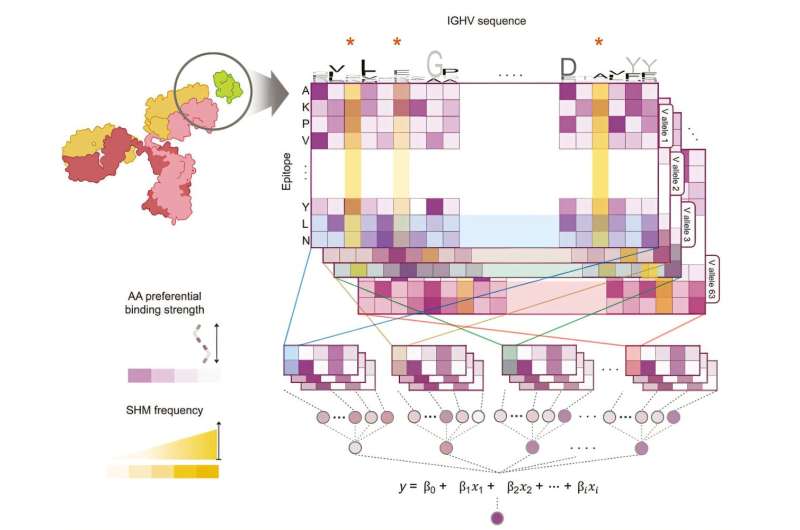
The research team overcame the limitations of existing neoantigen discovery, which relied primarily on predicting T cell reactivity, and developed an AI-based neoantigen prediction technology that integrally considers both T cell and B cell reactivity.
This technology has been validated through large-scale cancer genome data, animal experiments, and clinical trial data for cancer vaccines. It is evaluated as the first AI technology capable of quantitatively predicting B cell reactivity to neoantigens.
Significance of B cells in cancer vaccines
Neoantigens are antigens composed of protein fragments derived from cancer cell mutations. Because they possess cancer-cell specificity, they have gained attention as a core target for next-generation cancer vaccines. Companies like Moderna and BioNTech developed COVID-19 vaccines using the mRNA platforms they secured while advancing neoantigen-based cancer vaccine technology, and they are currently actively conducting clinical trials for cancer vaccines alongside global pharmaceutical companies.
However, current cancer vaccine technology is mostly focused on T cell-centered immune responses, presenting a limitation in that it does not sufficiently reflect the immune responses mediated by B cells.
In fact, the research team of Professors Mark Yarchoan and Elizabeth Jaffee at Johns Hopkins University pointed out in Nature Reviews Cancer in May 2025 that “despite accumulating evidence regarding the role of B cells in tumor immunity, most cancer vaccine clinical trials still focus only on T cell responses.”
Clinical implications and future directions
The KAIST team’s new AI model overcomes existing limitations by learning the structural binding characteristics between mutant proteins and B cell receptors (BCR) to predict B cell reactivity. In particular, an analysis of cancer vaccine clinical trial data confirmed that integrating B cell responses can significantly enhance anti-tumor immune effects in actual clinical settings.
Professor Jung Kyoon Choi stated, “Together with Neogen Logic Co., Ltd., which is currently commercializing neoantigen AI technology, we are conducting pre-clinical development of a personalized cancer vaccine platform and are preparing to submit an FDA IND with the goal of entering clinical trials in 2027. We will enhance the scientific completeness of cancer vaccine development based on our proprietary AI technology and push forward the transition to the clinical stage step-by-step.”
More information
Jeong Yeon Kim et al, B cell–reactive neoantigens boost antitumor immunity, Science Advances (2025). DOI: 10.1126/sciadv.adx8303
Journal information: Science Advances , Nature Reviews Cancer
Leave a Reply