
December 29, 2025 by Daegu Gyeongbuk Institute of Science and Technology
Collected at: https://phys.org/news/2025-12-ai-complex-nanocrystal-reactions-revealing.html
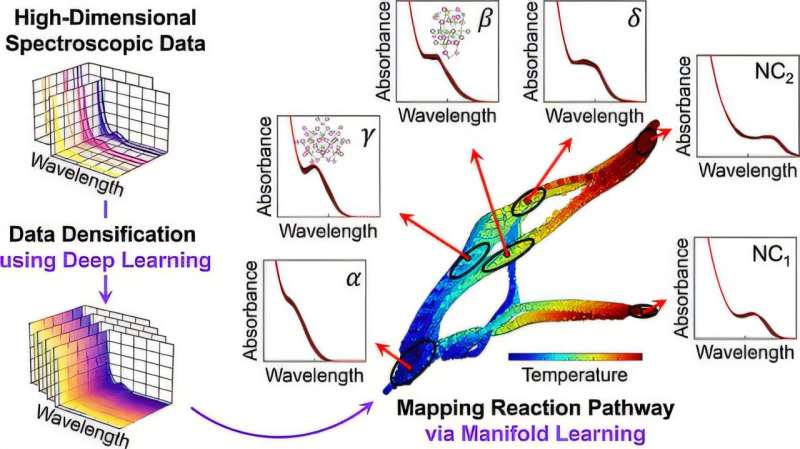
Professor Joongoo Kang’s team from the Department of Physics and Chemistry at DGIST and Professor Sohee Jeong’s team from the Department of Energy Science at Sungkyunkwan University have developed a technology that visualizes the synthetic reaction pathways of semiconductor nanocrystals (colloidal quantum dots) using artificial intelligence (AI).
This achievement allows AI to analyze complex chemical reaction flows, which are difficult to understand through experiments alone, and to display them intuitively like a subway map. It is expected to significantly accelerate development of next-generation display and sensor materials.
A paper describing this work is published in the Journal of the American Chemical Society.
Semiconductor nanocrystals (colloidal quantum dots) are nanometer-sized semiconductor particles and next-generation nanomaterials whose absorption and emission color and intensity can be precisely controlled by size. They are a key material for high-color reproducibility displays, attracting attention from global companies like Samsung Display as innovative quantum dot luminescent materials. Their significance is also increasing in the field of infrared cameras and sensors.
However, investigating and revealing the steps involved in the formation of each nanocrystal is very challenging. Previously, researchers had to estimate reaction pathways using a method similar to inference, based on limited experimental data, which limited their ability to interpret results accurately due to data insufficiency and complex reaction behavior.
To address this issue, the research team combined transformer-based AI, renowned as the latest natural language processing technology, with topological data analysis. Using this approach, the AI automatically completes incomplete data to accurately reconstruct the entire reaction flow and identify structural connections between different data sets. Through this, the research team successfully visualized the complex reaction process as a single map.
The team used this technology to synthesize InAs (indium arsenide) nanocrystals, a next-generation infrared semiconductor material, and confirmed that the growth pathway, previously thought to be single, actually branches into multiple pathways. They also discovered that materials added during synthesis act as “traffic lights” and are crucial in determining the reaction flow.
Professor Kang said, “This study is a significant achievement demonstrating that AI can act as an ‘invisible navigation’ to uncover hidden pathways in chemical reactions that are difficult for humans to observe.”
Professor Jeong added, “This technology will significantly enhance research efficiency in various new fields in material development.”
More information: Byeoksong Lee et al, Topological Machine Learning Unveils Hidden Reaction Pathways in Nanocrystal Synthesis, Journal of the American Chemical Society (2025). DOI: 10.1021/jacs.5c15371
Journal information: Journal of the American Chemical Society
Leave a Reply