
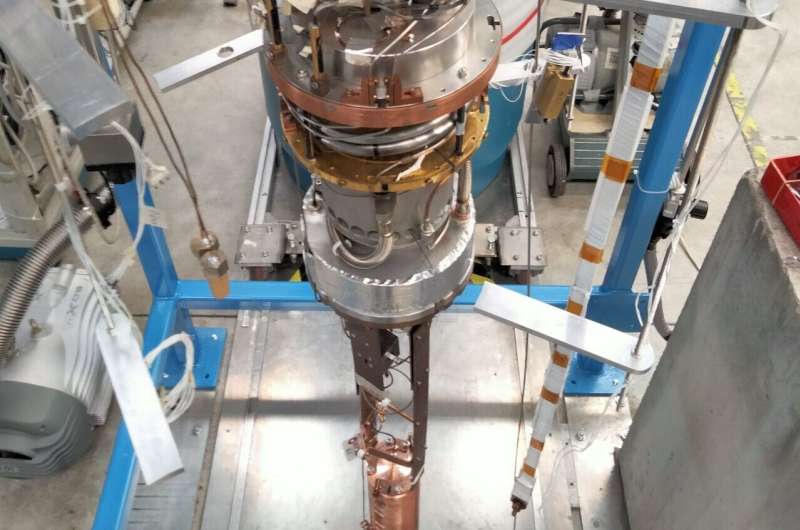
December 30, 2025 by Ingrid Fadelli, Phys.org
Collected at: https://phys.org/news/2025-12-dark-axions-quantum-powered-haloscope.html
Axions are hypothetical light particles that could solve two different physics problems, as they could explain why some nuclear interactions don’t violate time symmetry and are also promising dark matter candidates. Dark matter is a type of matter that does not emit, reflect or absorb light, and has never been directly observed before.
Axions are very light particles theorized to have been produced in the early universe but that would still be present today. These particles are expected to interact very weakly with ordinary matter and sometimes convert into photons (i.e., light particles), particularly in the presence of a strong magnetic field.
The QUAX (Quest for Axions/QUaerere AXion) collaboration is a large group of researchers based at different institutes in Italy, which was established to search for axions using two haloscopes located in Italy at Laboratori Nazionali di Legnaro (LNL) and Laboratori Nazionali di Frascati (LNF), respectively.
In a paper published in Physical Review Letters, the collaboration report the results of their most recent search for dark matter axions employing a microwave cavity immersed in a strong magnetic field and exploiting the axion-photon coupling.
“Our paper follows the INFN (Istituto Nazionale di Fisica Nucleare) research line on axions, active since 2015,” Giosuè Sardo Infirri and Pino Ruoso, part of the QUAX collaboration, told Phys.org.
“Our aim is to build a high frequency haloscope (i.e. working above 10 GHz, with sensitivity reaching theoretically motivated models). The paper contains the last big step of the collaboration toward this goal.
“The motivation to search for axions comes from the fact that the dark matter problem is of primary importance for the physics community and the fact that the axion is one of the most motivated candidates.”
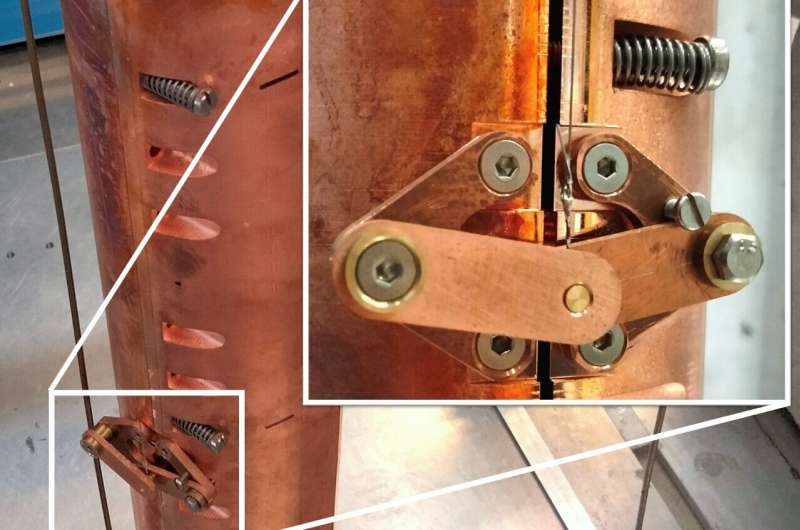
The cavity used in the experiment: a copper cavity that can be opened in a clamshell-like mechanism with a detail of the tuning mechanism. Credit: QUAX Collaboration.
A decade-long search for axions with haloscopes
Since the axion mass is not known, an experiment looking for axions should be capable of detecting axions in a wide interval of possible mass values. The key idea behind recent efforts by the QUAX collaboration is to be sensitive in a high mass region previously unexplored by other experiments.
The instruments that the researchers rely on have extremely high sensitivities that allow them to probe a wide interval of mass values above 40 microeV, a region of particular interest following recent theoretical predictions. The instruments they use, known as haloscopes, are sophisticated systems designed to prompt the conversion of axions into detectable photons, picking up associated signals.
“The QUAX collaboration is looking for power deposited by the interaction of axions with virtual photons coming from the magnetic field,” explained Sardo Infirri and Ruoso.
“The signal is then a very low power excess at a specific frequency that we don’t know, above noise. To detect this small signal, we use a copper cavity inserted in the magnetic field.”
In this magnetic field-exposed copper cavity, axions would be expected to deposit a very low power excess when converted into real photons. This very low power can be collected by a properly coupled antenna and detected with a detection chain based on a quantum limited amplifier. To search for different masses, the detection chain works on a wide frequency range.
“By opening the cavity, we change its frequency, and therefore the possible converted axion mass,” said the authors. “For any cavity aperture we can then confront between pure noise and the presence of a signal.”
Results of the search and future research plans
The QUAX collaboration did not yet pick up any signals that would be consistent with the conversion of axions into photons. Nonetheless, their recent search demonstrated the tunability of their partly automated system, highlighting its potential as a tool to probe signals at varying frequencies that could be linked with axion to photon conversion.
“Our initial search sets a basis for a working haloscope that could work autonomously at high frequency,” said Sardo Infirri and Ruoso.
“Our contribution to the scientific community is the adaptation of the haloscope to higher frequencies, which opens a new interval of axion masses to be probed. The important implications of an axion search are the following: if an axion trace is found, we will have the first evidence of dark matter, while the absence of it will only exclude some theoretical models of this dark matter.”
The QUAX collaboration is now planning the next axion searches using the haloscopes based at LNL and LNF. In their future experiments, they both plan to further increase the sensitivity of the haloscopes and seek for axions with masses in an extended range like those they searched for in their recent study.
“In our next studies, we also plan to extend the probed region as much as we can, using more and better cavities,” added Sardo Infirri and Ruoso.
“We would also like to automate the system completely, so that we can switch it on and let it acquire data autonomously.”
More information: G. Sardo Infirri et al, Search for Postinflationary QCD Axions with a Quantum-Limited Tunable Microwave Receiver, Physical Review Letters (2025). DOI: 10.1103/4dv9-72t5.
Journal information: Physical Review Letters
Leave a Reply