
December 29, 2025 by Education University of Hong Kong
Collected at: https://phys.org/news/2025-12-multi-core-black-carbon-particles.html
Researchers at The Education University of Hong Kong (EdUHK) have contributed to a study revealing that conventional theories on the structure of black carbon particles—such as those emitted by wildfires—may have significantly underestimated their impact on global climate systems.
The study is published in the journal Nature Communications.
Traditionally, black carbon (BC) particles were represented as a simple “core-shell” structure in global climate simulations, with a single carbon core located at the particle center surrounded by outer layers. However, an international inter-disciplinary research team, including scholars from the Chinese Mainland, Hong Kong, China, the United States, the United Kingdom, Israel, Japan, and South Korea, has found that in long-range transported wildfire smoke, about one-fifth (21%) of black carbon particles—especially those larger than 400 nm in diameter, contain two or more cores.
These “multi-core” aerosols, previously unaccounted for in global climate models, may hold the answer to the persistent underestimation of BC’s light absorption by approximately 50% compared to real-world measurements.
Dr. Joseph Ching, assistant professor in the Department of Science and Environmental Studies at EdUHK, is part of that international research team led by Professor Weijun Li from the School of Earth Sciences at Zhejiang University. The collaboration also includes experts in atmospheric science, global climate modeling, electron microscopy, atmospheric environment, air pollution, and Earth system science.
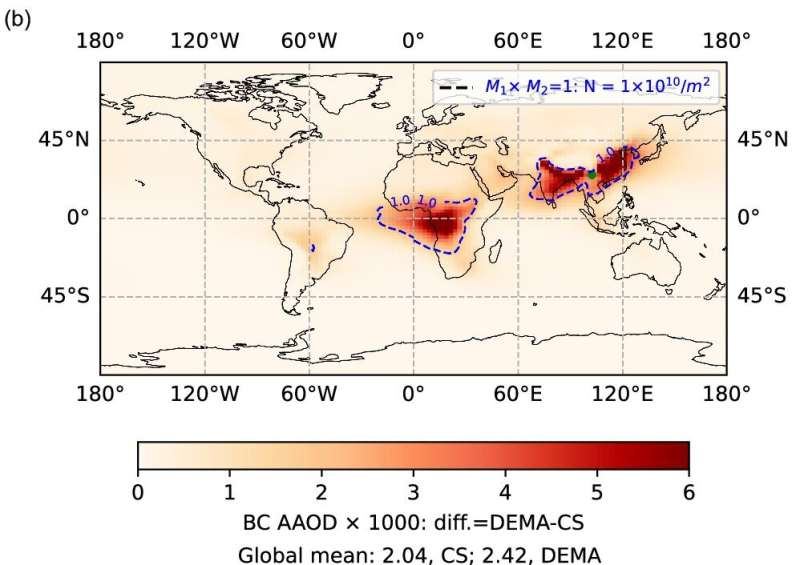
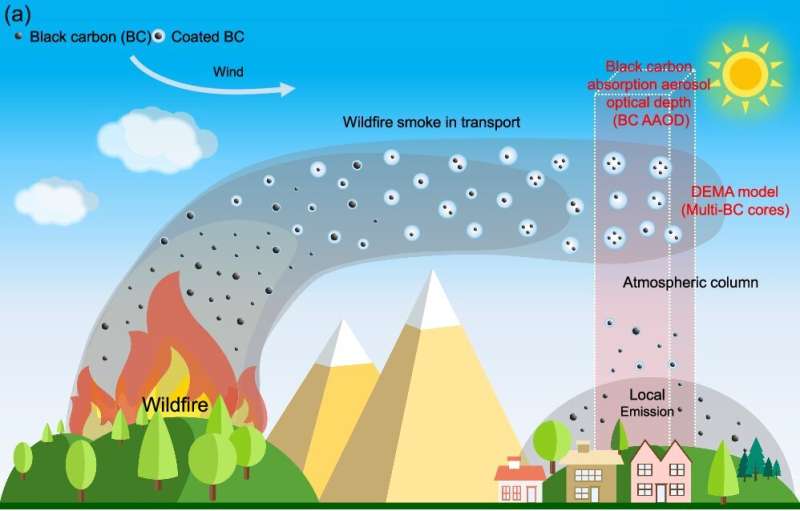
Global impact of multi‒core black carbon (BC) particles on black carbon absorption aerosol optical depth (BC AAOD). b Global distribution of annually average differences in BC AAOD using Core‒Shell (CS) model and dynamic effective medium approximation (DEMA) with Mie theory (DEMA–Mie) respectively. Blue lines mark the area where the number concentration reaches 1010 m-2 for BC-containing particles with the diameter (Dp) larger than 400 nm and the diameter of BC cores (Dc) larger than 200 nm (i.e., M1×M2 = 1) in the atmospheric column. Green point is the sample station. Credit: Nature Communications (2025). DOI: 10.1038/s41467-025-65079-2
Wildfires are becoming deadlier and more costly. According to data by global re-insurer Munich Re quoted by the media, of the 200 most damaging fires since 1980, half of those costing US $1 billion or more occurred in the last decade. Understanding the true impact of the BC particles produced by wildfires is therefore crucial for assessing their effects on the climate system and developing effective solutions.
Previous theories suggested that BC “ages” primarily by accumulating additional layers. Hence, its climate impact has often been calculated under the assumption of a single core per particle emitted to the atmosphere. However, based on fieldwork conducted during Yunnan’s wildfire season combined with advanced electron microscopy, the international team found that particles can collide and coalesce, forming clusters with multiple cores within a single particle which often exceed 200 nm in core diameter.
Dr. Chen Xiyao, lead author of the study, stated, “The mixing state of BC is fundamental to understanding its climate effects. Ignoring coagulation and multi-core structures impedes accurate assessment and policy development regarding BC’s role in climate change.”
Using AI to quantify the impact of multi-core particles
To quantify the impact of multi-core particles, the team developed a machine learning emulator for absorption enhancements and incorporated it into a global atmospheric model. Their simulations revealed that multi-core BC particles contribute to a 19% increase in global average BC absorption, particularly in wildfire-affected regions including Southeast Asia, southwestern China, the Tibetan Plateau, Southern Africa, and North America.
Professor Li Weijun, corresponding author, explained, “Our nanoscale observations have identified abundant multi-core black carbon particles in both wildfire and urban environments—structures previously unrepresented in climate models. By refining our algorithms, we have simulated their enhanced optical absorption and quantified their contribution to global warming, enabling more precise evaluation of black carbon’s climate impact. This study provides a more solid foundation in atmospheric science for climate governance and global cooperation.”
Dr. Joseph Ching, who played a pivotal role in the atmospheric modeling component, added that the integrated approach of combining particle-level measurements, optical simulations, global climate modeling and machine learning, advances our understanding of black carbon’s warming effects and brings us closer to accurately assessing its radiative forcing, and supports the development of more effective climate policies.
The authors recommend that future climate models explicitly incorporate the multi-core mixing state of black carbon to improve the accuracy of global radiative forcing assessments and guide more informed emission reduction strategies.
Co-author Professor Mark Jacobson of Stanford University highlighted that this research reinforces black carbon’s role as the second-leading contributor to global warming, emphasizing the urgency of mitigation efforts.
Given the projected increase in wildfire activity and anthropogenic emissions under ongoing global warming, integrating these insights is essential for effective climate governance and international collaboration. The study also contributes to advancing the United Nations Sustainable Development Goals (SDGs), particularly Goals 3 (Good Health and Well-being), 11 (Sustainable Cities and Communities), and 13 (Climate Action).
More information: Xiyao Chen et al, Locating the missing absorption enhancement due to multi‒core black carbon aerosols, Nature Communications (2025). DOI: 10.1038/s41467-025-65079-2
Journal information: Nature Communications
Leave a Reply