
By Perimeter Institute December 28, 2025
Collected at: https://scitechdaily.com/physicists-crack-a-new-code-to-explore-dark-matters-hidden-life/
A new computational breakthrough is giving scientists a clearer view into how dark matter structures evolve.
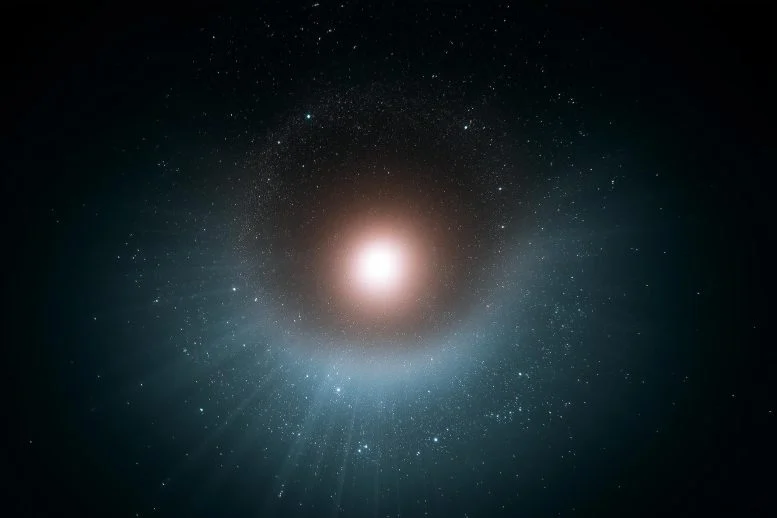
Dark matter has remained one of the biggest mysteries in cosmology for almost a hundred years, shaping the universe while remaining invisible and poorly understood. A new study from researchers at the Perimeter Institute now introduces a computational tool designed to track the evolution of a particular dark matter candidate known as self-interacting dark matter halos. These enormous structures are thought to host galaxies such as the Milky Way.
The study, published in Physical Review Letters, expands scientists’ ability to explore how different types of dark matter particle interactions influence the growth and behavior of cosmic structures over time.
Self-interacting dark matter is defined by the ability of its particles to collide with one another, while remaining effectively invisible to ordinary baryonic matter, including protons, neutrons, and electrons. This behavior has important consequences for dark matter halos, which many theorists believe are central to the processes that shape galaxies and trigger star formation.
“Dark matter forms relatively diffuse clumps which are still much denser than the average density of the universe,” says James Gurian, a postdoctoral fellow at Perimeter Institute. “The Milky Way and other galaxies live in these dark matter halos.”
Gravothermal Collapse and Halo Evolution
The evolution of self-interacting dark matter halos is governed by a phenomenon known as gravothermal collapse. This process arises from a counterintuitive property of gravity, where systems bound by gravity become hotter rather than cooler as they lose energy.
Because self-interacting dark matter can carry energy through particle collisions, that energy gradually flows outward within a halo. As a result, the central region becomes increasingly hot and dense, driving further changes in the structure of the halo over time.
To map the structures formed by self-interacting dark matter, scientists typically use one approach for when dark matter is less dense with infrequent collisions, and a different approach for dark matter that is denser with more frequent collisions – but they lacked a mapping approach for in-between characterizations. Gurian and his co-author Simon May, a former Perimeter postdoctoral fellow, developed a code, KISS-SIDM, that is faster and more accurate than previous codes that came before it and is publicly available for researchers to use.
Implications for Black Hole Formation
Understanding the core collapse process also intrigues physicists because it could have observable implications for black hole formation. But the details of how the process ends are an open question in physics, and this code is a step towards answering it.
“The fundamental question is, what’s the final endpoint of this collapse? That’s what we’d really like to do — study the phase after you form a black hole,” says Gurian.
Reference: “Core Collapse Beyond the Fluid Approximation: The Late Evolution of Self-Interacting Dark Matter Halos” by James Gurian and Simon May, 24 November 2025, Physical Review Letters.
DOI: 10.1103/2ycz-3fvv
Leave a Reply