
December 23, 2025 by University of Manchester
Collected at: https://techxplore.com/news/2025-12-machine-robots-total-darkness-infrared.html
From disaster zones to underground tunnels, robots are increasingly being sent where humans cannot safely go. But many of these environments lack natural or artificial light, making it difficult for robotic systems, which usually rely on cameras and vision algorithms, to operate effectively.
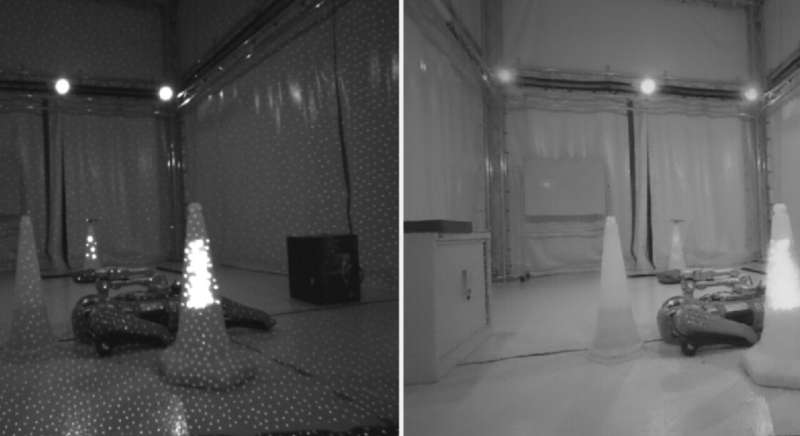
A team consisting of Nathan Shankar, Professor Hujun Yin and Dr. Pawel Ladosz from The University of Manchester is tackling this challenge by teaching robots to “see” in the dark. Their approach uses machine learning to reconstruct clear images from infrared cameras—sensors that can “see” even when no visible light is present.
The breakthrough, published in a paper on the arXiv preprint server, means that robots can continue using their existing vision algorithms without making changes, reducing both computational costs and the time it takes to deploy them in the field.
As project lead Dr. Ladosz explains, “Our work enables robots to function in darkness with minimal changes to their platforms. This lowers development costs, speeds up deployment and opens the door to operations in some of the most challenging environments imaginable.”
Looking ahead, the team sees potential beyond low-light settings. By adapting their system to sensors such as sonar or thermal cameras, they could potentially expand robotic vision into an even wider range of extreme conditions.
More information: Nathan Shankar et al, CLEAR-IR: Clarity-Enhanced Active Reconstruction of Infrared Imagery, arXiv (2025). DOI: 10.48550/arxiv.2510.04883
Journal information: arXiv
Leave a Reply