
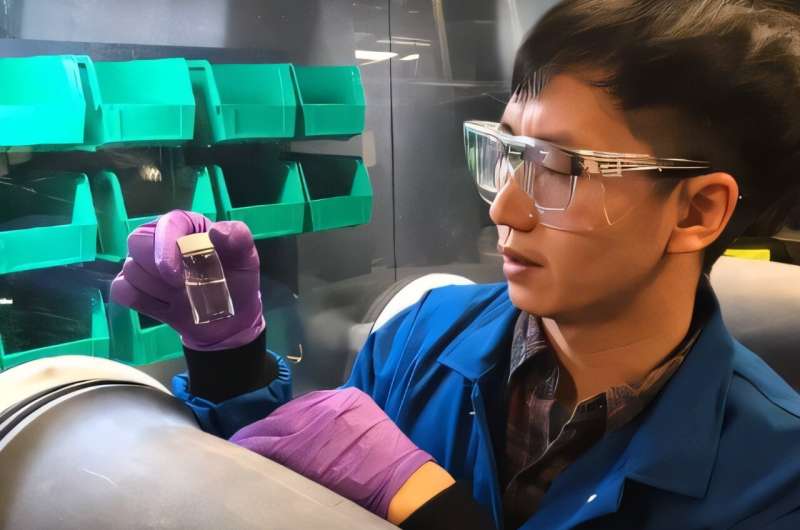
December 21, 2025 by Ingrid Fadelli, Phys.org
Collected at: https://techxplore.com/news/2025-12-ionic-liquids-perovskite-degradation-solar.html
Solar cells, devices that can generate electricity from sunlight, are already helping to reduce fossil fuel emissions in many countries worldwide. In recent years, energy engineers have been assessing the potential of materials other than silicon for the development of efficient, durable and more affordable solar cells.
These materials include perovskites, particularly halide perovskites. These are materials with a characteristic crystal structure (ABX₃) that contain halides, chemical compounds comprised of a halogen element bonded with a metal or positively charged ion.
Halide perovskites are known to efficiently absorb light and transport charge carriers, thus they typically result in photovoltaics that attain high power conversion efficiencies (PCEs). Nonetheless, most halide perovskite-based solar cells are significantly less stable than conventional silicon cells, which essentially means that their performance rapidly degrades over time.
Researchers at Purdue University and Emory University and other institutes have introduced a new strategy to improve the operational stability of halide perovskite-based solar cells.
Their proposed approach, outlined in a paper published in Nature Energy, entails enhancing solar cells with newly designed ionic liquids, salts that are liquid at low temperatures and interact strongly with some materials.
“Our group is specialized in organic synthesis, hybrid perovskite crystal growth, and device engineering,” Letian Dou, senior author of the paper, told Tech Xplore.
“Our industry sponsor approached and asked us to synthesize novel additives for them to improve the long-term stability of the devices. We searched literature and got inspired by an earlier work using ionic liquid as additives. We noticed the researchers who performed this study only used some simple commercially available ionic liquids without carefully engineering the molecule structures.”
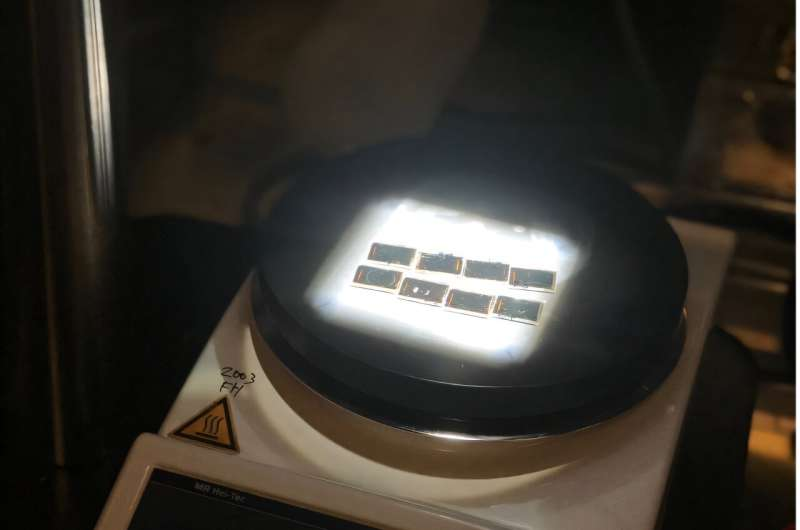
The team’s enhanced solar cells tested at 90C and under 1-Sun illumination. Credit: Wenzhan Xu.
Inspired by earlier efforts in the field, Dou and his colleagues set out to design various new molecules that strongly interact with perovskites, reducing tiny imperfections (i.e., defects) and slowing down their degradation over time. Notably, the ionic liquids they designed were found to be more effective than those introduced in previous studies in stabilizing perovskite solar cells.
New ionic liquids that enhance solar cells
Halide perovskite solar cells are typically comprised of three layers. These include two so-called interface layers and the active perovskite layer sandwiched between them.
“It is very important to minimize the defects in the perovskite layer, as well as the two interfaces (top and bottom of the perovskite layer),” explained Dou. “Despite widespread efforts aimed at improving the top interface by coating an additional surface passivation layer, few efforts have been made for bulk defect passivation and bottom (buried) interface.”
The most promising ionic liquid designed by the researchers, dubbed MEM-MIM-CI, binds strongly to positively charged lead ions in perovskites, while also filling halide vacancies (i.e., sites at which halide ions are missing). Dou and his colleagues added this liquid to a perovskite material, then used it to develop a solar cell and assessed its stability.
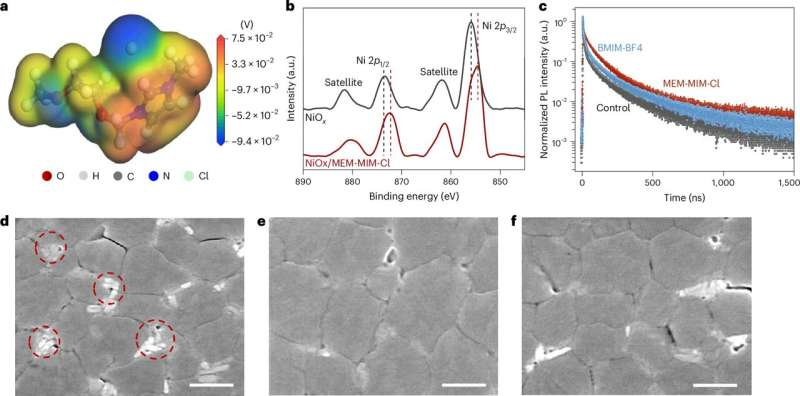
Effect of IL on the buried perovskite interface. Credit: Nature Energy (2025). DOI: 10.1038/s41560-025-01906-6
“These new ionic liquids, when added into the perovskite precursor, introduce an intermediate phase during the crystallization process,” said Dou.
“This intermediate phase slows down the crystallization and promotes the growth of large grain-sized perovskite with fewer defects. Additionally, we found that the new ionic liquid preferentially accumulates at the bottom interface, suppressing defect formation.”
The team assessed the performance of a solar cell based on their enhanced perovskite material under very harsh conditions. Initially, they tested it at temperatures of 65–80°C and under intense light (1-Sun irradiation, which corresponds to full sunlight).
“Our sponsor later set a higher bar and wanted to see how the device degraded under even harsher conditions, at least 90°C with light,” said Dr. Wenzhan Xu, first author of the paper.
“Therefore, we also implemented these harsher conditions and demonstrated that our devices retain 90% of their initial performance for over 1,500 hours under continuous 1-Sun illumination and temperatures of 90°C under open circuit condition—this is harsher than the condition typically used by other researchers.”
Towards the deployment of perovskite solar cells
The initial results gathered by Dou, Xu and their colleagues highlight the potential of carefully designed ionic liquids for improving the stability of halide perovskite-based solar cells. In the future, they could inspire other research teams to create similar ionic liquids and add them to perovskite precursor materials.
“The materials we used are very easy to synthesize and scalable,” said Dou. “This strategy has the potential to be extended to the industrial fabrication of large-area PSC devices because the ionic liquids used are also compatible with scalable, solution-based deposition techniques such as blade coating.
“Additionally, we found that the ionic liquids can increase the efficiency and stability of wide-bandgap and lead-free perovskite systems, demonstrating the versatility of this strategy for tandem solar cell applications.”
Dou and his collaborators are now planning additional studies aimed at improving the stability of perovskite-based photovoltaics. For instance, they are now trying to design even more effective molecules that could further improve the durability of solar cells in realistic conditions.
“We will also aim to gain deeper insight into the fundamental mechanisms governing ionic liquid–perovskite interactions using advanced spectroscopy and imaging methods,” added Dou.
“We welcome collaborations with other industry partners (the patent related to this technology is available for licensing). We hope that this innovation will drive the commercialization and widespread adoption of stable PSCs.”
More information: Wenzhan Xu et al, Ionic liquids improve the long-term stability of perovskite solar cells, Nature Energy (2025). DOI: 10.1038/s41560-025-01906-6.
Journal information: Nature Energy
Leave a Reply