
December 19, 2025 by SLAC National Accelerator Laboratory
Collected at: https://phys.org/news/2025-12-materials-hotter-sun-surface-electricity.html
Warm dense matter is a state of matter that forms at extreme temperatures and pressures, like those found at the center of most stars and many planets, including Earth. It also plays a role in the generation of Earth’s magnetic field and in the process of nuclear fusion.
Although warm dense matter is found all over the universe, researchers don’t have many good theories to describe the physics of materials under those conditions. Measurements of a material’s electrical conductivity would help test and refine models of warm dense matter. However, classic probes for such measurements require contact with the material. These can’t be used because materials in a warm dense matter state are very hot, often as hot or even hotter than the surface of the sun. Consequently, information about the electrical conductivity has so far been inferred indirectly.
In other words, without direct measurements, “there’s a lot of stuff in the universe happening that we as physicists are still struggling to understand,” said Ben Ofori-Okai, assistant professor at the Department of Energy’s SLAC National Accelerator Laboratory and Stanford University and a researcher at the Stanford PULSE Institute.
Now, after nine years of work, a team led by Ofori-Okai has reported a new contactless method for directly measuring the electrical conductivity of warm dense matter in an article published in the journal Nature Communications. Using light as a probe, they demonstrated their method on aluminum as it transitions from a solid to warm dense matter.
“This is the most accurate technique for measuring electrical conductivity in warm dense matter to date,” said study author Siegfried Glenzer, High Energy Density Sciences (HEDS) Division director and professor for photon science at SLAC. “I think it will be an important new way to benchmark theoretical studies.”
An unexpected drop in electrical conductivity
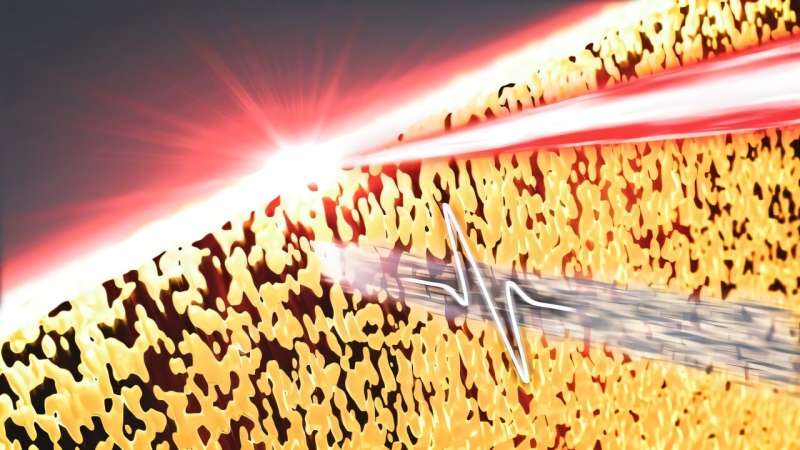
In their experiments at SLAC, the researchers first rapidly heated an aluminum sample with a laser to 10,000 Kelvin (17,540°F)—almost twice the temperature of the surface of the sun—to create a warm dense matter state. Then they hit the samples with terahertz-frequency light, electromagnetic radiation with submillimeter wavelengths. That radiation induced an electric field in the warm dense matter sample that can be measured without contact, and with that information the team could then calculate the electrical conductivity of the aluminum.
The team found the electrical conductivity plummeted twice as they heated the sample. The first dip, which they had expected, occurred when the aluminum transitioned from a solid to a warm dense matter state.
The second dip came as a surprise. To figure out what caused it, the team used SLAC’s instrument for megaelectron ultrafast electron diffraction (MeV-UED) at the Linac Coherent Light Source (LCLS). Sending the instrument’s beam of energetic electrons through the sample as it turned into warm dense matter revealed how the aluminum’s atomic structure rearranged within a millionth of a millionth of a second.
“This allowed us to match the second jump to when the structure of warm dense matter aluminum changes from ordered to disordered,” Glenzer said. “The ability of SLAC’s facilities to resolve ultrafast processes opens the door for these discoveries.”
Next, the team will apply the method to more materials, including copper, to better understand fundamental materials physics, and tungsten, a metallic dopant used in nuclear fusion capsules.
“I’m looking forward to making these measurements on more complicated materials, as well as materials relevant to Earth’s core, like iron,” said Ofori-Okai, who was a postdoctoral researcher in the HEDS Division when he began this work.
More information: Benjamin K. Ofori-Okai et al, Unveiling structural effects on the DC conductivity of warm dense matter via terahertz spectroscopy and ultrafast electron diffraction, Nature Communications (2025). DOI: 10.1038/s41467-025-65559-5
Journal information: Nature Communications
Leave a Reply