
December 19, 2025 by Macquarie University
Collected at: https://phys.org/news/2025-12-quantum-memory-problems.html
A team of Australian and international scientists has, for the first time, created a full picture of how errors unfold over time inside a quantum computer—a breakthrough that could help make future quantum machines far more reliable.
The researchers, led by Macquarie University’s Dr. Christina Giarmatzi, found that the tiny errors that plague quantum computers don’t just appear randomly. Instead, they can linger, evolve and even link together across different moments in time.
The team has made its experimental data and code openly available, and the full study is published in Quantum.
“We can think of it as quantum computers retaining memory of the errors, which can be classical or quantum depending on the way these errors are linked,” says Dr. Giarmatzi.
“A lot of quantum protocols assume quantum computers have no such memory (known as Markovian) but that’s simply not true.”
This type of behavior is one of the key obstacles to building practical, large-scale quantum computers.

Quantum detective: Dr. Christina Giarmatzi from Macquarie University led the team that created the first complete picture of how errors unfold over time inside quantum computers. Credit: Kate Field
How the breakthrough was achieved
“We’ve been able to reconstruct the entire evolution of a quantum process across multiple points in time—something that hasn’t been done before,” Dr. Giarmatzi said. “It lets us see not only when noise happens, but how it carries through time.”
The breakthrough opens the door to more advanced ways of modeling, predicting and correcting errors in quantum devices, not just in superconducting chips but also in systems such as trapped ions and spin qubits.
“We’ve opened a new window into how quantum systems behave over time, when their errors are correlated,” Dr. Giarmatzi said. “That’s essential if we want quantum computers to become truly useful and error-free.”
To achieve this, the team ran a series of experiments on cutting-edge superconducting quantum processors—some in the lab at the University of Queensland and others accessed through IBM’s cloud-based quantum computers.
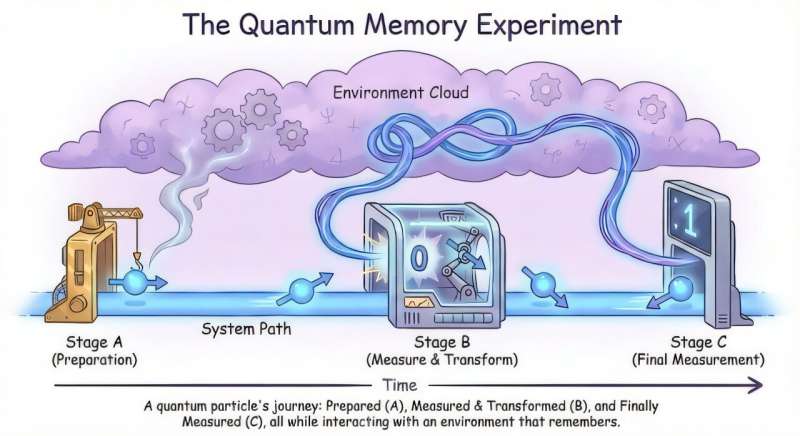
Previous attempts to map the behavior of quantum systems over time all hit the same roadblock: after measuring a quantum system mid-experiment, scientists couldn’t freely set it up again for the next step, because the setting-up depends on whether the result of the measurement was 0 or 1.
The new method solves this by adding a clever twist, assuming that 50% of the time, the result was 1, and the remaining time, the result was 0. Then, the researchers used software to work backwards with the data, to figure out what state it was in.
“The hardware could do it,” said co-author Dr. Fabio Costa from Nordita in Stockholm. “What we figured out was how to actually prepare the system after a mid-circuit measurement.”
Implications for future quantum computing
What they found is that even today’s best quantum machines show subtle but important time-linked noise patterns—including noise that is quantum in nature and comes from nearby qubits on the same chip.
Understanding these patterns will help quantum scientists design better characterization and error-correction tools, a crucial step toward building dependable, fault-tolerant quantum computers.
“It’s rewarding when theoretical models can be brought to life on real hardware, and especially so when they can help develop the hardware itself,” said Tyler Jones, who worked on the project as a Ph.D. student at the University of Queensland. “Robust characterization of time correlations in quantum systems is needed on the path to building powerful quantum machines.”
More information: Multi-time quantum process tomography on a superconducting qubit, Quantum (2025). DOI: 10.22331/q-2025-12-02-1582
Leave a Reply