
December 18, 2025 by Paul Arnold, Phys.org
Collected at: https://phys.org/news/2025-12-scientists-quantum-recycled-atoms.html
Like their conventional counterparts, quantum computers can also break down. They can sometimes lose the atoms they manipulate to function, which can stop calculations dead in their tracks. But scientists at the US-based firm Atom Computing have demonstrated a solution that allows a quantum computer to repair itself while it’s still running.
Missing qubits
The team zeroed in on quantum computers that use neutral atoms (atoms with equal numbers of protons and electrons). These individual atoms are the qubits, or the basic building blocks of a quantum computer’s memory. They are held in place by laser beams called optical tweezers, but the setup is not foolproof.
Occasionally, an atom slips out of its trap and disappears. When this happens mid-calculation, the whole process can grind to a halt because the computer can’t function with a missing part.
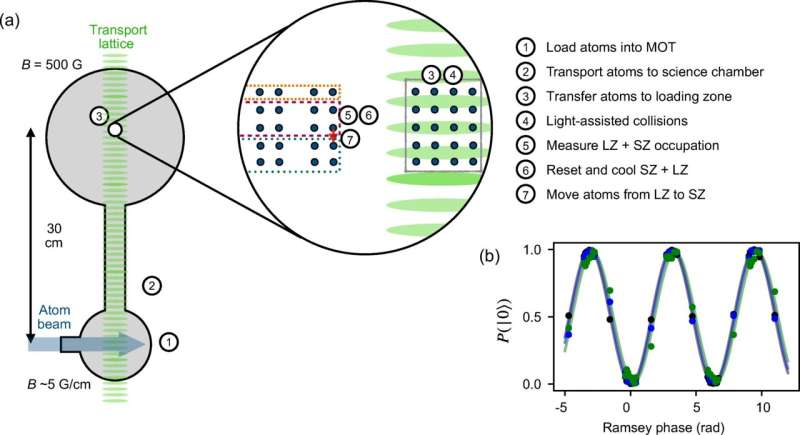
In a paper published in the journal Physical Review X, the researchers detail how they solved this problem by rearranging the atoms within the machine. Instead of having all the atoms in a single crowded group, the team organized them into five distinct zones. This means that if an atom is lost in one part of the computer, the other qubits will not be affected.
The specialized zones are a “Register” for storing qubits, an “Interaction Zone” for performing calculations and a “Measurement Zone” for checking errors using helper atoms known as “ancillas.” There is also a “Storage Zone,” a reservoir of spare atoms to replace those that are lost and a “Loading Zone’ to bring in new atoms from the outside to refill the reservoir.
Credit: M. Norcia/Atom Computing
Recycle and repair
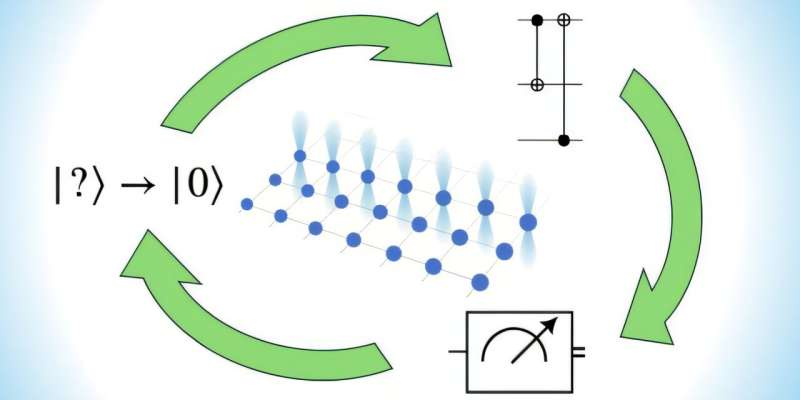
But the solution is even more sophisticated than that. This neutral atom-based quantum computer can detect a breakdown and fix it on the fly. When the system notices a missing qubit, it reaches into the storage zone and moves a new atom into place.
Once this atom is in position, the computer prepares it for work by resetting it to its ground state (lowest-energy state). The computer can also recycle the ancillas once they have performed their checks by resetting them in the same way.
To demonstrate that their solution works, the study authors had the computer run a repetition code, a process that checks its own work for mistakes. They ran these checks 41 times in a row, and each time, the machine successfully replaced its lost atoms without disturbing the data being processed. Without this self-repairing ability, the system would have run out of atoms after a few rounds.
“We have demonstrated the ability to reinitialize and reuse ancilla atoms following a midcircuit measurement in a neutral atom quantum processor… enabling the indefinite execution of quantum circuits on a platform where qubits have an inherently limited lifetime,” wrote the research team in their paper.
There is still a lot of work for the team to refine their system, but by overcoming the limited lifespan of individual atoms, they have moved a step closer to a quantum computer that can run indefinitely.
More information: J. A. Muniz et al, Repeated Ancilla Reuse for Logical Computation on a Neutral Atom Quantum Computer, Physical Review X (2025). DOI: 10.1103/v7ny-fg31
Journal information: Physical Review X
Leave a Reply