
By Amit Malewar Published: December 18, 2025
Collected at: https://www.techexplorist.com/clues-origin-longest-gamma-ray-burst-ever-observed/101571/
In a universe that often follows its own rules, gamma-ray bursts (GRBs) are some of the most striking cosmic events we know. They are brief, bright flashes that usually last from a few milliseconds to a few minutes.
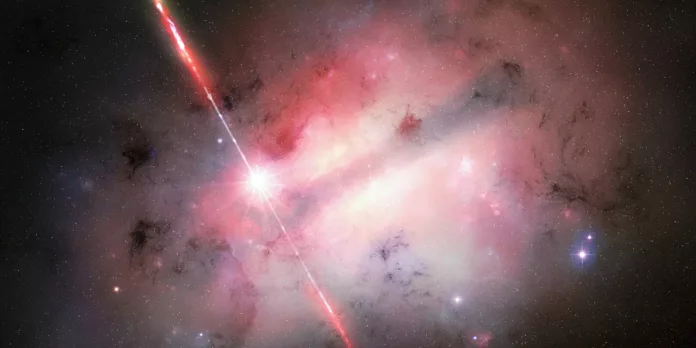
They’re usually born in one of two ways: when two neutron stars, each no bigger than a city, collide, or when a massive star collapses after exhausting its nuclear fuel. Both pathways create a newborn black hole, and some of the infalling matter gets funneled into narrow, near‑light‑speed jets that emit gamma rays.
But none of these familiar scenarios can explain a jet that keeps firing for days. And that’s precisely why GRB 250702B has astronomers scratching their heads.
The strange outburst was first spotted on July 2 by NASA’s Fermi Gamma‑ray Space Telescope. Within hours, a team led by astronomer O’Connor mobilized three space‑based observatories to track the event’s X‑ray afterglow. For 65 days, the Neil Gehrels Swift Observatory, NuSTAR, and the Chandra X‑ray Observatory watched the fading embers of the explosion, gathering clues about what could have caused such an unusually persistent blast. Their results now appear in The Astrophysical Journal Letters.
O’Connor’s analysis showed that GRB 250702B is an outlier. This event does not fit any standard explanation for GRBs. Scientists agree that a black hole consumed a star, but the specifics of how this happened are still debated.
“The continued accretion of matter by the black hole powered an outflow that produced these flares, but the process continued far longer than is possible in standard GRB models,” said O’Connor. “The late X-ray flares show us that the blast’s power source refused to shut off, which means the black hole kept feeding for at least a few days after the initial eruption.”
The Carnegie Mellon team suggests that the culprit was a stellar‑mass black hole, tiny compared to the supermassive giants that anchor galaxies. In their scenario, the black hole shredded a companion star, stretching it into spaghetti‑like strands under its intense gravity. As the black hole consumed the star’s remains, it launched powerful jets that produced the gamma‑ray flash and the lingering X‑ray glow.
Astronomers call this kind of event a tidal disruption event (TDE). Still, because it involves a black hole a million times smaller than the usual suspects, O’Connor refers to it as a “micro‑TDE.”
Using telescopes on Earth and in space, researchers traced GRB 250702B to the constellation Scutum, near the dense, dusty plane of the Milky Way. A separate study led by Jonathan Carney of the University of North Carolina, Chapel Hill, revealed that the host galaxy is unexpectedly massive.
“This galaxy turns out to be surprisingly large, with more than twice the mass of our own galaxy,” he said.
Carnegie Mellon researchers, including O’Connor, graduate students Hannah Skobe and Xander Hall, and Assistant Professor Antonella Palmese, contributed to the analysis.
“The studies of the host galaxy can inform the origin of this unusual transient,” Palmese said. “By looking at the morphology and stellar population, we can understand what the history of this galaxy may have been.”
Skobe led the effort to analyze the galaxy’s structure using Hubble Space Telescope images. But the data raised more questions than answers.
“Looking at the Hubble data, it was unclear whether the system was a merger of two separate galaxies or a single galaxy with a dust lane,” Skobe said. “To investigate this, we modeled the data for both cases but couldn’t distinguish which was preferred.”
The tie‑breaker came from NASA’s James Webb Space Telescope. Its NIRCam instrument delivered crystal‑clear images showing that a dust lane indeed bisects the galaxy.
“The resolution of Webb is unbelievable. We can see so clearly that the burst shone through this dust lane, spilling across the galaxy,” said Huei Sears of Rutgers University, who led the Webb imaging team.
GRB 250702B has forced astronomers to rethink what black holes, especially small ones, are capable of. A jet that burns for days challenges long‑standing models and hints at exotic physics still waiting to be understood.
For now, the universe has offered up a rare puzzle piece. And as scientists continue to sift through the data, GRB 250702B stands as a reminder that even in a sky full of explosions, some still manage to surprise.
Journal Reference:
- Brendan O’Connor, Ramandeep Gill, James Delaunay et al. Comprehensive X-Ray Observations of the Exceptional Ultralong X-Ray and Gamma-Ray Transient GRB 250702B with Swift, NuSTAR, and Chandra: Insights from the X-Ray Afterglow Properties. The Astrophysical Journal Letters. DOI 10.3847/2041-8213/ae1741
Leave a Reply