

By University of Warsaw, Faculty of Physics December 9, 2025
Collected at: https://scitechdaily.com/quantum-antenna-breaks-barrier-in-measuring-elusive-terahertz-signals/
A research team has created a quantum antenna capable of precisely measuring terahertz frequency combs for the first time.
A research team from the Faculty of Physics and the Centre for Quantum Optical Technologies at the Centre of New Technologies, University of Warsaw has introduced a new approach for detecting extremely weak terahertz signals by using a “quantum antenna.” Their method relies on a specialized system that employs Rydberg atoms for radio wave detection, allowing them not only to capture these signals but also to accurately calibrate a frequency comb in the terahertz range.
This part of the electromagnetic spectrum was considered largely unexplored until recently, and the breakthrough, reported in Optica, offers a pathway toward highly sensitive spectroscopy and a new class of quantum sensors that can function at room temperature.
Terahertz (THz) radiation occupies a unique position within the electromagnetic spectrum, sitting between microwaves (such as those used in Wi-Fi) and infrared light at the intersection of electronics and optics. It promises a wide range of applications, including scanning packages without harmful X-rays, enabling ultra-fast 6G communication, and advancing spectroscopy and organic compound imaging.
Despite this potential, using THz radiation for precise and sensitive measurements has remained difficult. Significant advancements in generating and detecting THz waves have been made in recent years, yet achieving an accurate measurement of a frequency comb had remained out of reach until this work.
The Role of Frequency Combs
Why is this so important? Frequency combs, which earned a Nobel Prize in 2005, are most easily visualized as an extremely precise ruler, but one created from light or radio waves. Instead of millimeter markings, one has a series of uniformly spaced lines (“teeth”) at strictly defined frequencies. This “electromagnetic ruler” allows physicists to measure the frequency of an unknown signal with extreme accuracy—simply by checking which “tooth” on the ruler the signal aligns with. As a result, combs serve as a reference standard for calibrating and tuning other devices across a very wide range. Depending on where in the electromagnetic spectrum this ruler is located, we refer to optical, radio, or terahertz frequency combs.
Terahertz frequency combs are particularly interesting because they would enable calibration and, consequently, more precise measurements in a frequency range significantly higher (faster oscillating) than radio waves, yet lower than optical waves (light). However, this type of comb is difficult to measure precisely—it is too fast for modern electronics and, at the same time, cannot be recorded with optical methods. Although the spacing between the comb’s teeth can be determined, and the total power emitted across the spectrum can be measured, it has been challenging to determine the power contribution of a single tooth.
The scientists from the Faculty of Physics and the Centre for Quantum Optical Technologies at the Centre of New Technologies, University of Warsaw successfully overcame this limitation and measured the signal emitted by a single terahertz comb tooth for the first time. To do this, they used a gas of rubidium atoms in a Rydberg state. A Rydberg atom is defined as having a single electron excited to a very high orbit by being illuminated with precisely tuned lasers. This “swollen” atom becomes a quantum antenna, extremely sensitive to external electric fields. Furthermore, using tunable lasers, it can then be tuned to one specific frequency of such a field, in a range extending up to terahertz waves.
Traditionally, in Rydberg electrometry, the phenomenon of Autler-Townes splitting is used to measure the electric field. Its huge advantage is that the measurement result depends only on fundamental atomic constants, providing an absolutely calibrated readout. Unlike classical antennas, which require laborious calibration in specialized radio laboratories, the atomic-based system is, in a sense, a standard unto itself. Moreover, thanks to the richness of energy states in the atom, such a sensor can be tuned almost continuously over an enormous range—from a direct current (DC) signal up to the aforementioned terahertz.
Enhancing Sensitivity Through Light Conversion
However, this method has a limitation: on its own, it is not sensitive enough to record very weak terahertz signals. To remedy this, the research team additionally applied a radio wave-to-light conversion technique invented at the University of Warsaw and adapted it to the needs of terahertz radiation. In this process, the weak terahertz signal is converted into optical photons, which can then be detected with immense sensitivity using single-photon counters.
This hybrid approach is the key to success: it combines the extreme sensitivity of photon detection with the ability to “recover” the calibration capabilities of the Autler-Townes method even for the weakest signals.
Mapping and Calibrating the Terahertz Comb
The sensor based on Rydberg atoms possesses all the features needed to perform precise frequency comb calibration: it can be tuned to a single tooth of the comb, and then retuned to the next, and the next. The scientists managed to observe several dozen teeth in a very wide frequency range this way. Additionally, thanks to the knowledge of the fundamental properties of atoms, the comb was directly calibrated, precisely determining its intensity.
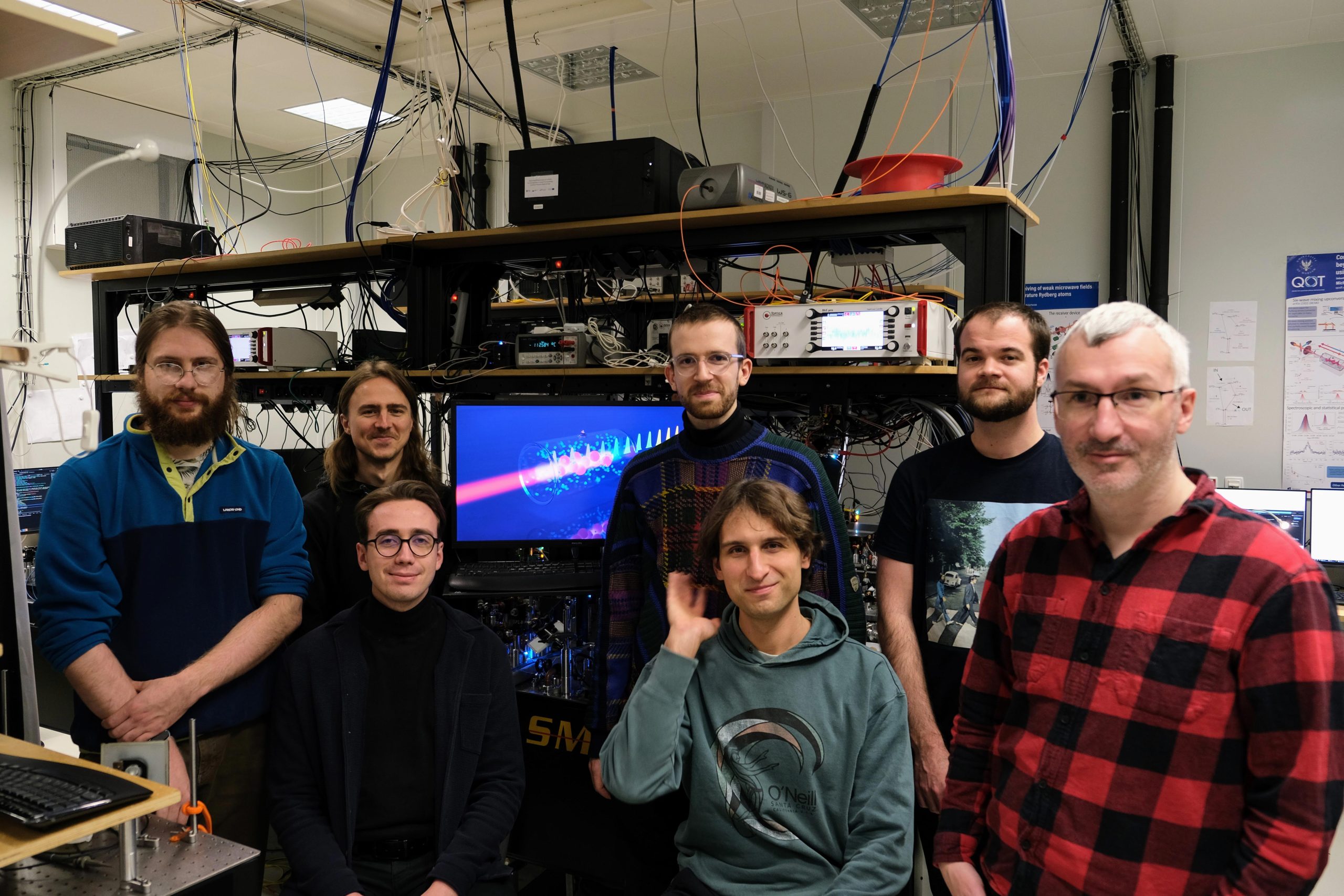
The results obtained by the physicists from the University of Warsaw Wiktor Krokosz, Jan Nowosielski, Bartosz Kasza, Sebastian Borówka, Mateusz Mazelanik, Wojciech Wasilewski, and Michał Parniak are more than just another sensitive detector.
They are the foundation for a new branch of metrology. Thanks to the advantages of Rydberg atoms, the revolutionary applications of optical frequency combs can now be transferred to the hitherto difficult terahertz domain. Crucially, unlike many quantum technologies requiring extremely low temperatures, the developed system operates at room temperature, which drastically reduces costs and facilitates future commercialization. This opens the door to creating reference measurement standards for the upcoming era of terahertz technologies.
Reference: “Electric-field metrology of a terahertz frequency comb using Rydberg atoms” by Bartosz Kasza, Michał Parniak, Wojciech Wasilewski, Mateusz Mazelanik, Jan Nowosielski, Wiktor Krokosz and Sebastian Borówka, 19 November 2025, Optica.
DOI: doi:10.1364/OPTICA.578051
The project “Quantum Optical Technologies” (FENG.02.01-IP.05-0017/23) is implemented as part of Measure 2.1 International Research Agendas of the Foundation for Polish Science, co-financed by the European Union from Priority 2 of the European Funds for Modern Economy Program 2021–2027 (FENG). The research is also one of the results of the SONATA17 and PRELUDIUM23 projects funded by the National Science Centre.)
Leave a Reply