
December 4, 2025 by Torsten Lauer, Central Institute of Mental Health
Collected at: https://techxplore.com/news/2025-12-biological-intelligence-basis-ai.html
In a new research project led by the Central Institute of Mental Health (CIMH) in Mannheim, scientists are investigating how insights into learning processes in animal brains can be used to make artificial intelligence (AI) systems more flexible and efficient. The project is titled NAILIt—Neuro-inspired AI for Learning and Inference in non-stationary environments.
In NAILIt, researchers at the CIMH are collaborating with colleagues from the Hector Institute for Artificial Intelligence in Psychiatry (HITKIP), the Interdisciplinary Center for Scientific Computing (IWR) at Heidelberg University, and the Center for Integrative Physiology and Molecular Medicine (CIPMM) at Saarland University. Together, they aim to develop new approaches that will allow future AI systems to adapt to changing conditions—such as new tasks or unexpected situations—with the flexibility and versatility known from living organisms.
Project partners working alongside project manager Prof. Dr. Daniel Durstewitz (CIMH) and his employees are Prof. Dr. Georgia Koppe (HITKIP, IWR) and Prof. Dr. Jonas-Frederic Sauer (CIPMM) with their teams. The project is outlined in a Perspective article published in Nature Machine Intelligence.
Research at the interface of biology and artificial intelligence
At the core of NAILIt lies the question of how the learning principles observed in animal brains can be transferred to artificial intelligence (AI). Whereas modern AI models—such as large language models—are typically trained once on massive datasets and then operate with fixed parameters, animals continually adjust their behavior to new situations. They do so rapidly, efficiently, and with minimal effort. Such adaptive capabilities are becoming increasingly important for AI systems used in real-world scenarios, for example in autonomous vehicles or in interactive AI agents that engage directly with humans.
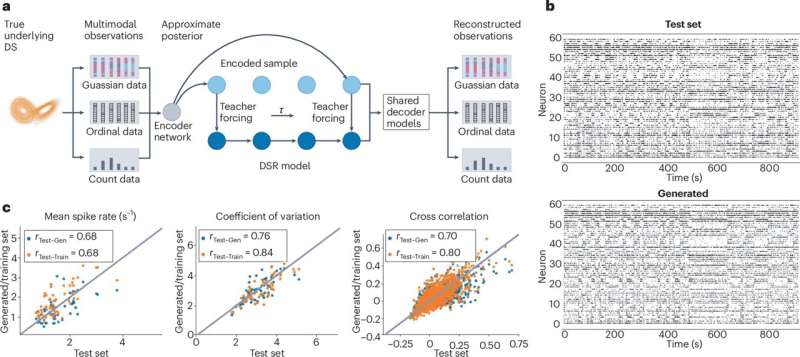
The researchers use state-of-the-art AI tools developed in-house for dynamical systems reconstruction (DSR) to derive generative models of learning from neural and behavioral data. These models are intended to show how the brain processes information and adapts in real time, i.e. while tasks are being performed.
From foundational learning principles to future AI systems
Building on this, the scientists, led by Prof. Dr. Daniel Durstewitz, head of the Department of Theoretical Neuroscience at the CIMH, aim to identify fundamental learning principles that can be transferred to AI. The researchers’ goal is to enable AI models that can adapt to new situations independently and flexibly without having to be completely retrained each time.
The project team will also examine how these data-derived mechanisms can be translated into spiking neural networks (SNNs), which process information in ways more closely aligned with biological neurons. The goal here is to pave the way for more energy-efficient and biologically plausible forms of artificial intelligence.
Long-term perspectives for clinical application and AI research
“Our work is not only intended to improve AI systems, but also to further our understanding and prediction of dynamical processes in the brain in mental disorders,” says Durstewitz. “In the long term, the methods we develop will also be used in psychiatric contexts, for example to predict individual disease progression or to control adaptive neurofeedback procedures.”
The project’s findings will be published in scientific journals and presented at major conferences in AI and machine learning. In the future, they will also be transferred to industrial collaborations and biomedical applications.
More information: Daniel Durstewitz et al, What neuroscience can tell AI about learning in continuously changing environments, Nature Machine Intelligence (2025). DOI: 10.1038/s42256-025-01146-z
Journal information: Nature Machine Intelligence
Leave a Reply