
December 3, 2025 by Rohini Subrahmanyam, Indian Institute of Science
Collected at: https://phys.org/news/2025-12-ramanujan-formulae-pi-modern-high.html
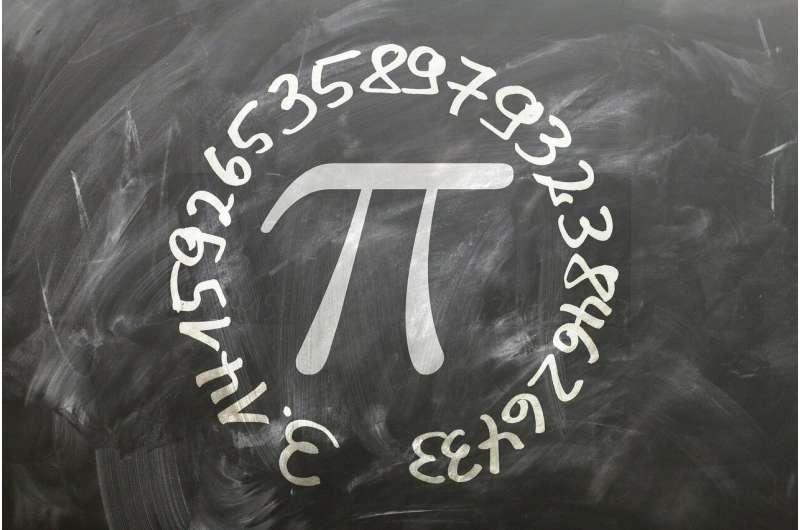
Most of us first hear about the irrational number π (pi)—rounded off as 3.14, with an infinite number of decimal digits—in school, where we learn about its use in the context of a circle. More recently, scientists have developed supercomputers that can estimate up to trillions of its digits.
Now, physicists at the Center for High Energy Physics (CHEP), Indian Institute of Science (IISc) have found that pure mathematical formulas used to calculate the value of pi 100 years ago has connections to fundamental physics of today—showing up in theoretical models of percolation, turbulence, and certain aspects of black holes.
The research is published in the journal Physical Review Letters.
Ramanujan’s formulas and their legacy
In 1914, just before he sailed from Madras to Cambridge, the famous Indian mathematician Srinivasa Ramanujan published a paper listing 17 mathematical formulas to calculate pi. They were highly efficient and helped compute pi faster than other methods at the time. Even with very few mathematical terms in them, the formulas still yielded many correct decimal digits of pi.
The formulas were so foundational that they form the basis for modern computational and mathematical techniques—even the ones used by supercomputers—to compute digits of pi.
“Scientists have computed pi up to 200 trillion digits using an algorithm called the Chudnovsky algorithm,” says Aninda Sinha, Professor at CHEP and senior author of the new study. “These algorithms are actually based on Ramanujan’s work.”
Exploring the physics connection
The question that Sinha and Faizan Bhat, first author and former IISc Ph.D. student, asked was: Why should such astonishing formulas exist at all? In their work, they looked for a physics-based answer.
“We wanted to see whether the starting point of his formulas fit naturally into some physics,” says Sinha. “In other words, is there a physical world where Ramanujan’s mathematics appears on its own?”
They found that Ramanujan’s formulas naturally come up within a broad class of theories called conformal field theories, specifically within logarithmic conformal field theories. Conformal field theories describe systems with scale invariance symmetry—essentially systems that look identical no matter how deep you zoom in, like fractals.
In a physical context, this can be seen at the critical point of water—a special temperature and pressure at which both liquid and vapor forms of water become indistinguishable from the other. At this point, water shows scale invariance symmetry and its properties can be described using conformal field theory.
Critical behavior also comes up in percolation (how things spread through a medium), at the onset of turbulence in fluids, and certain descriptions of black holes—phenomena that can be explained by the more specific logarithmic conformal field theories.
Implications for modern physics
The researchers found that the mathematical structure underlying the starting point of Ramanujan’s formulas also comes up in the mathematics underlying these logarithmic conformal field theories.
Using this connection, they could efficiently calculate certain quantities in these theories—ones that could potentially help them understand phenomena like turbulence or percolation better. This is similar to Ramanujan going from the starting point of his formulas and efficiently deriving pi.
“[In] any piece of beautiful mathematics, you almost always find that there is a physical system which actually mirrors the mathematics,” says Bhat.
“Ramanujan’s motivation might have been very mathematical, but without his knowledge, he was also studying black holes, turbulence, percolation, all sorts of things.”
The study shows that Ramanujan’s century-old formulas have a hitherto hidden application in making current high-energy physics calculations faster and more tractable. Even without this, however, Sinha and Bhat say they were just baffled by the beauty of Ramanujan’s mathematics.
“We were simply fascinated by the way a genius working in early 20th century India, with almost no contact with modern physics, anticipated structures that are now central to our understanding of the universe,” says Sinha.
More information: Faizan Bhat et al, Ramanujan’s 1/𝜋 Series and Conformal Field Theories, Physical Review Letters (2025). DOI: 10.1103/c38g-fd2v
Journal information: Physical Review Letters
Leave a Reply