
December 1, 2025 by Daegu Gyeongbuk Institute of Science and Technology
Collected at: https://techxplore.com/news/2025-12-cooling-electricity-powered-3d-smart.html
A research team developed a 3D Smart Building Energy-saving device capable of automatically controlling heating and cooling without electricity or an external power source.
The findings are published in the journal Advanced Materials. The study was led by Professor Kim Bong-hoon from the Department of Robotics and Mechatronics Engineering at DGIST, in collaboration with KAIST, POSTECH, Kyung Hee University, and Kongju National University.
Buildings account for about 30% of the world’s total energy use, and 70% of that is for heating and cooling, which worsens greenhouse gas emissions and air pollution. This increases the demand for eco-friendly technologies that make heating and cooling more efficient. However, the existing heating and cooling devices often require an external power source or have limited control options.
How the 3D smart device works
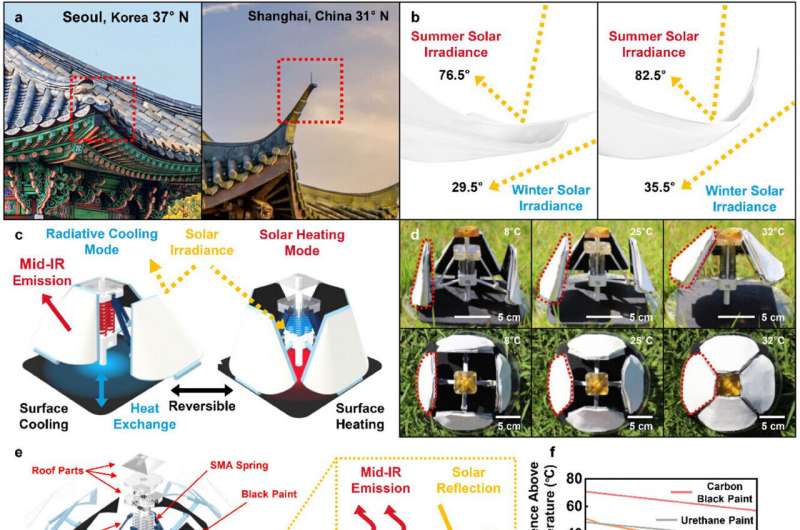
To address these limitations, Professor Kim’s team developed a 3D smart structural device that automatically opens and closes in response to sunlight angles, enabling it to switch between cooling and heating. This design is based on traditional architecture principles, where the angles of the eaves vary with latitude. The device uses a shape memory alloy (SMA) that responds to temperature changes by opening and closing without requiring an external power source.
Specifically, when the device’s three-dimensional structure is closed, its surface reflects solar heat and emits mid-infrared light to function in cooling mode. Conversely, when the structure is open, the black surface that absorbs sunlight is exposed, switching to heating mode. In short, the device automatically transitions between cooling and heating without extra operation, based on the season or outside temperature changes, to help reduce building energy usage.
Testing and future applications
The research team conducted experiments from various angles and under different conditions in an actual outdoor environment, confirming that it can stably control heating and cooling regardless of the building’s structural form. When applied to real buildings, it is expected to be an effective energy-saving solution without using additional power.
Professor Kim stated, “This study presents an eco-friendly heating and cooling system that operates independently without a power source and suggests a new direction for next-generation energy-saving building technology. Since it was selected as the cover study for a world-renowned academic journal, we will contribute to saving energy in industrial sites and urban buildings by developing practical applications.”
More information: Ho Jun Jin et al, Development of 3D Reversible Smart Energy‐Saving Devices for Adaptive Energy Management, Advanced Materials (2025). DOI: 10.1002/adma.202507682
Journal information: Advanced Materials
Leave a Reply