
By University of Warsaw November 30, 2025
Collected at: https://scitechdaily.com/new-research-shows-how-entanglement-amplifies-light/
Researchers discovered that when atoms interact and remain entangled with light, they emit stronger, more coordinated bursts of energy.
This breakthrough could lead to faster, more efficient quantum devices and improved control over light-matter systems.
Collective Light Behavior in Cavity Systems
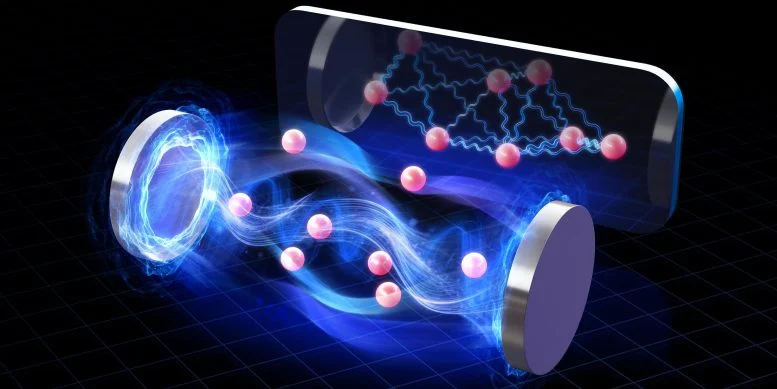
Light–matter systems bring many emitters (e.g., atoms) into a shared optical mode inside a cavity. This mode forms a stable pattern of light between mirrors placed very close together, creating conditions that allow the atoms to act collectively in ways that isolated atoms cannot. One of the most striking examples is superradiance, a coordinated quantum effect in which a large group of atoms emits light in perfect synchrony, producing a much stronger burst than they would individually.
Many theoretical studies assume that the interaction between light and matter is the dominant force in these systems. Under this assumption, researchers often treat the entire group of atoms as a unified “giant dipole,” evenly linked to the cavity field. This field creates interactions across the whole ensemble as if every atom were connected to all others.
“Photons act as mediators that couple each emitter to all others inside the cavity,” says Dr. João Pedro Mendonça, the first author of the article, who completed his PhD at the Faculty of Physics of the University of Warsaw and is now working as a researcher at the Centre for New Technologies at the University of Warsaw.
In actual materials, however, atoms that sit close together also influence one another through short-range dipole–dipole interactions that are frequently ignored. The researchers examined what happens when these intrinsic atom-atom effects are included. Their findings show that these local interactions can either weaken or strengthen the longer-range processes driven by photons, directly affecting whether superradiance occurs. Understanding this relationship is crucial for interpreting experiments in conditions where light and matter strongly affect one another.

Why Entanglement Matters in Light–Matter Physics
Entanglement plays a central role in how light and matter respond together, linking their behavior in subtle but important ways. Despite this, many widely used analytical and numerical tools treat light and matter as if they are separate, which removes this link from the picture.
“Semiclassical models greatly simplify the quantum problem but at the cost of losing crucial information; they effectively ignore possible entanglement between photons and atoms, and we found that in some cases this is not a good approximation,” the authors explain.
To address this gap, the team developed a computational method that explicitly includes entanglement. This approach captures correlations within the atomic group and between the atoms and photons. The results show that local interactions between nearby emitters can reduce the threshold needed for superradiance. They also reveal an overlooked ordered state that exhibits superradiant features. Altogether, the work demonstrates that incorporating entanglement is necessary to fully identify the possible states that can emerge in light–matter systems.
Impact on Quantum Energy Technologies
Beyond theoretical interest, cavity-based light–matter platforms are central to several developing quantum technologies. One prominent example is quantum batteries, which are expected to charge and discharge more rapidly and efficiently by taking advantage of collective quantum behavior. Superradiant dynamics can speed up both processes, potentially boosting overall energy-transfer performance.
This study explains how short-range atomic interactions shape these behaviors. By changing the microscopic conditions that support superradiance, these interactions act as adjustable parameters for optimizing charging and energy flow in real materials and cavities.
“Once you keep light–matter entanglement in the model, you can predict when a device will charge quickly and when it won’t. That turns a many-body effect into a practical design rule,” said João Pedro Mendonça. Similar control over light–matter correlations is also relevant for other platforms, including quantum networks and precision sensors.
International Collaboration Behind the Findings
The project emerged through close cooperation across several institutions. João Pedro Mendonça completed multiple research visits to the United States, supported by the University of Warsaw “Excellence Initiative – Research University” (IDUB) program and the Polish National Agency for Academic Exchange (NAWA). The researchers emphasize that collaboration played a key role in achieving these results. “This is a great example of how international mobility and collaboration can open the door to breakthroughs,” the team notes.
Reference: “Role of Matter Interactions in Superradiant Phenomena” by João Pedro Mendonça, Krzysztof Jachymski and Yao Wang, 23 September 2025, Physical Review Letters.
DOI: 10.1103/z8gv-7yyk
Leave a Reply