
November 26, 2025 by Saint Louis University
Collected at: https://phys.org/news/2025-11-exceptional-lasing-modes.html
Exceptional points (EPs) are non-Hermitian singularities where two or more eigenstates coalesce, resulting in the eigenspace collapsing in dimensionality. Over the past decade, researchers have uncovered a wealth of exotic phenomena near EPs.
In laser physics, for example, EPs have been linked to pump-induced laser termination, loss-induced lasing, and the design of quasi-parity-time-symmetric laser systems that boost the output power of large-area lasers while preserving single-mode operation.
New findings challenge conventional wisdom
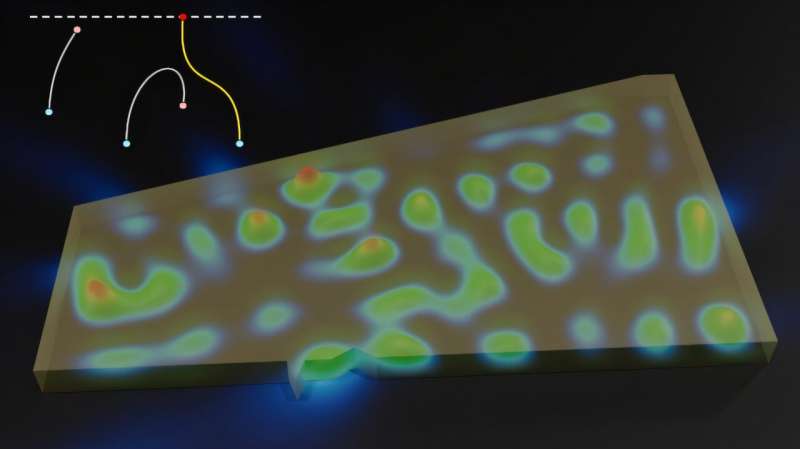
A new study, published in Physical Review Letters, reports yet another surprising effect of EPs in laser systems. The work asks a straightforward question: in a laser cavity supporting multiple modes within the gain bandwidth, is the first lasing mode always the one with the highest gain and fastest gain acceleration (i.e., the steepest increase in modal gain with applied material gain)? Conventional wisdom suggests yes. However, the authors demonstrate that this intuition can fail.
“We considered a scenario where two modes with lower quality factors coalesce at an EP (or experience an avoided crossing in the vicinity of an EP) as the material gain increases. Our intuition was that this coalescence might enhance the effective modal gain of one of these modes, allowing it to reach threshold first,” said Ramy El-Ganainy, Ph.D., professor of optics and photonics at the Department of Electrical and Computer Engineering at Saint Louis University, and the paper’s corresponding author.
Collaboration and discovery process
The idea emerged from a scientific exchange.
“Ramy approached me with the idea that EPs might reorder lasing thresholds during a meeting organized by the Mathematisches Forschungsinstitut Oberwolfach (MFO) in Germany on Nonlinear Optics: Physics, Analysis, and Numerics.
“We discussed it, and he floated some ideas about using both single-cavity and coupled-cavity systems to observe the effect. I realized I could probably identify a scenario where this happens in a single-cavity system under uniform pumping,” said Julius Kulig, a postdoctoral fellow in Jan Wiersig’s group at the Institute of Physics, Otto-von-Guericke University, Magdeburg, and the paper’s first author.
After returning to Magdeburg, Kulig and Wiersig set out to show that such a case indeed exists. Meanwhile, Qi Zhong, then a postdoctoral fellow in El-Ganainy’s group at Saint Louis University, together with El-Ganainy, designed a discrete photonic system composed of coupled cavities where the effect could also be demonstrated.
This discovery highlights that even in established fields like laser engineering, revisiting fundamental assumptions through the lens of non-Hermitian physics can yield unexpected insights. It also highlights the critical role of funded scientific meetings such as the ones organized by MFO in fostering collaborations that bridge expertise across institutions and research cultures.
More information: Julius Kullig et al, Exceptional Points and Lasing Thresholds: When Lower-Q Modes Win, Physical Review Letters (2025). DOI: 10.1103/zc6x-pfw2. On arXiv: DOI: 10.48550/arxiv.2510.23846
Journal information: Physical Review Letters , arXiv
Leave a Reply