
Tanya Weaver Wed 26 Nov 2025
Collected at: https://eandt.theiet.org/2025/11/26/fast-curing-concrete-alternative-promises-faster-3d-printed-construction
A quick-setting, low-carbon alternative to concrete could speed up the 3D printing of buildings and infrastructure, according to a study.
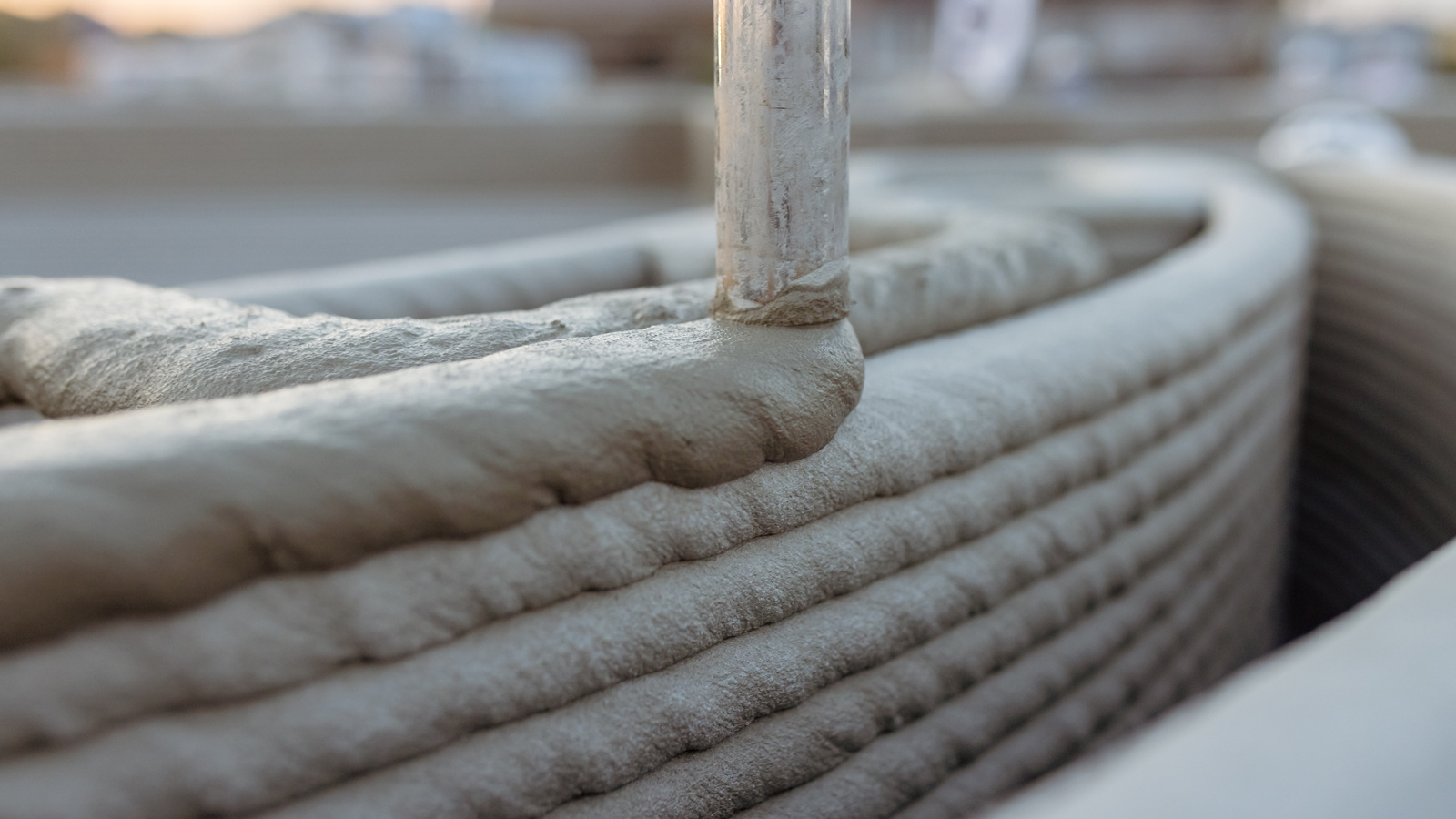
Researchers at Oregon State University (OSU) have developed a 3D printable, clay-based material that provides structural properties comparable to concrete, yet cures immediately after printing.
Large-scale 3D concrete printing has taken off in recent years as a rapid and cost-effective means of construction. Low-cost homes have been printed in countries across the world, while the technique has also been used to build anything from railway stations to 30-metre-tall buildings .
While rapid, there are some drawbacks. Cement, the binding agent in concrete, generates around 2.5 billion tonnes of CO2 every year – about 8% of the global total. Concrete also takes multiple days to cure, inhibiting progress on construction projects.
In contrast, the material developed by the researchers has a much smaller environmental footprint compared to cement as it mainly consists of soil that is then fused with hemp fibres, sand and biochar (a carbon-rich matter made by heating wood chips and other organic biomass under low oxygen).
This clay-based material cures as it’s being extruded from the printer. According to the researchers, this is due to an acrylamide-based binding agent, which undergoes a chemical reaction known as frontal polymerisation. This makes it strong enough to be printed over unsupported gaps, such as the tops of window openings.
Devin Roach, assistant professor of mechanical engineering in the OSU College of Engineering, said: “The printed material has a buildable strength of 3 megapascals [a unit of pressure] immediately after printing, enabling the construction of multilayer walls and freestanding overhangs like roofs.
“It surpasses 17 megapascals – the strength required of residential structural concrete – in just three days, compared to as long as 28 days for traditional cement-based concrete.”
In eight to 10 days it fully cures, reaching a strength of over 40 megapascals.
While currently the material costs more to produce than standard cement-based concrete, the researchers are hopeful that with more work they will be able to bring the cost down and prove its structural properties in further tests.
Roach said: “I’m incredibly proud of our innovative, transdisciplinary team for coming up with a material that can make a difference in people’s lives in multiple ways.
“Especially with the frequency of destructive natural disasters, we need to be able to get shelter and other structures built quickly – and we can do that with a material that is readily available and is associated with comparatively little emissions.”
The study – 3D printing of sustainable infrastructure using rapid-set clay concrete with biobased additives – has been published in the journal Advanced Composites and Hybrid Materials.
Leave a Reply