
November 24, 2025 by Ingrid Fadelli, Phys.org
Collected at: https://phys.org/news/2025-11-quantum-photonic-chip-emitting-molecules.html
Photonic quantum processors, devices that can process information leveraging quantum mechanical effects and particles of light (photons), have shown promise for numerous applications, ranging from computations and communications to the simulation of complex quantum systems.
To be deployed in real-world settings, however, these photonic chips should reliably integrate many deterministic and indistinguishable single-photon sources on a single chip.
So far, achieving this has proved highly challenging. Most such photonic quantum chips developed so far utilize solid-state single-photon emitters that are limited by so-called spectral diffusion (i.e., the random “wandering” of their emission frequency).
This essentially means that they rarely exhibit lifetime-limited transitions, conditions in which the color spread of photons is determined solely by the natural excited-state lifetime of emitters. Notably, this condition is necessary for the reliable on-chip integration of indistinguishable single-photon sources.
Researchers at Huazhong University of Science and Technology, Wuhan Institute of Quantum Technology and Zhejiang University have introduced a new molecular chip that could overcome the limitations of previously introduced photonic quantum processors.
Their chip, presented in a paper in Nature Nanotechnology, integrates light-emitting single molecules with single-mode waveguides, narrow optical components that guide in integrated circuits.
“In our earlier work, we found that single organic molecules embedded in a single-crystalline nanosheet can exhibit remarkably stable, lifetime-limited emission when coupled to photonic circuits,” Xue-Wen Chen, senior author of the paper, told Phys.org.
“This insight motivated us to pursue a molecular quantum photonic chip capable of hosting multiple indistinguishable single-photon sources in parallel. The present study represents the first major step toward that vision.”

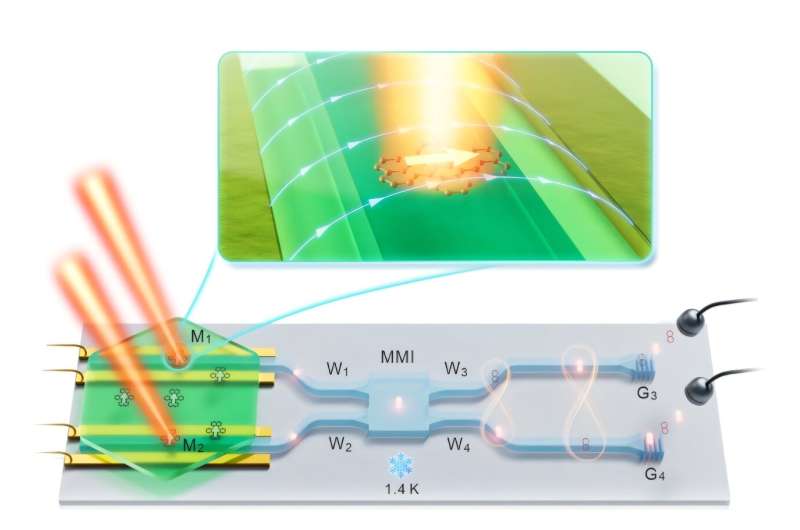
RF single photons from a pair of waveguide-coupled single molecules. Credit: Nature Nanotechnology (2025). DOI: 10.1038/s41565-025-02043-7
An innovative chip with unique capabilities
To develop their chip, Chen and his colleagues created two indistinguishable single-photon sources derived from two independent molecules embedded in a single-crystalline organic nanosheet. They showed that the emissions of these two molecules display a quantum optics effect known as Hong-Ou-Mandel (HOM) interference, which indicates that they are indistinguishable.
“Our molecular quantum photonic chip is built on a hybrid integration platform that combines molecule-embedded organic nanosheets, silicon-nitride photonic circuits, and metal microelectrodes,” explained Chen.
“Within this architecture, DBT fluorescent molecules are integrated into the photonic waveguides at controlled orientation and positions so that their emission can be efficiently coupled into the circuit.”
A crucial characteristic of the chip developed by the researchers is that each of the molecules it is based on can be electrically tuned. By applying carefully calibrated electric fields via electrodes on the chip, the researchers showed that they could shift the transition frequencies of two molecules in separate waveguide channels, prompting them to become identical.
“Each molecule then emits single photons into its respective waveguide, and these photons are routed to an on-chip beam splitter,” said Chen.
“At the beam splitter, the photons meet and undergo HOM interference, causing them to coalesce into the same output port when they are truly indistinguishable. By measuring the second-order correlation between the beam splitter’s two outputs, we quantify the HOM visibility, which directly reflects how indistinguishable the photons from the two independent molecules are.”
Towards the realization of scalable quantum photonic processors
This work by Chen and his colleagues introduces a promising strategy for integrating many indistinguishable single photons on a chip. In the future, the methods they employed could open new possibilities for development of large-scale quantum photonic architectures based on molecular emitters.
“Having taken this critical first step, we can further pursue the realization of larger-scale chip-integrated multichannel indistinguishable single-photon sources and quantum interference, thereby laying a critical foundation for achieving scalable optical quantum information processing,” said Chen.
The results published by these researchers could soon inspire the design of new quantum processors based on molecular emitters. Meanwhile, the team is working on improving their molecular quantum photonic chip and broadening its functionalities.
“Looking ahead, we plan to expand the platform to support larger arrays of indistinguishable single-photon sources and to further enhance light–matter interaction through structures such as microcavities and slow-light waveguides to improve efficiency,” added Chen.
“These advances will enable increasingly sophisticated on-chip quantum photonic functionalities, ultimately paving the way toward integrated quantum logic operations and scalable quantum information processing architectures.”
More information: Tailin Huang et al, On-chip quantum interference of indistinguishable single photons from integrated independent molecules, Nature Nanotechnology (2025). DOI: 10.1038/s41565-025-02043-7.
Journal information: Nature Nanotechnology
Leave a Reply