

By University of Stuttgart November 22, 2025
Collected at: https://scitechdaily.com/scientists-teleport-information-between-distant-photons-for-the-first-time/
Researchers at the University of Stuttgart have successfully teleported quantum states between photons from two distant light sources, marking a pivotal advance toward practical quantum repeaters.
Life online remains vulnerable, with cybercriminals able to access financial accounts or impersonate individuals with increasing ease. The rise of AI has enabled attackers to carry out more complex and targeted intrusions.
Quantum cryptography is emerging as a possible solution. This approach uses fundamental principles of quantum physics to protect information, making it extremely difficult for outsiders to intercept data without being detected. Even so, developing the technology needed for a functional quantum internet continues to involve major scientific challenges.
A team at the Institute of Semiconductor Optics and Functional Interfaces (IHFG) at the University of Stuttgart has now reported an important step forward in one of the core components of such a network: the ‘quantum repeater’. Their findings were published in Nature Communications.
Nanometer-sized semiconductor islands for information transfer
“For the first time worldwide, we have succeeded in transferring quantum information among photons originating from two different quantum dots,” says Prof. Peter Michler, head of the IHFG and deputy spokesperson for the Quantenrepeater.Net (QR.N) research project.
To understand the significance of this, it helps to recall how digital communication works. Whether sending a message or streaming video, data travels as sequences of zeros and ones. Quantum communication operates on the same concept, but the information is carried by individual photons. A zero or one is encoded in the photon’s polarization (i.e., their orientation in the horizontal and vertical directions or in a superposition of both states).
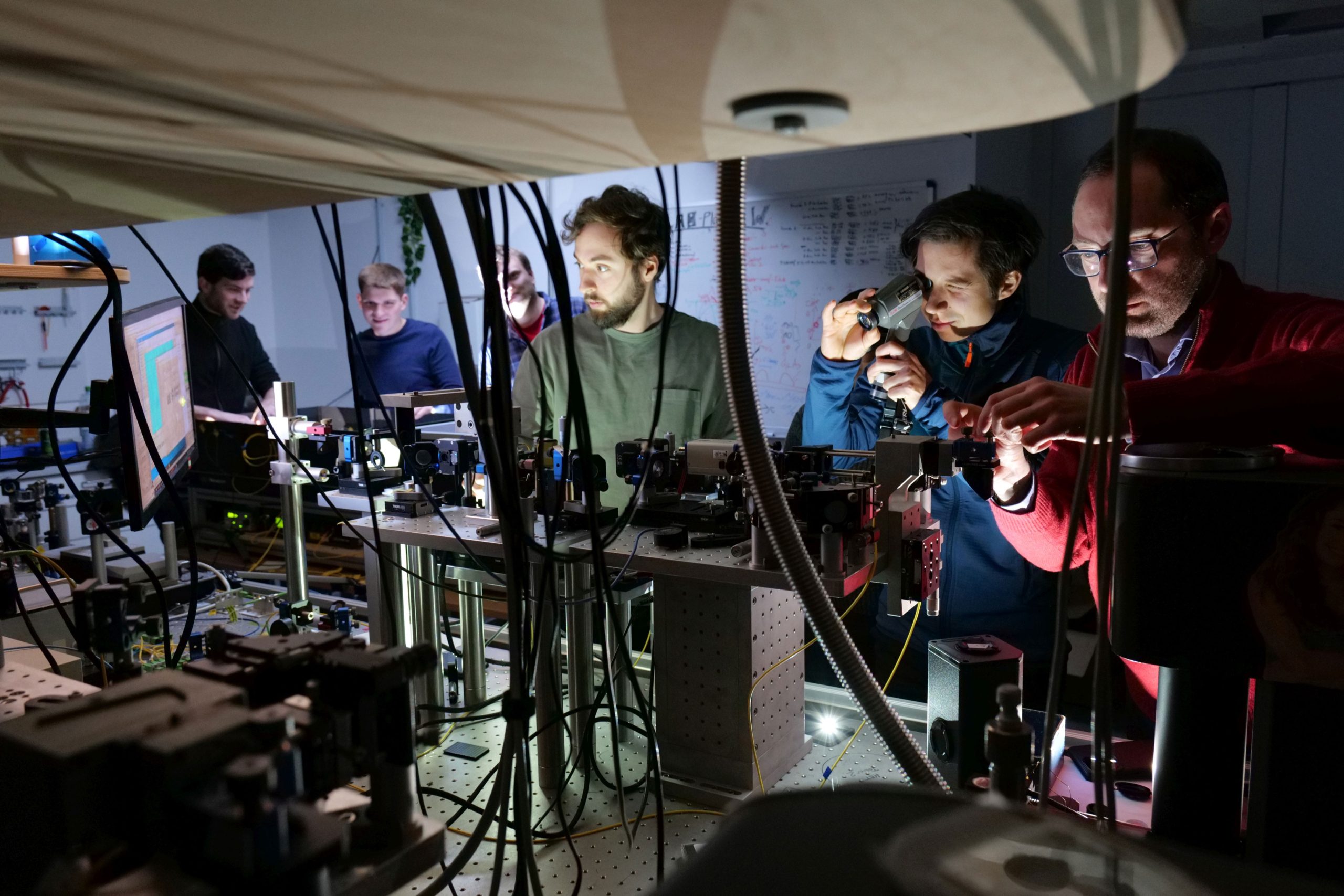
Because photons behave according to the principles of quantum mechanics, their polarization cannot always be examined without disturbing them. Any attempt to intercept the signal leaves detectable evidence, which makes unauthorized access visible.
Making the quantum internet ready for the fiber-optic infrastructure
There is another major obstacle. A practical quantum internet would rely on optical fibers—just like today’s digital networks. However, light can travel only a certain distance before weakening. Standard data signals must be refreshed roughly every 50 kilometers with an optical amplifier.
This approach cannot be used for quantum communication, since quantum states cannot be copied or boosted in the usual way. Instead, quantum physics provides a different solution: information can be transferred from one photon to another as long as the information itself is not directly revealed, a process known as quantum teleportation.
Quantum repeaters as nodes for information transmission
Building on this, physicists are developing quantum repeaters that renew quantum information before it is absorbed in the optical fiber. They are to serve as nodes for the quantum internet. However, there are considerable technical hurdles.
To transmit quantum information via teleportation, the photons must be indistinguishable (i.e., they must have approximately the same temporal profile and color). This proves extremely difficult because they are generated at different locations from different sources.
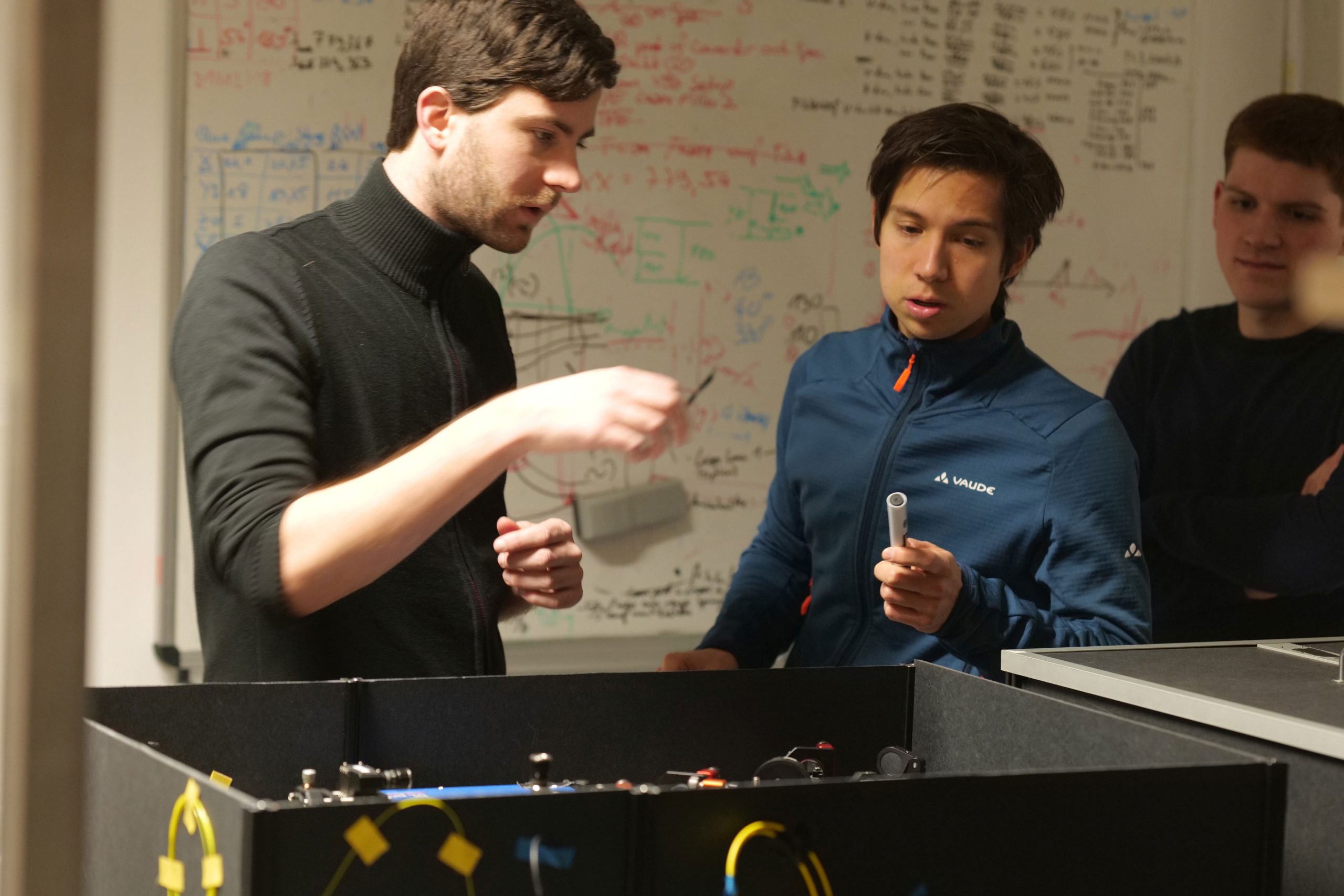
“Light quanta from different quantum dots have never been teleported before because it is so challenging,” says Tim Strobel, scientist at the IHFG and first author of the study. As part of QR.N, his team has developed semiconductor light sources that generate almost identical photons.
“In these semiconductor islands, certain fixed energy levels are present, just like in an atom,” says Strobel. This allows individual photons with defined properties to be generated at the push of a button. “Our partners at the Leibniz Institute for Solid State and Materials Research in Dresden have developed quantum dots that differ only minimally,” says Strobel.
This means that almost identical photons can be generated at two locations.
Information is “beamed” from one photon to another
At the University of Stuttgart, the team succeeded in teleporting the polarization state of a photon originating from one quantum dot to another photon from a second quantum dot. One quantum dot generates a single photon, the other an entangled photon pair.
“Entangled” means that the two particles constitute a single quantum entity, even when they are physically separated. One of the two particles travels to the second quantum dot and interferes with its light particle. The two overlap.
Because of this superposition, the information of the single photon is transferred to the distant partner of the pair. Instrumental for the success of the experiment were “quantum frequency converters”, which compensate residual frequency differences between the photons. These converters were developed by a team led by Prof. Christoph Becher, an expert in quantum optics at Saarland University.
Improvements for reaching considerably greater distances
“Transferring quantum information between photons from different quantum dots is a crucial step toward bridging greater distances,” says Michler.
In the Stuttgart experiment, the quantum dots were separated only by an optical fiber of about 10 m in length. “But we are working on achieving considerably greater distances,” says Strobel.
In earlier work, the team had shown that the entanglement of the quantum dot photons remains intact even after a 36-kilometer transmission through the city center of Stuttgart. Another aim is to increase the current success rate of teleportation, which currently stands at just over 70%. Fluctuations in the quantum dot still lead to slight differences in the photons.
“We want to reduce this by advancing semiconductor fabrication techniques,” says Strobel. “Achieving this experiment has been a long-standing ambition — these results reflect years of scientific dedication and progress,” says Dr. Simone Luca Portalupi, group leader at the IHFG and one of the study coordinators. “It’s exciting to see how experiments focused on fundamental research are taking their first steps toward practical applications.”
Reference: “Telecom-wavelength quantum teleportation using frequency-converted photons from remote quantum dots” by Tim Strobel, Michal Vyvlecka, Ilenia Neureuther, Tobias Bauer, Marlon Schäfer, Stefan Kazmaier, Nand Lal Sharma, Raphael Joos, Jonas H. Weber, Cornelius Nawrath, Weijie Nie, Ghata Bhayani, Caspar Hopfmann, Christoph Becher, Peter Michler and Simone Luca Portalupi, 17 November 2025, Nature Communications.
DOI: 10.1038/s41467-025-65912-8
Research into quantum repeaters is funded by the Federal Ministry of Research, Technology and Space (BMFTR) as part of the “Quantenrepeater.Net (QR.N)” project.
Leave a Reply