
By Stevens Institute of Technology November 12, 2025
Collected at: https://scitechdaily.com/hypersonic-breakthrough-could-make-one-hour-global-flights-possible/
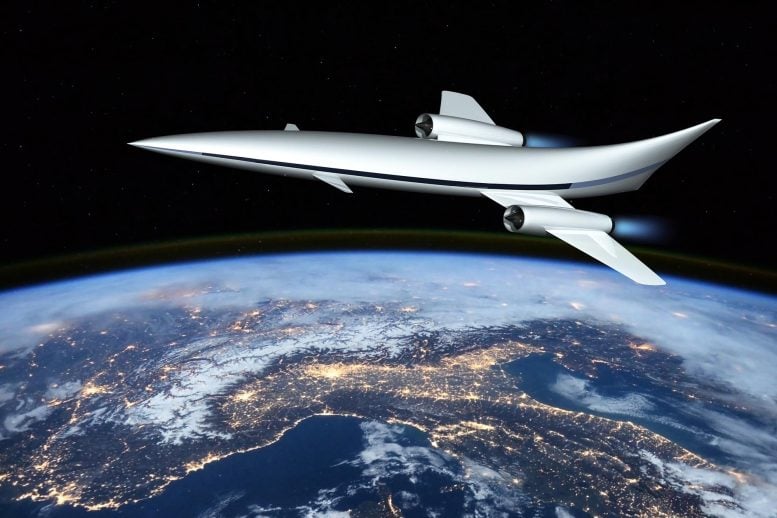
Hypersonic flight could turn marathon international trips into one-hour commutes, bringing science fiction closer to reality.
A new experiment supports the long-debated Morkovin’s hypothesis, showing that turbulence at Mach 6 mimics that of slower airflows. This revelation could make hypersonic flight, and perhaps space access, far more achievable.
Hypersonic Flight: From Science Fiction to Reality
If it ever becomes possible, hypersonic flight, once imagined only in science fiction, could completely reshape global travel. Journeys that now take an entire day could shrink to the length of a typical movie. A flight from Sydney to Los Angeles, for example, might take just one hour instead of fifteen.
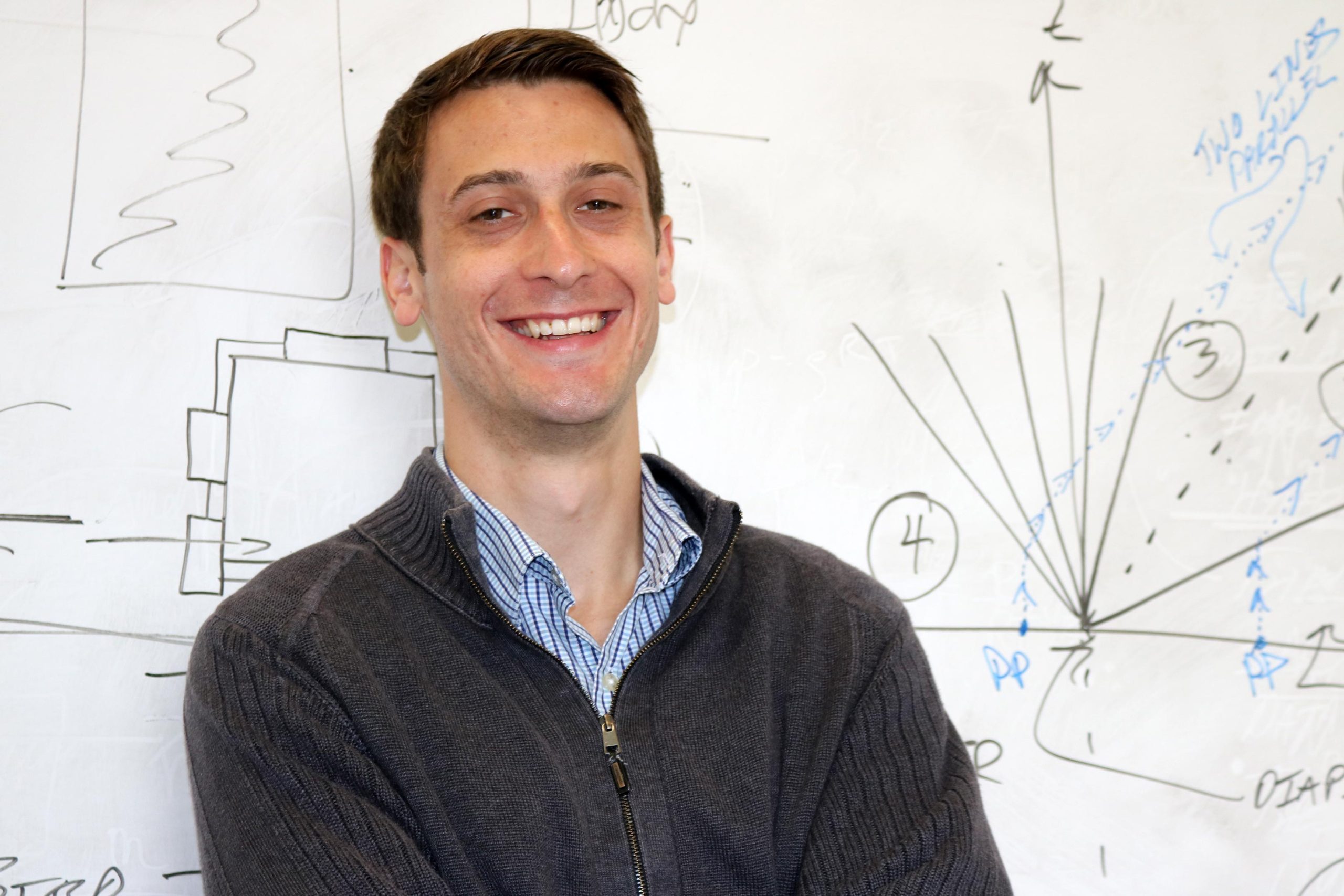
“It really shrinks the planet,” says Professor Nicholaus Parziale, whose research focuses on making such hypersonic flight a reality, and who is a recent recipient of the Presidential Early Career Award for Scientists and Engineers for his research into the fluid mechanics that affects high-speed flight. “It will make travel faster, easier, and more enjoyable.”
The Heat and Turbulence Barrier
Covering half the globe in an hour may sound impossible, yet this goal is edging closer. Military aircraft already reach twice or even three times the speed of sound, or Mach 2 and Mach 3, where Mach 1 equals about 760 miles per hour at sea level. To make the Los Angeles–Sydney trip in one hour, a plane would need to reach Mach 10, or ten times the speed of sound. The biggest challenge lies in the intense turbulence and heat produced as an aircraft tears through the atmosphere at such extreme speeds.
Air doesn’t behave the same way at slow and fast speeds, and aerospace engineers use specific terms to describe the difference: incompressible and compressible flow. In incompressible flow, which happens at lower speeds (below about Mach 0.3 or 225 miles per hour), air density barely changes, making design calculations simpler. Once speeds climb past the sound barrier, however, the airflow becomes compressible. “That’s because a gas can ‘squish,’” Parziale explains, or in scientific terms, compress.
How Compressibility Changes Flight Dynamics
Compression causes the air’s density to shift dramatically with changes in pressure and temperature, altering how the aircraft interacts with the surrounding air. “Compressibility affects how the airflow goes around the body and that can change things like lift, drag, and thrust required to take off or stay airborne.” These factors are critical to how any aircraft is designed.
Engineers already understand airflow well for planes flying below or near the speed of sound, referred to as “low Mach” numbers. But designing vehicles that travel at five to ten times that speed requires understanding airflow under much harsher conditions. That puzzle still holds some mystery, except for one guiding idea known as Morkovin’s hypothesis.
Morkovin’s Hypothesis: Turbulence Across the Sound Barrier
Formulated by Mark Morkovin in the mid-20th century, the hypothesis postulates that when air moves at Mach 5 or Mach 6, the turbulence behavior doesn’t change all that much from slower speeds. Although air density and temperature change more in faster flows, the hypothesis states that the basic “choppy” motion of turbulence stays mostly the same.
“Basically, the Morkovin’s hypothesis means that the way the turbulent air moves at low and high speeds isn’t that different,” says Parziale. “If the hypothesis is correct, it means that we don’t need a whole new way to understand turbulence at these higher speeds. We can use the same concepts we use for the slower flows.” That also means that hypersonic planes don’t need a significantly different design approach.
Yet, so far no one has been able to provide sufficient experimental evidence to support Morkovin’s hypothesis. That became the subject of Parziale’s new study, titled “Hypersonic Turbulent Quantities in Support of Morkovin’s Hypothesis,” which will be published today (November 12) in Nature Communications.
Testing the Hypothesis: Lasers, Krypton, and a Decade of Work
In the study, Parziale’s team used lasers to ionize a gas called krypton, which is seeded into the air flowing inside a wind tunnel. That temporarily made krypton atoms form an initially straight, glowing line. Then researchers used ultra-high-resolution cameras to take pictures of how that fluorescent krypton line moves, bends, and twists through the wind tunnel’s air — akin to how a leaf swirls through the little eddies in a river.
“As that line moves with the gas, you can see crinkles and structure in the flow, and from that, we can learn a lot about turbulence,” says Parziale, adding that he spent 11 years building that clever setup. “And what we found was that at Mach 6, the turbulence behavior is pretty close to the incompressible flow.”
Early on, Parziale’s group was supported by the Air Force Office of Scientific Research Young Investigator Research Program (YIP) in 2016 and Office of Naval Research (ONR) YIP in 2020, with the current work being supported by ONR.
Toward Hypersonic and Space Travel
Although the hypothesis isn’t fully confirmed yet, the study brings us one step closer to hypersonic flight because it suggests that planes don’t need an entirely new design to fly at hypersonic speeds. And that simplifies things.
“Today, we must use computers to design an airplane, and the computational resources to design a plane that will fly at Mach 6, simulating all the tiny, fine, little details would be impossible,” says Parziale. “The Morkovin’s hypothesis allows us to make simplifying assumptions so that the computational demands to design hypersonic vehicles can become more doable.”
The study findings also hold promise for changing how space transportation is done, Parziale explains. “If we can build planes that fly at hypersonic speed, we can also fly them into space, rather than launching rockets, which would make transportation to and from low Earth orbit easier,” he says. “It will be a game-changer for transportation not only on Earth, but also in low orbit.”
Reference: “Hypersonic turbulent quantities in support of Morkovin’s hypothesis” by B. A. Segall, T. C. Keenoy, J. C. Kokinakos, J. D. Langhorn, A. Hameed, D. Shekhtman and N. J. Parziale, 12 November 2025, Nature Communications.
DOI: 10.1038/s41467-025-65398-4
Leave a Reply