
By Helmholtz-Zentrum Dresden-Rossendorf November 16, 2025
Collected at: https://scitechdaily.com/turbulent-bubbles-confirm-a-century-old-physics-theory/
Scientists have uncovered evidence of classic turbulence occurring within swarms of rising gas bubbles.
An international team of scientists from the Helmholtz-Zentrum Dresden-Rossendorf (HZDR), Johns Hopkins University, and Duke University has found that a classic theory describing turbulence in fluids also explains how bubbles rising through water create chaotic motion. Their study, which tracked both bubbles and surrounding fluid particles in three dimensions, offers the first direct experimental confirmation that “Kolmogorov scaling” can appear in turbulence driven by bubbles. The findings were published in Physical Review Letters.
Turbulence caused by bubbles is common in everyday life and industry, from fizzing beverages to chemical reactors and ocean waves. When many bubbles rise through a liquid, the motion of their wakes stirs the surrounding water into a turbulent flow.
Understanding this process is vital for advancing industrial technologies, refining climate models, and improving designs that rely on mixing fluids. For decades, however, scientists have debated whether the turbulence theory developed in 1941 by Russian mathematician Andrey Kolmogorov, known as “K41 scaling,” applies to these bubbly systems. Earlier experiments and computer simulations had produced conflicting results, leaving the question unresolved until now.
”We wanted to get a definitive answer by looking closely at the turbulence between and around bubbles, at very small scales,” says Dr. Tian Ma, lead author of the study and physicist at the Institute of Fluid Dynamics at HZDR.
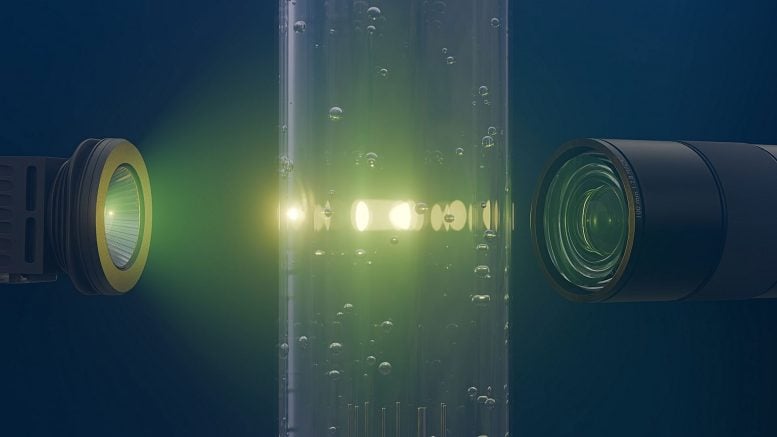
To accomplish this, the researchers employed an advanced method known as 3D simultaneous Lagrangian tracking of both phases. This approach enables scientists to monitor the motion of bubbles and the tiny tracer particles in the surrounding water with exceptional accuracy and in real time. The experiment took place in a water column measuring 11.5 cm in width, where carefully controlled swarms of bubbles were released from the bottom. Four high-speed cameras captured the motion at a rate of 2,500 frames per second.
They studied four different cases, varying the bubble size and the amount of gas, to replicate realistic bubbly flows. Importantly, the bubbles with three to five millimeters in diameter were large enough to wobble as they rose, creating strong turbulent wakes. In two of the four cases – those with moderate bubble size and density – the turbulence in the flow closely followed Kolmogorov’s predictions at small scales, that is, for eddies smaller than the size of the bubbles. This marks the first time such scaling has been confirmed experimentally in the midst of a bubble swarm.
Decoding turbulence: energy cascades from big to small
”Kolmogorov’s theory is elegant. It predicts how the energy that cascades from big turbulent eddies down to smaller and smaller ones – until it’s eventually dissipated through viscous effects – controls the fluctuations of the turbulent fluid motion,” explains co-author Dr. Andrew Bragg from Duke University. ”Finding that this theory also describes bubble-driven turbulence so well is both surprising and exciting.”
The team also developed a new mathematical formula to estimate the rate at which turbulence loses energy due to viscous effects – known as the energy dissipation rate. Their formula, which only depends on two bubble-related parameters – its size and how densely packed the bubbles are – matched the experimental data remarkably well. Interestingly, they found that Kolmogorov scaling was stronger in regions outside the bubbles’ direct wakes. In those wakes, the fluid is so strongly disturbed that the classic turbulent energy cascade is overpowered.
One crucial insight was that for the classic Kolmogorov ”inertial range“ – where his scaling laws work best – to appear clearly in bubble-induced turbulence, the bubbles would need to be significantly larger. But there’s a catch: in reality, bubbles of such large sizes would break apart due to their own instability. This means there is a fundamental limit to how well the K41 theory can apply to bubbly flows. ”In a way, nature prevents us from getting perfect Kolmogorov turbulence with bubbles. But under the right conditions, we now know it gets close,” says Dr. Hendrik Hessenkemper, a co-author on the study who performed the experiments.
The findings not only settle an ongoing scientific debate but could also help engineers better design bubble-based systems, from chemical reactors to wastewater treatment. And for physicists, it adds another system – bubbly flows – to the growing list of chaotic phenomena where Kolmogorov’s 1941 theory proves surprisingly robust.
The researchers emphasize that their study is just the beginning. Future work could investigate how turbulence behaves with even more complex bubble shapes, bubble mixtures, or under different gravitational or fluid conditions. ”The more we understand the fundamental rules of turbulence in bubbly flows, the better we can harness them in real-world applications,” summarizes Ma. ”And it’s pretty amazing that a theory from over 80 years ago continues to hold up in such a bubbly environment.”
Reference: “Kolmogorov Scaling in Bubble-Induced Turbulence” by Tian Ma, Shiyong Tan, Rui Ni, Hendrik Hessenkemper and Andrew D. Bragg, 20 June 2025, Physical Review Letters.
DOI: 10.1103/v9mh-7pw1
Leave a Reply