
November 13, 2025 by Ingrid Fadelli, Phys.org
Collected at: https://phys.org/news/2025-11-vibrational-anomalies-solids.html
Phonons are sound particles or quantized vibrations of atoms in solid materials. The Debye model, a theory introduced by physicist Peter Debye in 1912, describes the contribution of phonons to the specific heat of materials and explains why the amount of heat required to raise the temperature of solids drops sharply at low temperatures.
The Debye model assumes that vibrational frequencies are continuously distributed in a solid material. Past studies, however, found that when phonons have particularly short wavelengths, some anomalies can emerge.
The first of these reported anomalies, the so-called Van Hove singularity (VHS), is characterized by sharp features in the vibrational density of states (DOS) observed in crystals. The second, known as a boson peak, entails a significant excess in the DOS in amorphous solids or glasses.
Researchers at the Chinese Academy of Sciences and Xi’an Jiaotong University recently introduced a new unified model that could explain both these anomalies in the vibrational behavior of solids. This framework, presented in a paper published in Nature Physics, could open new possibilities for the study of quantized vibrations in both ordered and disordered solids.
“The Debye theory treats low-frequency phonons as elastic waves in a continuous medium, deriving that the low-frequency vibrational density of states (VDOS) is proportional to the square of the frequency, thus quantitatively explaining the cubic law for low-temperature specific heat capacity,” Gan Ding, first author of the paper, told Phys.org.
“Yet it has two major limitations. First, when the wavelength approaches the lattice, the long-range periodicity of the lattice leads to a singularity in the VDOS, known as the VHS. Second, in amorphous solids without long-range periodicity, low-frequency phonons deviate from the Debye prediction, resulting in an excess in the VDOS, known as the BP.”
Explaining both reported vibrational anomalies
The primary objective of the recent work by Ding and his colleagues was thus to explain both VHS and BP, while also shedding light on the relationship between these two anomalies. To do this, the team first developed a new mathematical model that treats vibrations in solids as “elastic” phonons that resonate with local modes.
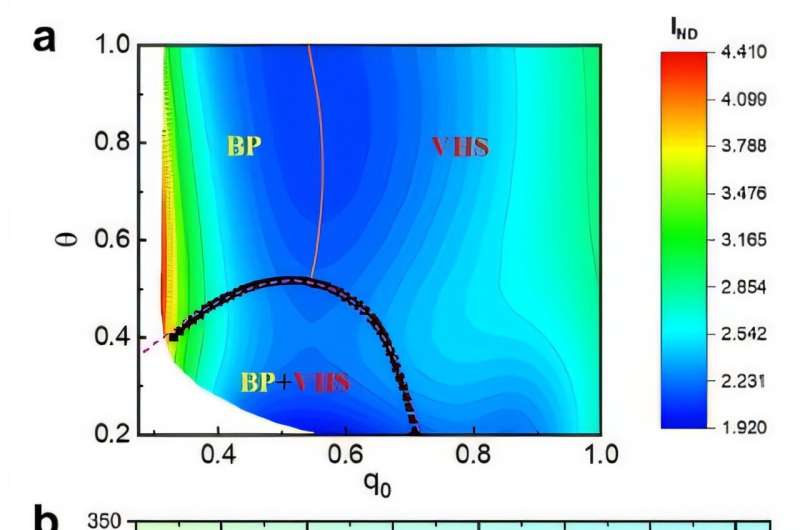
Unified theory of phonon in solids: (a) Non-Debye anomaly panoramic phase diagram of BP and VHS. (b) Validation with low-temperature specific heat data from 143 real solids. Credit: Ding et al.
“A phonon is a ‘quasiparticle’ that exhibits wave-particle duality,” explained Ding.
“Starting with the phonon propagation and scattering, we theoretically derived the damping behavior and nonlinear dispersion for multi-degree-of-freedom vibrational system. This led to an analytical expression for the VDOS that unifies the description of both ordered crystals and disordered glasses.”
Using the mathematical model they introduced, the authors constructed a phase diagram that describes variations in the vibrational anomalies of materials depending on their elastic behavior, stiffness and density. Notably, this phase diagram is applicable to both previously reported anomalies that are not explained by the Debye model.
“We provided a clear framework for identifying the VHS, BP and their coexistence,” said Ding.
“The validity of the unified model of phonons is further supported by a comparison with experimental heat capacity data from a wide range of real solids, encompassing 143 crystalline and glassy materials. Our paper not only clarifies the physical origin of the BP and its relationship with the VHS but also deepens the fundamental understanding of the elastic limits of solids as continuous media.”
Guiding future research and material designs
The predictions made by the researchers’ model were found to be aligned with earlier experimental observations of vibrational anomalies in a wide range of solid materials. In the future, their model could help to gather important insight into the emergence of these anomalies within various materials.
The team’s unified framework could also inform the design of new materials with low thermal conductivity, such as glasses and high-entropy alloys, which could have valuable technological applications. Concurrently, it could be used to study quantum properties that amorphous solids exhibit at low temperatures, such as superconductivity.
“In future research, we plan to apply this theoretical model to tackle ongoing controversies in condensed matter physics, such as the low-frequency non-phononic behavior of amorphous solids in the continuous medium limit, the anomalies in low-temperature thermal conductivity and even superconductivity,” added Ding.
More information: Gan Ding et al, Unified theory of phonon in solids with phase diagram of non-Debye anomalies, Nature Physics (2025). DOI: 10.1038/s41567-025-03057-7.
Journal information: Nature Physics
Leave a Reply