

Jack Loughran Wed 12 Nov 2025
Collected at: https://eandt.theiet.org/2025/11/12/humans-can-learn-detect-ai-faces-just-five-minutes-training-study-finds
Just five minutes of training can drastically improve people’s ability to differentiate between AI-generated faces and real ones, a University of Reading study has shown.
Researchers assessed 664 participants’ ability to distinguish between real human faces and faces generated by computer software called StyleGAN3. Without any training, super-recognisers (individuals who score significantly higher than average on face recognition tests) correctly identified fake faces 41% of the time, while participants with typical abilities scored just 31%. If they had their eyes closed and guessed, people’s performance would actually improve, correctly guessing around 50% of faces due to pure chance.
The use of AI-generated imagery on the internet has been rising at exponential rates in recent years, leading to concerns that deep fakes and misinformation could be made easier to believe than ever and have negative political or societal impacts. AI faces could also be used to impersonate others for the purposes of identity theft and crime.
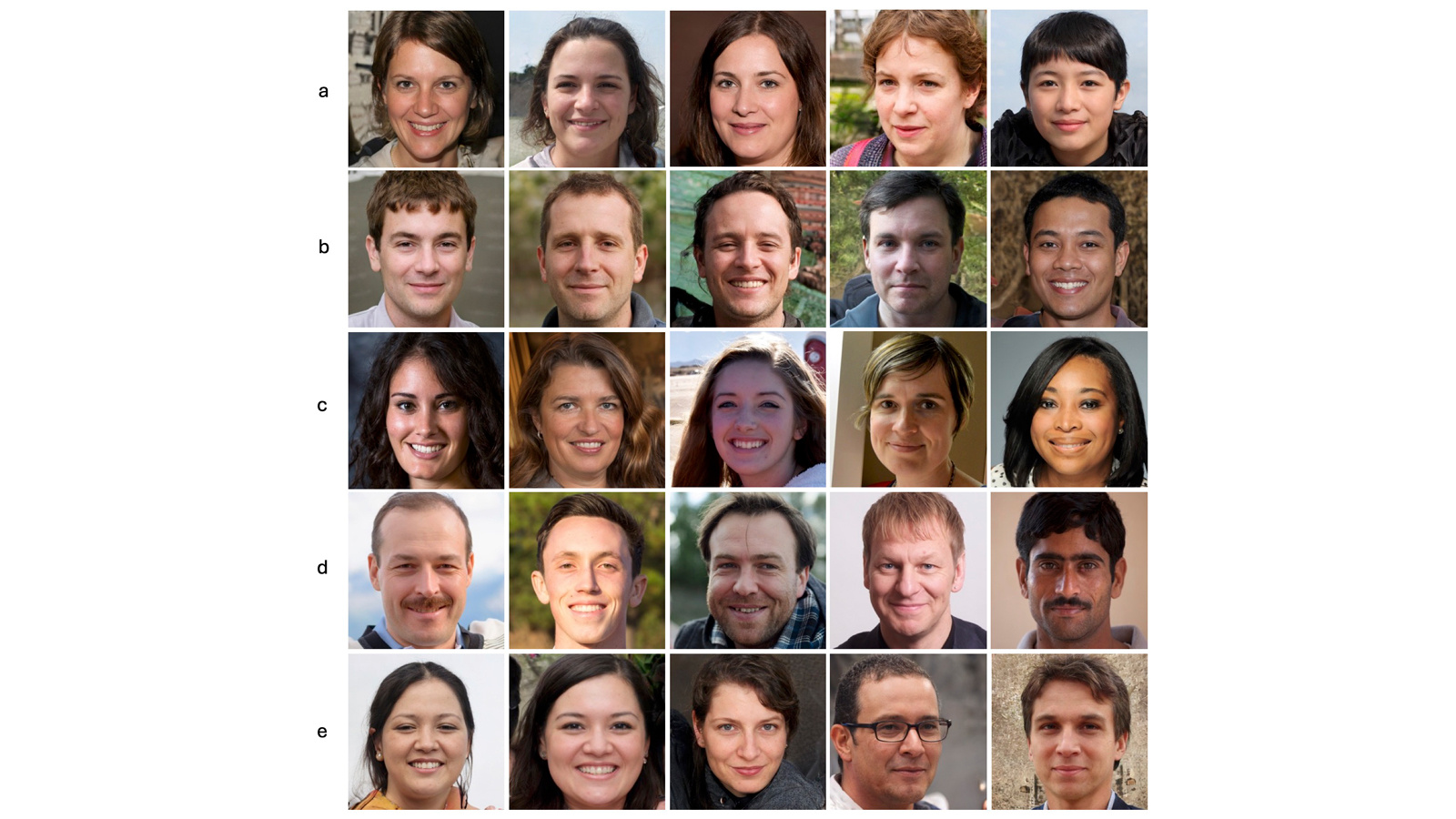
Some of the faces used in the experiments. Only rows C and D show faces of real people. © University of Reading
To improve detection, the researchers gave participants a brief training lesson, which highlighted common computer rendering mistakes such as unusual hair patterns or incorrect numbers of teeth. Following this, super-recognisers were able to achieve 64% accuracy on average in detecting fake faces, while typical participants scored 51% accuracy.
Dr Katie Gray, lead researcher at the University of Reading, said: “Computer-generated faces pose genuine security risks. They have been used to create fake social media profiles, bypass identity verification systems and create false documents.
“The faces produced by the latest generation of AI software are extremely realistic. People often judge AI-generated faces as more realistic than actual human faces.
“Our training procedure is brief and easy to implement. The results suggest that combining this training with the natural abilities of super-recognisers could help tackle real-world problems, such as verifying identities online.”
The training affected both groups equally, suggesting that super-recognisers may use different visual cues than typical observers when identifying synthetic faces, rather than simply being better at spotting rendering errors.
Researchers used StyleGAN3 – the most advanced system available at the time – to create the faces. The team said that rapid advancements in the technology meant that participants tended to have poorer performance than those in previous studies. Future research will examine whether the training effects last over time and how super-recognisers’ skills might complement AI detection tools.
Leave a Reply