
November 10, 2025 by Vienna University of Technology
Collected at: https://phys.org/news/2025-11-reveals-individual-readiness.html
Climate change is leading to stronger flood disasters. TU Wien and Joanneum Research have developed a new model that shows how private and public protection measures interact.
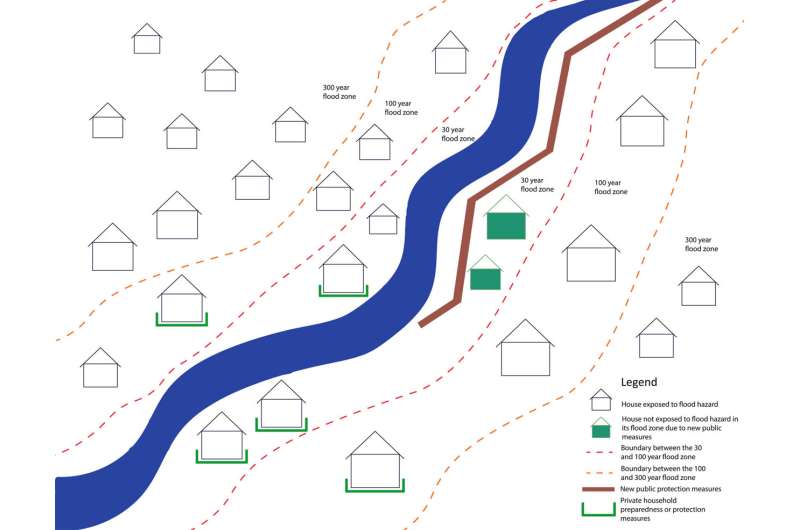
In many regions of the world, people will have to prepare for more severe flood events in the coming decades. There are two ways to tackle this problem: individuals can protect themselves—for example, through insurance or home modifications—or communities can work together to reduce flood risks, for instance by building dams or retention basins.
The interaction between these approaches can be represented in mathematical models. A research team led by TU Wien used extensive data that had surveyed thousands of Austrian households to study how natural conditions and human behavior interact in flood protection. Minimizing flood damage requires both approaches—individual and public.
The findings are published in the journal Water Resources Research.
‘After the flood’ comes before the flood
“During a flood disaster, people build up knowledge about floods and their impacts. They become aware of the risks. And after the flood, they are more willing to invest in flood protection, safeguard their homes, think about emergency plans, and perhaps take out insurance. They become more prepared for future floods,” says Carr from the Institute of Hydraulic Engineering and Water Resources Management at TU Wien, the lead author of the study.
“In total, 3,770 households across Austria were surveyed, and we have now analyzed the data.”
The results show a clear pattern: If there are no floods, preparedness decreases significantly. Even though the scientific assessment of flood risk remains unchanged, people put less priority on their flood protection measures.
Public measures influence individual behavior
This can lead to unintended consequences: “When public measures reduce the likelihood of floods, that is, of course, a positive outcome. But it also reduces individual preparedness, and many people forgo precautions that would still be very sensible,” explains Carr.
This phenomenon has been recognized for some time. This study, however, is the first to empirically demonstrate it and integrate it into a socio-hydrological model, allowing a mathematical analysis of how natural conditions, public, and private measures interact. Such models also help to better predict the effects of climate change on society.
Costs at an earlier point in time
“Due to climate change, major flood events could occur sooner,” says Carr.
“A large, once-in-a-century flood might have occurred only decades from now without climate change, but with it, it could happen within just a few years. This means that our protective measures may not yet have reached the standard they will achieve in the future,” she adds. “Costs will therefore arise earlier than expected and may be higher.”
It is essential to promote proactive flood protection. Action should ideally be taken before a major flood, not only afterward. “We need to better inform people, provide them with opportunities to protect themselves in time, and raise awareness about flood protection. This way, long-term costs are minimized,” emphasizes Carr.
Public and private measures must work together
Public and private measures should not be considered separately—ideally, they complement each other. The model also shows that reducing government measures increases risk, and this effect cannot be fully compensated by stronger private precautions. Even though individual precautions should be enhanced, withdrawing public support—effectively “privatizing the risk”—is not a sensible solution.
More information: Gemma Carr et al, Interactions Between Public and Private Flood Adaptation: Insights From a Socio‐Hydrological Model, Water Resources Research (2025). DOI: 10.1029/2025wr040502
Journal information: Water Resources Research


Leave a Reply