
By Technical University of Munich (TUM) November 4, 2025
Collected at: https://scitechdaily.com/googles-quantum-computer-unlocks-a-strange-new-realm-of-matter/
A quantum processor has revealed a previously unobserved exotic phase of matter. The discovery highlights the role of quantum computers in advancing fundamental physics.
Phases of matter describe the fundamental forms materials can take, such as water existing as liquid or ice. Traditionally, scientists have defined these phases under equilibrium, when a system remains stable over time. Yet nature also permits more unusual possibilities: phases that only appear when a system is forced out of equilibrium. In a new study published in Nature, researchers demonstrate that quantum computers provide a unique platform for investigating these exotic forms of matter.
Non-equilibrium quantum states and floquet systems
In contrast to conventional phases, non-equilibrium quantum phases are characterized by their time-dependent and dynamic behavior, features that cannot be explained by standard equilibrium thermodynamics. A particularly rich category of these phases emerges in Floquet systems, which are quantum systems subjected to periodic external driving. This rhythmic stimulation can generate entirely new patterns of order that do not exist in equilibrium, uncovering physical phenomena that lie beyond the scope of ordinary matter phases.
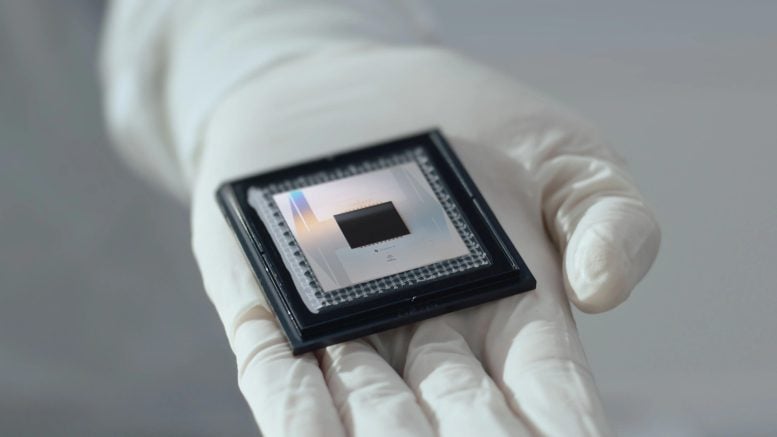
Working with a 58-qubit superconducting quantum processor, a collaboration between the Technical University of Munich (TUM), Princeton University, and Google Quantum AI successfully created a Floquet topologically ordered state, a phase that had long been theorized but never experimentally realized. The researchers directly visualized the directed edge motions characteristic of this state and developed a new interferometric algorithm to probe its topological features. With these tools, they observed the dynamic “transmutation” of exotic particles, a predicted hallmark of these unusual quantum phases.
Quantum computer as a laboratory
“Highly entangled non-equilibrium phases are notoriously hard to simulate with classical computers,” said the first author, Melissa Will, a PhD student at the Physics Department of the TUM School of Natural Sciences. “Our results show that quantum processors are not just computational devices – they are powerful experimental platforms for discovering and probing entirely new states of matter.”
This work opens the door to a new era of quantum simulation, where quantum computers become laboratories for studying the vast and largely unexplored landscape of out-of-equilibrium quantum matter. The insights gained from these studies could have far-reaching implications, from understanding fundamental physics to designing next-generation quantum technologies.
Reference: “Probing non-equilibrium topological order on a quantum processor” by M. Will, T. A. Cochran, E. Rosenberg, B. Jobst, N. M. Eassa, P. Roushan, M. Knap, A. Gammon-Smith and F. Pollmann, 10 September 2025, Nature.
DOI: 10.1038/s41586-025-09456-3
Leave a Reply