
November 4, 2025 by University of Bonn
Collected at: https://techxplore.com/news/2025-11-rivermamba-ai-architecture.html
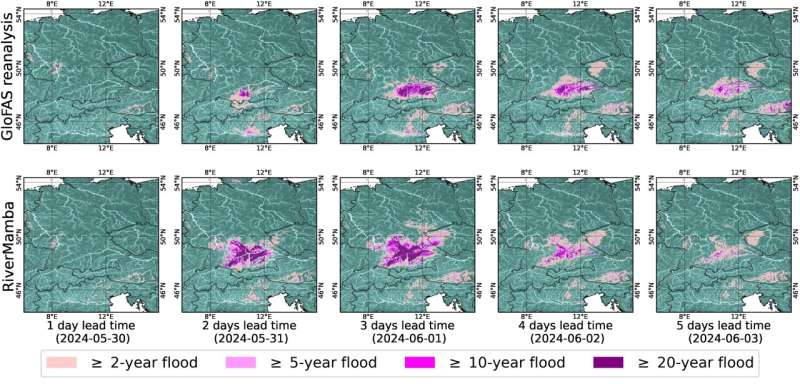
Extreme weather events such as heavy rain and flooding pose growing challenges for early warning systems worldwide. Researchers at the University Bonn, the Forschungszentrum Jülich (FZJ), and the Lamarr Institute for Machine Learning and Artificial Intelligence have developed RiverMamba, a new AI model that can predict river discharges and flood risks more accurately than previous methods.
The research team will present its findings on December 4 at this year’s NeurIPS 2025. RiverMamba thus makes an important contribution to climate adaptation and risk prevention—topics that are receiving special attention worldwide, particularly around UN World Tsunami Awareness Day on November 5.
The findings are published on the arXiv preprint server.
AI learns from environmental and climate data
RiverMamba is based on the so-called Mamba architecture, a new generation of deep learning models that can handle temporal and spatial environmental and climate data particularly efficiently. The system continuously evaluates data on precipitation, temperature, soil moisture, and flow velocity and recognizes patterns that are decisive for the development of floods.
RiverMamba combines the strengths of classic, physics-based models such as the Global Flood Awareness System (GloFAS), which makes global predictions but does not fully model local characteristics. GloFAS is very computationally intensive, with local, learning-based models such as Google’s Flood Hub, which is very efficient but can only predict river flows at existing measuring stations.
RiverMamba learns both from data from physics-based models and directly from extensive environmental and observational data. This enables it to make reliable predictions even when measurement series are incomplete or missing—for example, in smaller catchment areas or regions with limited data availability.
This ability to independently model complex interactions between weather, topography, and runoff behavior opens up new perspectives for more accurate flood forecasts worldwide.
The development was led by Prof. Dr. Jürgen Gall, Principal Investigator at the Lamarr Institute, in close collaboration with the Transdisciplinary Research Area “Modeling,” the Integrated Research Training Group at the DFG Collaborative Research Center “DETECT—Regional Climate Change: Disentangling the Role of Land Use and Water Management” (SFB 1502 DETECT) at the University of Bonn, and the project “Foundation Model for Weather Forecasting” (RAINA), a joint project of the University of Bonn, the Deutscher Wetterdienst (DWD), and the Forschungszentrum Jülich (FZJ). The interdisciplinary project combines AI research with climate modeling, hydrology, and weather forecasting—and shows how research from North Rhine–Westphalia contributes to overcoming global challenges.
“With RiverMamba, we are showing how AI can be used in a targeted manner to model environmental processes more realistically and efficiently,” says Prof. Dr. Jürgen Gall. “Such data-based approaches can usefully complement existing early warning systems—an important step toward more reliable forecasts in the face of increasing extreme weather events.”
More information: Mohamad Hakam Shams Eddin et al, RiverMamba: A State Space Model for Global River Discharge and Flood Forecasting, arXiv (2025). DOI: 10.48550/arxiv.2505.22535
Journal information: arXiv
Leave a Reply