
October 29, 2025 by National Research Council of Science and Technology
Collected at: https://techxplore.com/news/2025-10-cells-semiconductors-ai-reconstructs-microscopic.html
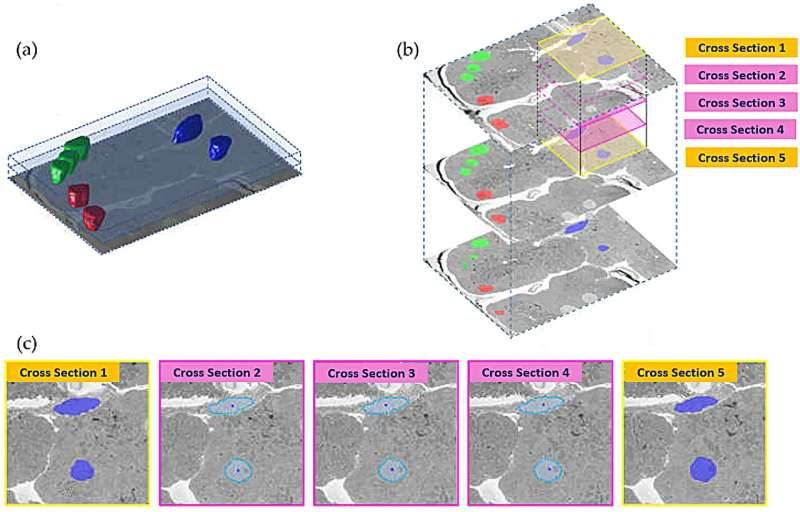
The Korea Research Institute of Standards and Science (KRISS) has developed an artificial intelligence (AI)-based image segmentation algorithm that can rapidly reconstruct three-dimensional (3D) structures from two-dimensional (2D) cross-sectional images of biological samples captured using a scanning electron microscope (SEM).
The newly developed algorithm requires manual analysis of only about 10% of the total image data, after which it automatically labels the remaining data to train the AI. The trained AI automatically performs segmentation, and the results are reconstructed in 3D.
This research is published in Microscopy and Microanalysis.
Compared with conventional methods—where researchers had to manually analyze every cross-sectional image—the new approach reduces the time and cost required for 3D visualization by more than half, significantly improving research efficiency.
A SEM captures a series of cross-sectional images of a specimen at intervals of several tens of nanometers and reconstructs them into a 3D structure. Because it enables high-resolution observation of fine internal cellular structures, the SEM is widely used in life science research and medical diagnostics.
Image segmentation is a preprocessing step required for reconstructing 3D structures from SEM images. It involves determining the precise position and shape of specific structures—such as cell nuclei and mitochondria—in each cross-sectional image. By filtering out unnecessary information and clearly highlighting only the target structures, image segmentation enables accurate 3D reconstruction.
Traditionally, image segmentation relied on a supervised learning approach, in which experts manually examined hundreds or even thousands of cross-sectional images and annotated the target structures by hand. However, this process required significant time and manpower, and the results were often affected by subjective judgment and human error, making it difficult to ensure consistency and reliability in the final 3D reconstructions.
To address this challenge, the Emerging Research Instruments Group at KRISS developed a semi-supervised learning–based algorithm that uses periodically labeled images as reference points to automatically annotate the adjacent cross sections.
For example, if there are 100 cross-sectional SEM images, researchers manually label every tenth image, and the algorithm automatically performs labeling for the remaining 90 images, completing the full dataset analysis. This approach dramatically reduces the time and cost required to prepare datasets for AI-based 3D structure reconstruction.
In performance tests using mouse brain cell data, the algorithm developed by the KRISS research team demonstrated accuracy levels within 3% of those achieved by conventional methods, while reducing the required analysis time and cost to approximately one-eighth. Even when applied to large-scale data with a resolution of 4096 × 6144 pixels, the algorithm maintained both high accuracy and processing speed, showing stable performance throughout.
Senior Researcher Yun Dal Jae of the Emerging Research Instruments Group at KRISS stated, “The technology we developed can be applied not only in the biological sciences but also in a wide range of fields that require automated image analysis, such as semiconductor defect inspection and new materials development. In particular, it can be highly useful in areas where it is difficult to obtain AI training data due to privacy concerns or budget constraints.”
More information: Dal-Jae Yun et al, Three-Dimensional Reconstruction of Serial Block-Face Scanning Electron Microscopy Using Semantic Segmentation based on Semi-Supervised Deep Learning, Microscopy and Microanalysis (2025). DOI: 10.1093/mam/ozaf047

Leave a Reply