
By Tohoku University October 22, 2025
Collected at: https://scitechdaily.com/scientists-propose-quantum-network-to-finally-detect-universes-mysterious-missing-substance/
Researchers at Tohoku University have shown that linking quantum sensors in optimized networks can dramatically boost their sensitivity.
Uncovering dark matter, the invisible substance thought to bind galaxies together, remains one of the greatest mysteries in physics. While it cannot be directly observed or touched, scientists believe it leaves behind faint traces that might be captured using ultra-sensitive quantum instruments.
In a recent study, researchers at Tohoku University introduced a new approach to enhance the performance of quantum sensors by linking them in carefully engineered network configurations.
These sensors operate according to the laws of quantum physics, allowing them to detect incredibly subtle signals that traditional sensors would miss. With this improvement, the precise detection of the delicate clues associated with dark matter may soon become achievable.
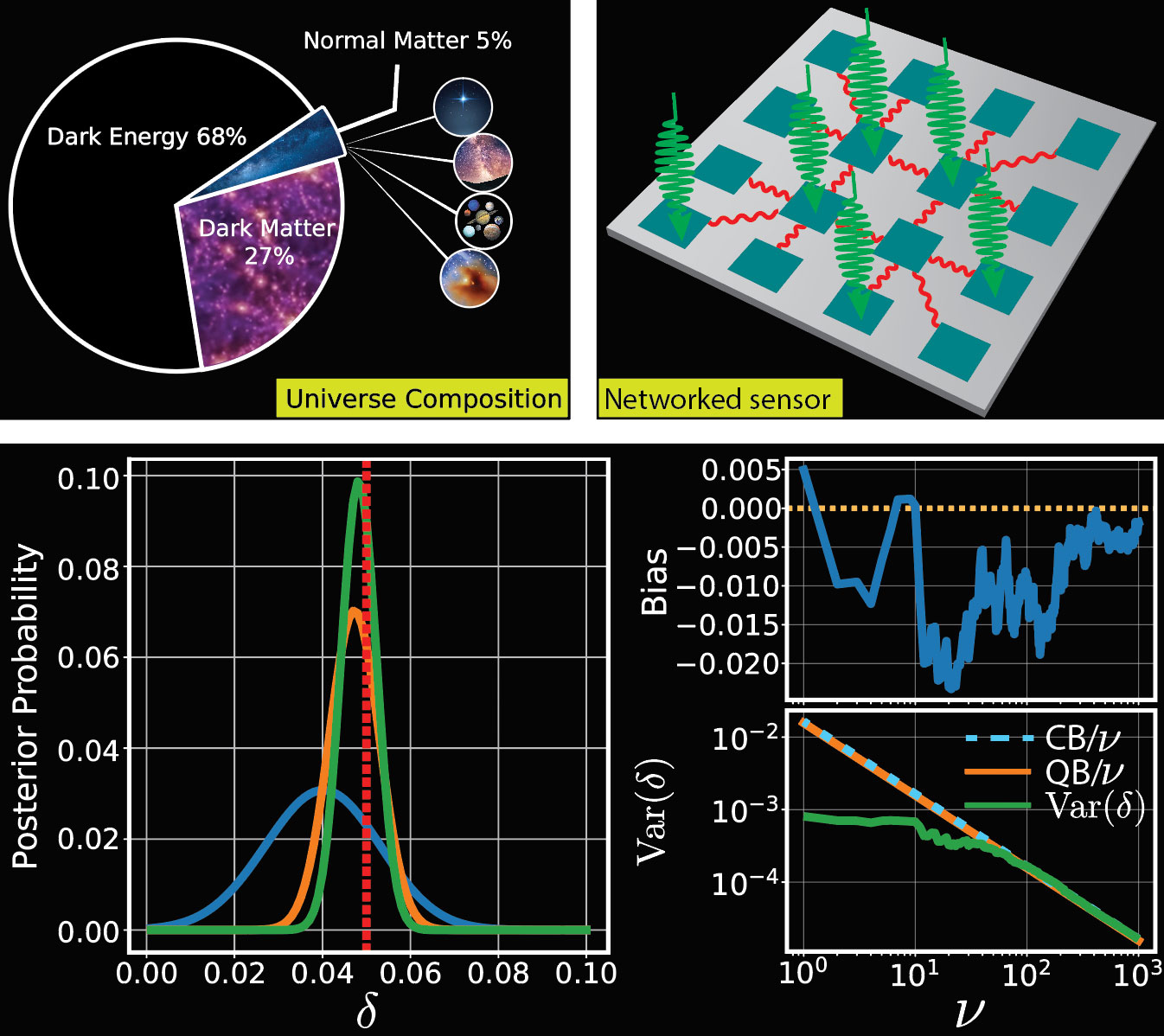
The research centers on superconducting qubits, tiny electrical circuits that function at extremely low temperatures. Although these qubits are typically used to build quantum computers, the team adapted them into powerful quantum sensors. By connecting multiple superconducting qubits into optimized networks, the researchers found that the system could pick up weak dark matter signals much more effectively than a single sensor working alone—much like a coordinated team achieving more together than any one member could individually.
Testing Different Network Designs
The team tested different network patterns, such as ring, line, star, and fully connected graphs, using systems of four and nine qubits. They then applied variational quantum metrology (a method similar to training a machine-learning model) to optimize how the quantum states were prepared and measured. To refine the results, Bayesian estimation was used to filter out noise, much like sharpening a blurry image.
The findings were striking: optimized networks consistently outperformed traditional methods, even when realistic noise was introduced. This shows the approach can work on today’s quantum devices.
“Our goal was to figure out how to organize and fine-tune quantum sensors so they can detect dark matter more reliably,” said Dr. Le Bin Ho, lead author of the study. “The network structure plays a key role in enhancing sensitivity, and we’ve shown it can be done using relatively simple circuits.”
Beyond dark matter, these quantum sensor networks could advance technologies such as quantum radar, gravitational wave detection, and ultra-precise timekeeping. Furthermore, they may one day improve GPS accuracy, enhance brain imaging with MRI, or help detect hidden underground structures.
“This research shows that carefully designed quantum networks can push the boundaries of what is possible in precision measurement,” Dr. Ho added. “It opens the door to using quantum sensors not just in laboratories, but in real-world tools that require extreme sensitivity.”
Looking ahead, the team plans to extend this approach to larger networks and explore ways to make the sensors more resistant to noise.
Reference: “Optimized quantum sensor networks for ultralight dark matter detection” by Adriel I. Santoso and Le Bin Ho, 1 October 2025, Physical Review D.
DOI: 10.1103/rv43-54zq
Leave a Reply