
Published on October 4, 2025 by Melissa Ait Lounis
Collected at: https://dailygalaxy.com/2025/10/planet-sized-collision-reason-you-alive/
According to a recent study, published in Science Advances, the early Earth was formed astonishingly fast, but it wasn’t initially a planet capable of supporting life. The building blocks of biology, including water and volatile compounds, were missing. Now, scientists believe that a cataclysmic collision with a Mars-sized body known as Theia may have been the event that changed everything.
A Planet Built Fast But Born Dry
Earth’s chemical structure solidified just three million years after the Solar System was born, according to scientists from the University of Bern’s Institute of Geological Sciences. Using the decay of manganese-53 into chromium-53 as a time marker, the team established an exceptionally precise formation timeline.
“A high-precision time measurement system based on the radioactive decay of manganese-53 was used to determine the precise age,” said Dr. Pascal Kruttasch, first author of the study.
But speed came with limitations. The young Earth was almost entirely lacking in essential compounds like water, carbon, and sulfur. It formed in the inner Solar System, a region where high temperatures made it hard for volatile substances to stick around or condense on rocky bodies.
Chasing Chemical Clues In Ancient Isotopes
To reconstruct Earth’s chemical evolution, the team compared chromium isotopes in ancient meteorites and select terrestrial rocks. Meteorites serve as snapshots of early Solar System material, while Earth’s oldest rocks still carry subtle isotopic traces of when the core, mantle, and crust separated.
“These measurements were only possible because the University of Bern has internationally recognized expertise and infrastructure for the analysis of extraterrestrial materials,” said Professor Klaus Mezger, co-author and isotope geochemist.
Their findings confirm that Earth’s interior was already fully structured before it acquired the compounds needed for life. That rules out the idea that local sources gradually delivered those materials. The inner Solar System simply didn’t have enough to offer. The timing and isotope data instead point to a more dramatic delivery system.
Theia’s Impact And The Origins Of The Moon
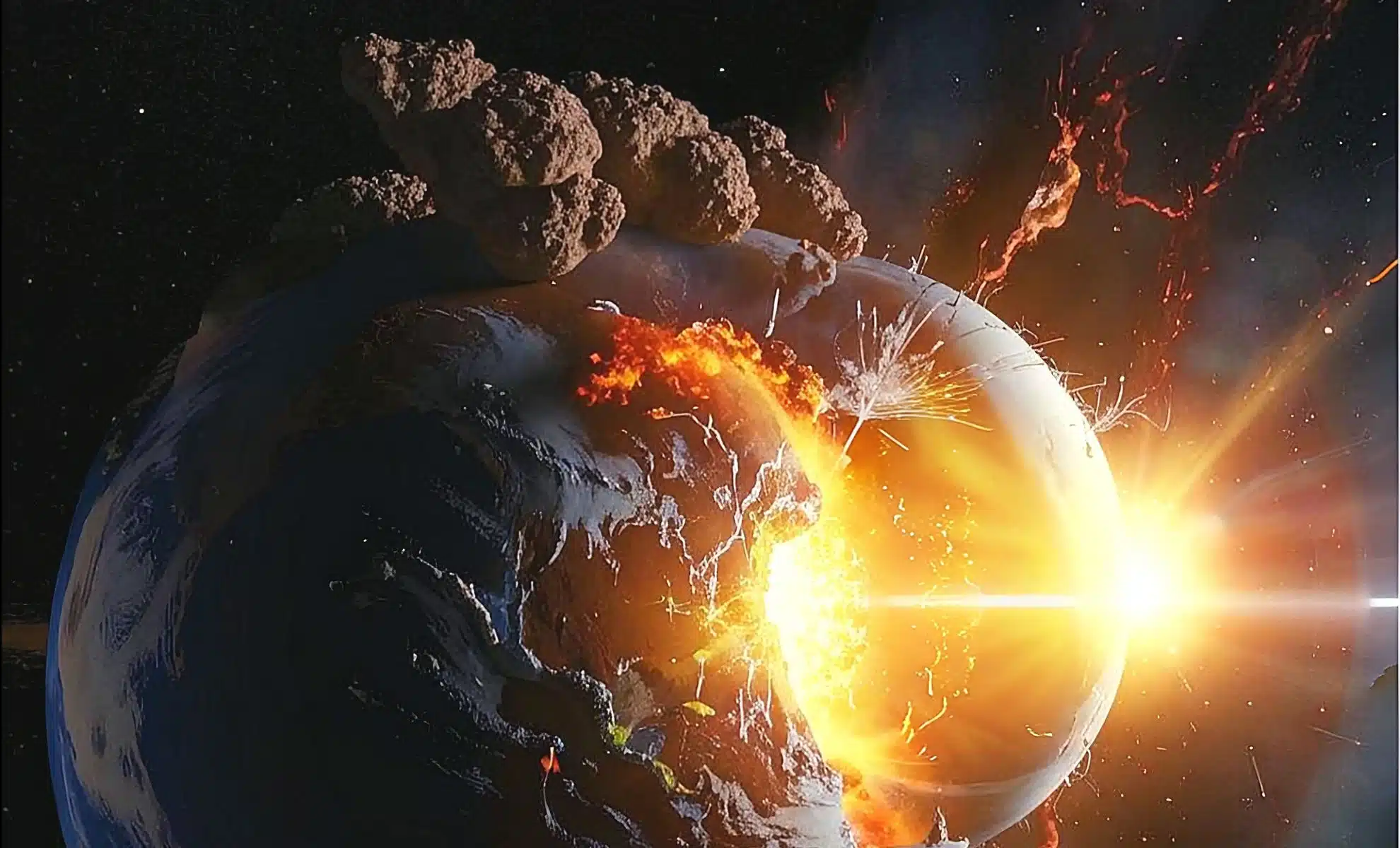
That turning point may have come from Theia, a planet-sized object thought to have collided with Earth after its internal layers had formed. According to the giant impact hypothesis, Theia likely came from a colder, more distant part of the Solar System, where water and carbon-rich compounds were much more common.
The impact didn’t just launch the material that formed the Moon, it may also have delivered a vital cargo of volatiles, seeding Earth with the elements it lacked.
This idea is backed by both chemical and physical evidence. Earth and the Moon share near-identical isotopic fingerprints, suggesting they formed from the same cataclysmic event. Earth’s present-day composition also shows signs of enrichment in volatiles that couldn’t have come from local sources. The sequence of events, the chemistry, and the orbital dynamics all point to a single, defining collision that reshaped Earth’s destiny.
A New Way Of Thinking About Habitability
Two planets can orbit at the same distance from their stars and end up nothing alike — especially if one gets struck by a volatile-rich body and the other doesn’t. As the researchers put it, “habitability is not guaranteed by orbit alone.” A planet’s ability to support life depends on its history — when, where, and how it received the materials life requires.
Still, the details of the Theia collision remain murky. Even though the theory is widely supported, “this collision event is insufficiently understood,” Kruttasch said. Scientists are now building more advanced models to explain not only how Earth and the Moon formed, but also why they share such similar chemical signatures.
Leave a Reply