
By Amit Malewar Published: October 3, 2025
Collected at: https://www.techexplorist.com/easy-formula-unlock-longer-lasting-batteries/101161/
Inside every lithium-ion battery, there’s a tiny dance going on. When you use your device, lithium ions migrate from the electrolyte and insert themselves into the solid electrode, a process known as “intercalation.” When you charge it back up, they return to the electrolyte. Simple, right?
For decades, scientists believed the speed of this dance depended on how quickly lithium ions could move into the electrode, following a classic choreography described by the Butler-Volmer equation, a century-old model for electrochemical reactions.
But here’s the twist: when researchers tried to measure this lithium shuffle, the results were all over the place. Some labs observed slow movements, while others saw lightning-fast ones, sometimes differing by a factor of one billion.
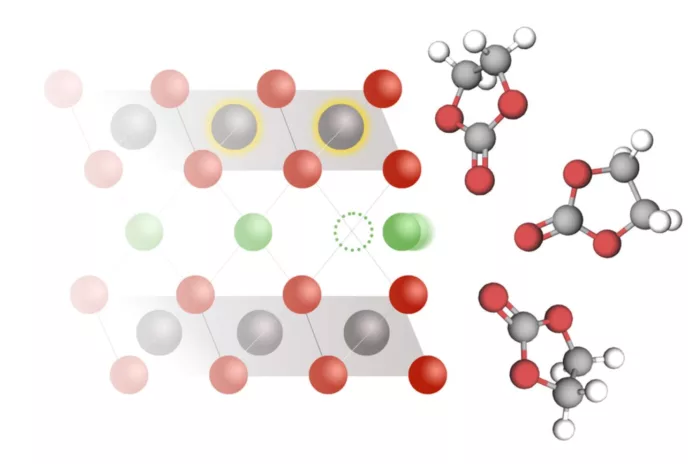
In a fresh twist to battery science, MIT researchers have measured the rates of lithium intercalation. They used this data to develop a model, which suggests lithium doesn’t go solo when slipping into electrodes; it brings an electron along for the ride. This buddy system, known as coupled ion-electron transfer (CIET), alters our understanding of the core reaction within lithium-ion batteries.
Using rapid-fire voltage pulses to an electrode, the team tested over 50 combos of battery materials, including those found in EVs and smartphones, and found that lithium’s entry rates were much slower than expected. The old-school Butler-Volmer model didn’t match reality.
Instead, the new theory suggests that lithium only becomes involved when an electron participates, thereby lowering the energy barrier and increasing the likelihood of the reaction.
CIET facilitates the entry of lithium into the electrode by lowering the energy barrier, allowing the reaction to occur more smoothly and frequently.
Martin Bazant, the Chevron Professor of Chemical Engineering and a professor of mathematics at MIT, said, “The electrochemical step is not lithium insertion, which you might think is the main thing, but it’s actually electron transfer to reduce the solid material that is hosting the lithium. Lithium is intercalated at the same time that the electron is transferred, and they facilitate one another.”
Novel method to improve battery performance
Thanks to MIT’s new model, scientists can now predict how fast lithium ions move during battery reactions, and the numbers actually match what experiments show. That’s a significant development, because the old Butler-Volmer model often fell short.
Even better? This new framework could explain why specific tweaks to electrodes and electrolytes enhance energy, power, and battery life, a process that has long relied on trial and error. With this model, battery design might finally shift from educated guessing to precision engineering.
Bazant said, “What we hope is enabled by this work is to get the reactions to be faster and more controlled, which can speed up charging and discharging.”
The team discovered a clever trick: tweak the electrolyte’s ingredients, and you can fine-tune how fast lithium and its electron buddy dive into the electrode. For instance, swapping out certain anions lowers the energy toll for the transfer, like giving lithium a VIP pass.
This kind of molecular matchmaking opens doors to faster reactions, smarter electrode designs, and juicier battery performance. It’s chemistry with a purpose, and a power boost.
This new study not only explains how lithium infiltrates electrodes but also could help batteries charge faster. By speeding up the lithium intercalation reaction, researchers can reduce charging times without compromising the system’s integrity.
And there’s more: the model may also help reduce pesky side reactions, where electrons wander off the electrode and dissolve into the electrolyte like rebellious teens. These reactions wear down the battery over time, so curbing them means longer life, better performance, and fewer battery breakdowns.
Yang Shao-Horn, the J.R. East Professor of Engineering at MIT and a professor of mechanical engineering, materials science and engineering, and chemistry said, “This is one of these papers where now we began to unify the observations of reaction rates that we see with different materials and interfaces, in one theory of coupled electron and ion transfer for intercalation, building up previous work on reaction rates.”
Journal Reference:
- Zhang, Y., Fraggedakis, D., Gao, T., Pathak, S., Zhuang, D., Grosu, C., Samantaray, Y., C. Neto, A. R., Duggirala, S. R., Huang, B., Zhu, Y. G., Giordano, L., Tatara, R., Agarwal, H., Stephens, R. M., Bazant, M. Z., & Shao-Horn, Y. (2025). Lithium-ion intercalation by coupled ion-electron transfer. Science. DOI: 10.1126/science.adq2541
Leave a Reply