
By Amit Malewar Published: September 24, 2025
Collected at: https://www.techexplorist.com/giant-hydrogen-bridge-connecting-two-dwarf-galaxies/101085/
Galaxies evolve due to numerous competing influences, including the frequency of collisions (major vs. minor), the rate at which they pass each other at high speeds, the stripping of gas in crowded regions of space, and the interactions that spark activity, such as star and black hole formation.
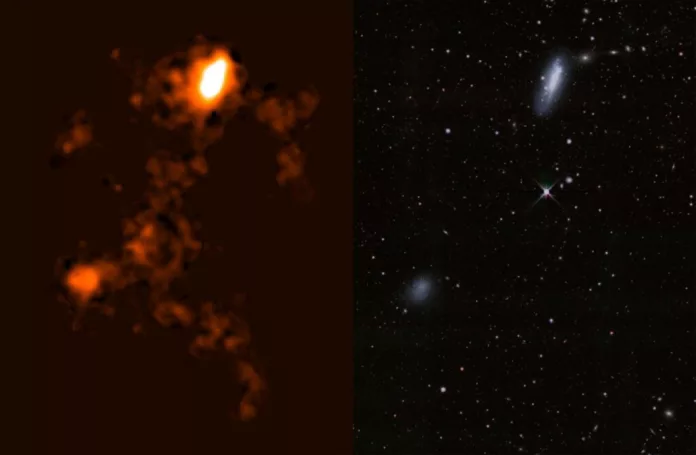
To better understand how galaxies change in different environments, scientists have studied these factors in detail. During this research, a pair of interacting galaxies, NGC 4532 and DDO 137, was discovered and is now jointly named WALLABY J123424+062511. This system is located in the northern part of the NGC 4636 field, about 1.7 million light-years south of the Virgo cluster and just under 2 degrees south of the galaxy M49.
Interestingly, the full size of the bridge connecting these two galaxies hadn’t been recognized before.
Astronomers at ICRAR–UWA have discovered a massive hydrogen bridge spanning 185,000 light-years between two dwarf galaxies, NGC 4532 and DDO 137, located 53 million light-years away from Earth.
But that’s not all: the bridge is trailed by a colossal gas tail extending 1.6 million light-years, making it the longest structure of its kind ever observed.
Lead author and ICRAR UWA astronomer Professor Lister Staveley-Smith said the discovery marked a significant step forward in understanding how galaxies interact.
The immense bridge and tail of gas between NGC 4532 and DDO 137 were shaped by powerful tidal forces as the galaxies orbited each other, like dancers caught in a gravitational whirl.
As they drifted toward the Virgo cluster’s scorching gas cloud, 200 times hotter than the Sun’s surface, they encountered ram pressure, a cosmic wind that stripped and heated their gas, stretching it into the record-breaking tail we see today.
Prof. Staveley-Smith compares the process to a satellite burning up as it re-enters Earth’s atmosphere, but stretched over a billion years.
As the galaxies plunge into the superheated gas cloud surrounding the Virgo cluster, the high-speed motion and dense electron environment act like a cosmic blowtorch. This intense ram pressure strips vast amounts of gas from the galaxies, feeding the enormous bridge and tail now observed.
Co-author and ICRAR UWA astrophysicist Professor Kenji Bekki said researchers discovered the colossal gas formations by using high-resolution observations of neutral hydrogen.
Neutral hydrogen is the raw material for star formation. That’s why discovering such a vast hydrogen bridge is a game-changer; it helps us understand how galaxies grow and evolve, especially in crowded cosmic neighborhoods.
Professor Staveley-Smith said the system had strong similarities with our own Milky Way and Magellanic System, providing a unique opportunity to study such interactions in detail.
Studying these gas bridges helps us understand how galaxies evolve, how their gas circulates, and what conditions enable the formation of stars.
This also deepens our understanding of the most significant structures in the Universe, how they form, evolve, and create stars throughout cosmic history.
Journal Reference:
- L Staveley-Smith, K Bekki, A Boselli, L Cortese et al. WALLABY pilot survey: the extensive interaction of NGC 4532 and DDO 137 with the Virgo cluster. Monthly Notices of the Royal Astronomical Society. DOI: 10.1093/mnras/staf1443
Leave a Reply