
September 18, 2025 by rtraiger
Collected at: https://www.eeworldonline.com/ai-native-chip-with-integrates-2-mb-sram-cortex-m4f-cpu-and-analog-sensor-interfaces/
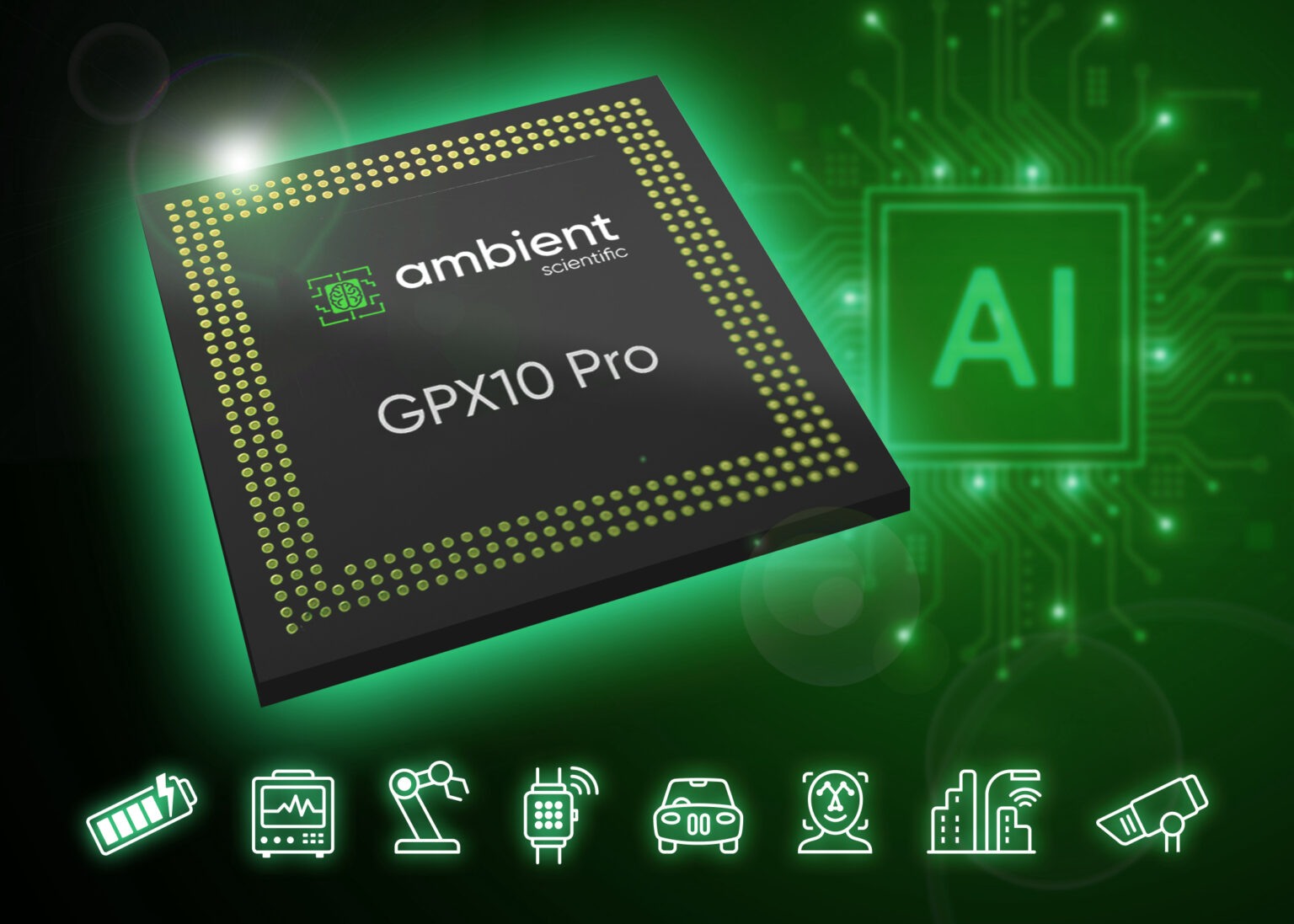
Ambient Scientific has introduced the GPX10 Pro, a system-on-chip designed specifically for edge AI applications. The device implements ten programmable AI cores based on the company’s DigAn silicon architecture, which maps neural network matrix-multiply operations and activation flows directly to in-memory analog compute blocks. This structure avoids the overhead of a conventional instruction set, enabling efficient execution of inference tasks on low-power, battery-operated devices.
The GPX10 Pro supports convolutional, recurrent, and gated neural networks, including CNNs, RNNs, LSTMs, and GRUs. The architecture delivers up to 2,560 multiply-accumulate operations per cycle across its cores, with a total peak throughput of 512 GOPs. By organizing the cores into two power domains, the chip can maintain always-on functions at extremely low power levels, consuming less than 100 µW during continuous keyword spotting.
On-chip resources include 2 MB of SRAM, ten times the memory available in the previous GPX10 device, allowing larger and more complex models to be implemented locally at the edge. The SoC also integrates an Arm Cortex-M4F CPU core for control functions, alongside analog interfaces such as an ultra-low-power ADC, I2S logic, and connections for up to eight analog and 20 digital sensors.
The platform is supported by the Nebula AI toolchain, which provides compatibility with TensorFlow, Keras, and ONNX frameworks. This software environment allows engineers to train, optimize, and deploy models to the GPX10 Pro, with flexibility to adapt to evolving network types. In addition, the SenseMesh hardware layer enables low-latency sensor fusion by connecting multiple sensors directly to the AI cores, reducing CPU overhead and minimizing idle power consumption.
The GPX10 Pro is intended for applications such as keyword spotting, voice recognition, intelligent sensing, and low-frequency vision, including use cases powered by a single coin cell battery. Demonstrations include fall detection, face identification, and appliance control at this year’s Electronica exhibition in Bangalore. The device is sampling now, with volume production scheduled for the first quarter of 2026.
Leave a Reply