
September 15, 2025 by JooHyeon Heo, Ulsan National Institute of Science and Technology
Collected at: https://techxplore.com/news/2025-09-solar-desalination-technology-sunlight-fresh.html
A research team from UNIST has unveiled a novel solar desalination technology that efficiently harnesses sunlight to evaporate seawater and generate clean drinking water—completely independent of external electricity. Importantly, this advanced system addresses common issues, such as salt accumulation, which can impair performance over time, offering a promising solution for water-scarce regions worldwide.
Led by Professor Ji-Hyun Jang of the School of Energy and Chemical Engineering, the team introduced a device designed to prevent salt buildup on its surface, ensuring long-term durability and reliable operation—key considerations for deployment in developing countries facing water shortages. The work is published in the journal Advanced Energy Materials.
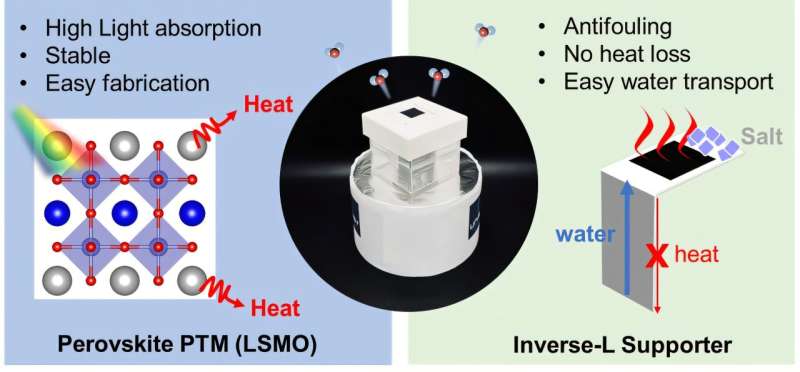
The core of this solar evaporator features a distinctive inverse-L-shaped paper structure. Thanks to its water-absorbing properties, similar to litmus paper, seawater naturally wicks upward along the paper column. When the water reaches the top, it encounters a heated photothermal material that rapidly converts it into vapor under sunlight. The material employed, La₀.₇Sr₀.₃MnO₃ (LSMO), a perovskite-based semiconductor, exhibits high thermal efficiency, enabling evaporation rates that are 8 to 10 times faster than conventional methods.
Due to its unique inverse-L geometry, salt ions are driven toward the edges of the device, where they crystallize as solid deposits. This built-in salt rejection mechanism not only prevents fouling but also facilitates easy salt collection and reuse, keeping the photothermal surface clean and maintaining optimal performance over time.
The system achieves an impressive evaporation rate of 3.40 kg m⁻2 h⁻¹ (approximately 3.4 liters), vastly surpassing the typical 0.3–0.4 kg/m²/h observed under natural sunlight. Durability tests further demonstrated stable operation over two weeks in highly concentrated saline solutions with 20% salt content, exceeding the salinity of normal seawater.
Lead author Dr. Saurav Chaule explained, “The inverse-L-shaped evaporator offers a sustainable approach to freshwater production and has potential applications in eco-friendly resource recovery, such as salt harvesting.”
Professor Jang emphasized, “By integrating innovative structural design with a perovskite-based photothermal material, we have developed a cost-effective, electricity-free device capable of producing 3.4 kg of freshwater per hour. This breakthrough provides a practical and scalable solution to the global water scarcity crisis.”
More information: Sourav Chaule et al, Inverse‐L Shaped Evaporator Based on La1−xSrxMnO3 Perovskite with Efficient Salt Collection via Localized Salt Gradient, Advanced Energy Materials (2025). DOI: 10.1002/aenm.202501360
Journal information: Advanced Energy Materials
Leave a Reply