
By Amit Malewar Published: September 12, 2025
Collected at: https://www.techexplorist.com/fabobscura-software-animates-real-world-objects/100950/
What if your coffee coaster could change moods with a tap? Or a kids’ book could animate itself without a single battery? Thanks to researchers at MIT’s Computer Science and Artificial Intelligence Laboratory (CSAIL), that kind of magic is now possible, using nothing but printed materials and a clever twist on a century-old optical trick.
The team has unveiled FabObscura, a design tool that lets anyone, from artists to advertisers, create dynamic, animated displays without electronics. The secret? A technique called barrier-grid animation, also known as scanimation, uses patterned overlays to reveal motion in static images.
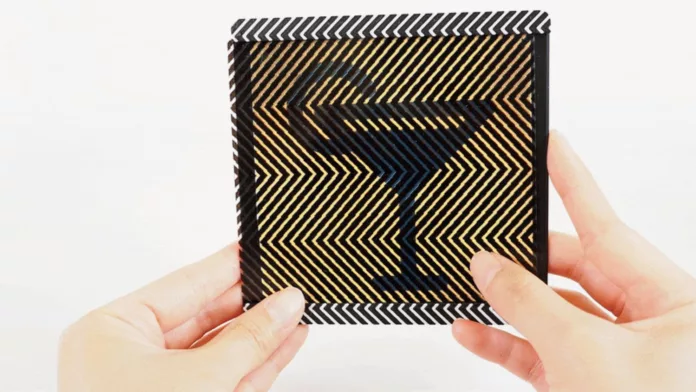
Barrier-grid animations work like visual sleight of hand. A printed image made by slicing and interweaving frames of an animation is paired with a transparent overlay that resembles a picket fence. Slide, rotate, or tilt the overlay, and the image appears to move.
Until now, most tools for creating these animations stuck to straight-line overlays. But FabObscura breaks that mold. It lets users design overlays in zigzags, spirals, radial swirls, and even mathematically defined curves.
Want a mouse to run in circles around a clock face? Or a flower to bloom as you twist a jar lid? FabObscura makes it possible.
“Our system can turn a seemingly static, abstract image into an attention-catching animation,” says MIT PhD student and CSAIL researcher Ticha Sethapakdi SM ’19, lead author of the paper presenting FabObscura. “The tool lowers the barrier to entry to creating these barrier-grid animations, while helping users express a variety of designs that would’ve been very time-consuming to explore by hand.”
At the heart of FabObscura is a simple but powerful insight: barrier patterns can be expressed as any continuous mathematical function. Users can type equations directly into the software to generate custom overlays. A constant function creates horizontal lines. A sine wave produces smooth, undulating motion. The interface even offers examples to help users experiment with different effects.
Once the animation frames are uploaded, say, a horse galloping or an eye blinking, FabObscura lets users preview the result and print the barrier and image using a standard inkjet printer. The pieces can be mounted on flat surfaces like books, phones, or picture frames. And for those feeling extra ambitious, the tool supports nested animations: two sequences on one surface, each revealed by moving the overlay in a different direction.
One CSAIL demo shows a car that rotates when the overlay moves vertically, but morphs into a spinning motorcycle when slid horizontally. Another turns a coaster from a coffee icon to a martini glass with just a press of the fingers.
The possibilities stretch far beyond novelty. Artists and designers can use FabObscura to create interactive prints, animated packaging, or signage that changes based on how it’s viewed. Imagine a construction sign that shifts to show “closed” or “open” depending on the angle, or a food label that animates when you twist the lid.
Even without electronics, these designs feel alive.
Of course, there are trade-offs. Nested animations, while visually striking, can lose clarity if too many frames are used. The team recommends sticking to high-contrast images and fewer frames to keep things crisp.
Looking ahead, the researchers plan to expand FabObscura’s capabilities. Soon, users may be able to upload full video clips, letting the software automatically select the best frames for animation. And while the current system is optimized for flat surfaces, the team is exploring 3D applications, possibly using 3D printers to fabricate curved or sculpted scanimations.
From spinning coins to blooming jars, FabObscura is turning everyday objects into dynamic storytelling canvases. And all it takes is a little math, a printer, and a dash of imagination.
Journal Reference:
- Ticha Sethapakdi, Maxine Perroni-Scharf et al. FabObscura: Computational Design and Fabrication for Interactive Barrier-Grid Animations.
Leave a Reply