
Arezki Amiri Published on September 7, 2025
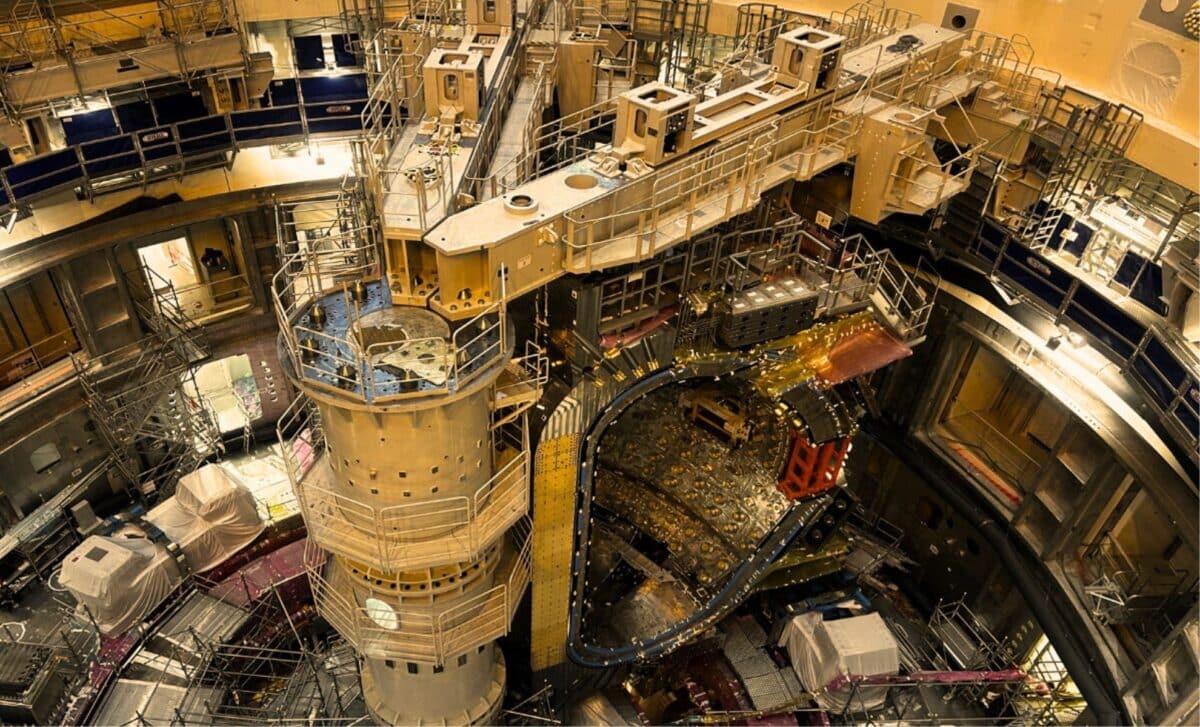
In the hills of southern France, engineers have begun a task that many believe could change the future of energy: assembling the heart of ITER, the world’s largest nuclear fusion experiment. According to the project’s own baseline update published in July 2024, this moment marks the most delicate and decisive phase in a decades-long effort to harness the same reaction that powers the sun.
Assembling the Tokamak’s Core
At the center of the effort is the vacuum vessel, a 19-metre-wide double-walled chamber where plasma hotter than 150 million degrees Celsius will be confined. It is being pieced together from nine vast steel sectors, each weighing about 440 tonnes, shipped from Europe and South Korea. When fully welded and sealed, the structure will weigh more than 5,200 tonnes—larger than many naval warships and unlike any component ever built for industry.
This summer, the American nuclear company Westinghouse was awarded a $180 million contract to take on the painstaking assembly work. The job is far from straightforward. Engineers must weld the enormous sectors into a perfectly aligned ring while compensating for thermal expansion and metal deformation.

There is no tolerance for error. If the plasma touches the chamber walls, the experiment fails. Westinghouse is working alongside long-standing European partners, Ansaldo Nucleare and Walter Tosto, who have already been instrumental in fabricating parts of the structure.
A Rare Global Collaboration
Although based in France, ITER is not a French project. It represents one of the most ambitious examples of scientific cooperation ever attempted. Thirty-five nations are involved, including the United States, China, Russia, Japan, South Korea, and all EU member states.
Each country contributes components, expertise, or technology, which are shipped to the site at Cadarache. There, teams integrate the pieces with millimetric precision, turning the construction site into something closer to a giant jigsaw puzzle on a planetary scale.
The division of labor reflects this shared responsibility. Europe is providing five of the vacuum vessel sectors, South Korea four. Elsewhere, the United States has shipped superconducting magnets more than 18 meters long, while Japan is supplying critical sections of the central solenoid. The scale of international effort has led some commentators to call ITER a kind of “nuclear United Nations,” with science replacing politics as the common language.
Timelines, Targets, and Setbacks
The original plan for ITER was to achieve its first plasma in 2018, but delays, redesigns, and funding debates have pushed the timeline forward. According to the latest official schedule, the machine will now begin a deuterium-deuterium phase in 2035, move to full magnetic energy and plasma current in 2036, and reach deuterium-tritium operations in 2039.
The goal is to achieve a fusion power amplification factor (Q) of 10—producing 500 megawatts of fusion power from 50 megawatts of input heating power. ITER itself will not generate electricity for the grid; that task is reserved for its successor, DEMO, which is already in early planning stages across Europe and Asia. Still, ITER is the proof-of-principle step, the machine that must demonstrate whether fusion can work at the scale humanity needs.
Holding the Sun on Earth
Fusion energy has long been described as the “holy grail” of clean power: virtually limitless, carbon-free, and safer than fission because it produces no long-lived radioactive waste. Yet achieving it has proved to be one of science’s greatest challenges. As Winston Churchill once remarked in a different context, “This is not the end. It is not even the beginning of the end. But it is, perhaps, the end of the beginning.” For ITER, that description feels apt.
The project is still many years away from ignition, but the assembly of the vacuum vessel signals a shift from design and fabrication to integration and operation. For researchers and policymakers alike, the promise of bottling the power of the stars is no longer abstract—it is being welded together, piece by massive piece, in a quiet corner of Provence.
Leave a Reply