
September 10, 2025 by Steve Martin, Purdue University
Collected at: https://techxplore.com/news/2025-09-image-algorithm-hyperspectral-info-conventional.html
Professionals in agriculture, defense and security, environmental monitoring, food quality analysis, industrial quality control, and medical diagnostics could benefit from a patent-pending innovation that opens new possibilities of conventional photography for optical spectroscopy and hyperspectral imaging.
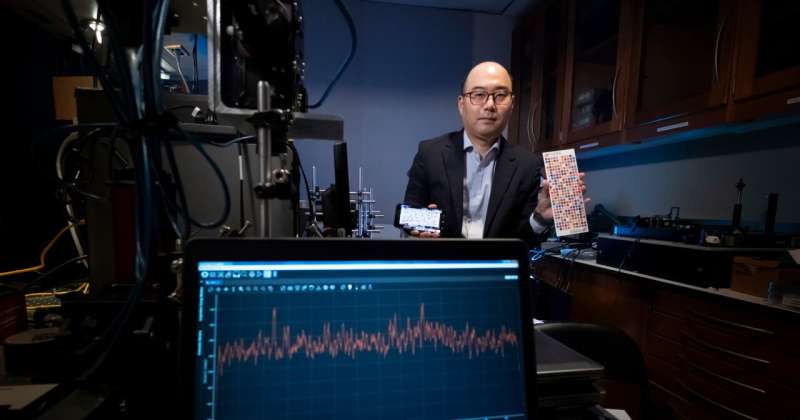
Young Kim, Purdue University professor, University Faculty Scholar and Showalter Faculty Scholar, and postdoctoral research associate Semin Kwon of the Weldon School of Biomedical Engineering created an algorithm that recovers detailed spectral information from photographs taken by conventional cameras. The research combines computer vision, color science and optical spectroscopy.
“A photograph is more than just an image; it contains abundant hyperspectral information,” Kim said. “We are one of the pioneering research groups to integrate computational spectrometry and spectroscopic analyses for biomedical and other applications.”
A paper about the team’s research has been published in the journal IEEE Transactions on Image Processing.
Kim disclosed the innovation to the Purdue Innovates Office of Technology Commercialization, which has applied for a patent to protect the intellectual property.
Generalizability and simplicity
Kwon said the work emphasizes recovering the arbitrary spectrum of a sample rather than solely relying on specific data-driven learning or pretrained algorithms, which excel only in preset tasks and samples.
The team’s method uses an algorithmically designed color reference chart and device-informed computation to recover spectral information from RGB values acquired using conventional cameras, such as off-the-shelf smartphones.
“Importantly, the spectral resolution—around 1.5 nanometers—is highly comparable to that of scientific spectrometers and hyperspectral imagers,” Kwon said. “Scientific-grade spectrometers have fine spectral resolution to distinguish narrow spectral features. This is critical in applications like biomedical optics, material analysis and color science, where even small wavelength shifts can lead to different interpretations.”
Kim said one advantage the Purdue method has over traditional technology is its algorithmic generalizability.
“From an algorithmic standpoint, to the best of our knowledge, our paper presents the first computational spectrometry method with 1.5-nm spectral resolution using a photograph of an arbitrary sample without relying on specific training data or predetermined algorithms,” he said.
Kwon said another advantage of the Purdue method is its hardware simplicity.
“Many mobile spectrometers require additional accessories and bulky components as mandatory attachments to smartphones,” he said. “In contrast, our method leverages the built-in camera of the smartphone. We envision that our general computational photography spectrometry will change how industry uses smartphones.”
Validation and next steps
Kim and Kwon are currently using the algorithm as a foundation for digital and mobile health applications in both domestic and resource-limited settings.
“Photography is central to these applications, but color distortion has posed a persistent challenge, which is why we are focusing on these settings,” Kim said. “This algorithm provides a basis for quantifying and correcting colors, enhancing the reliability of medical diagnostics.”
More information: Semin Kwon et al, Hyperspectral Information Extraction With Full Resolution From Arbitrary Photographs, IEEE Transactions on Image Processing (2025). DOI: 10.1109/TIP.2025.3597038
Leave a Reply