
Tanya Weaver Thu 4 Sep 2025
Collected at: https://eandt.theiet.org/2025/09/04/tentacle-underwater-robot-aims-cut-costs-and-boost-precision-offshore-inspections
A 1-metre-long underwater robot with soft manipulator technology aims to tackle the costs and challenges of subsea infrastructure inspection.
The robot is the result of a collaboration between the UK’s National Robotarium, a robotics and AI centre based at Heriot-Watt University in Edinburgh, and Senai Cimatec, a high-tech hub in Brazil.
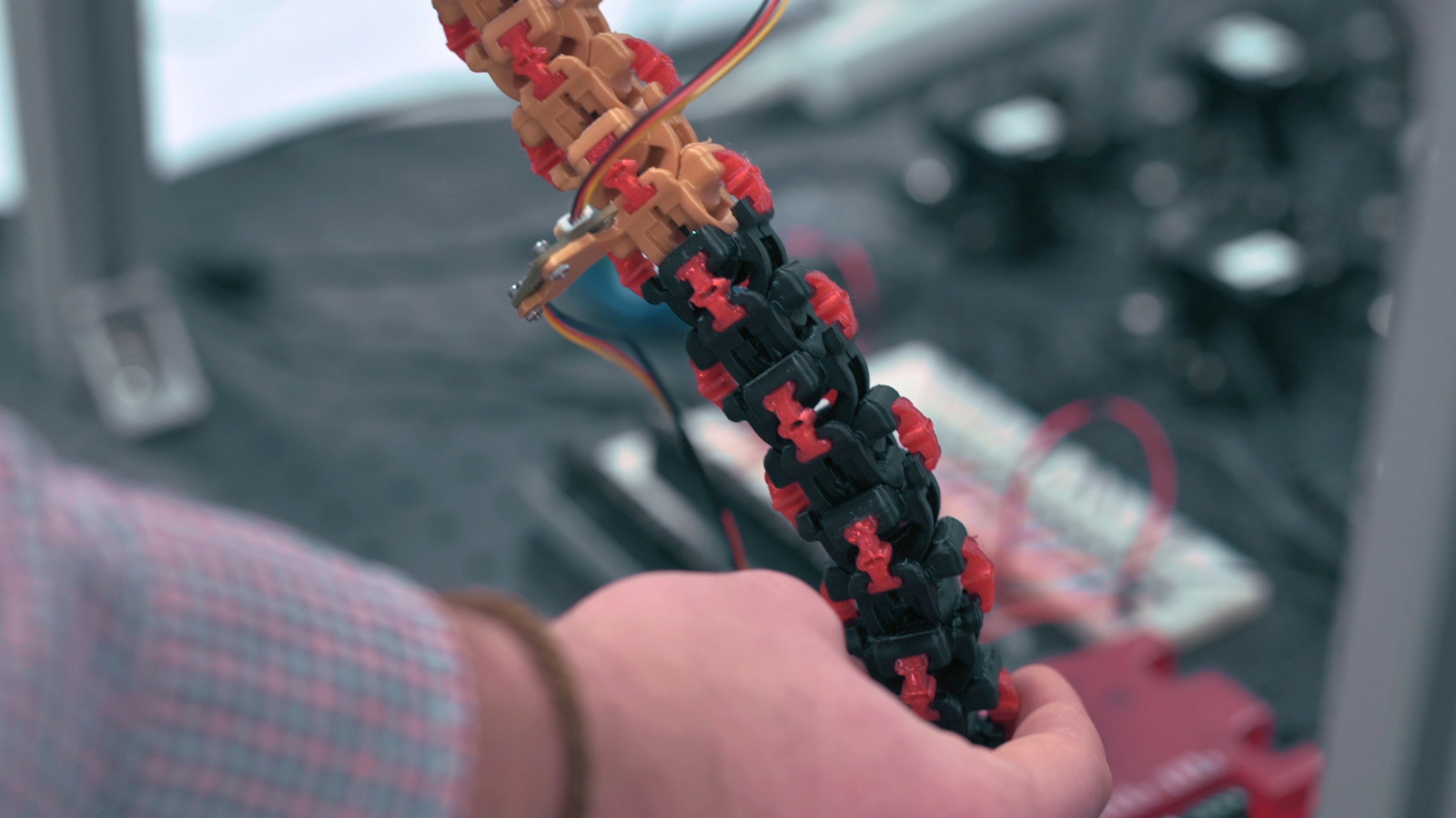
It features a 1-metre-long flexible backbone structure with tendon-like cable systems to control movement. Integrated sensors enable the robot to understand its position and shape underwater, allowing it to make precise movements even in turbulent conditions.
Once its target has been reached, the robot’s flexible body will make contact, conforming to the target structure for precise underwater positioning.

Ben Glasgow
After being deployed from an underwater vehicle, the robot will make its way to the offshore and marine infrastructure such as offshore wind farms or subsea pipelines, which require regular safety assessments to prevent failures.
Some offshore infrastructure, such as subsea pipelines, can reach depths of 3,000 metres below sea level, making them very challenging to inspect.
Traditional inspection methods often require large vessels and human divers with the use of conventional rigid manipulators, which run the risk of damaging delicate or complex subsea equipment.
The aim of this project was to demonstrate how soft robotics can be successfully scaled up to perform sophisticated inspection tasks while reducing operational costs and improving personnel safety and environmental sustainability.
Having developed the robotic manipulator, the National Robotarium’s engineers conducted various tests in a wave tank facility. These tests proved that the robot was able to position its tentacle-like arm with “remarkable” accuracy and maintain stability when subjected to external forces of up to 300g.
According to its engineers, even when intentionally disturbed it was able to correct its position and return to the desired state within seconds – a crucial capability for operation in unpredictable ocean environments.
Rowanne Miller, project manager at the National Robotarium, said: “Our team has taken this innovative underwater robot from initial concept through design and development to successful testing in real-world conditions.
“What makes this particularly exciting is that we’ve created a solution that doesn’t just incrementally improve existing technology – it fundamentally changes how we can approach underwater inspection tasks. This opens up new possibilities for safer, more precise interaction with critical subsea infrastructure, potentially transforming how we maintain and protect our offshore assets for decades to come.”
Lucas Silva, lead researcher at Senai Cimatec, said: “We worked together with the National Robotarium to conceive an innovative take on underwater manipulation, opening up new use cases for the industry.”
Leave a Reply