
By Amit Malewar Published: September 1, 2025
Collected at: https://www.techexplorist.com/mars-chunky-core-smooth-center/100828/
Mars may look like a quiet, dusty planet today, but its insides tell a far more chaotic story. New research published in Science reveals that the Red Planet’s mantle is not the smooth, layered structure we often see in textbooks. Instead, it’s riddled with ancient fragments, preserved remnants of a violent past, more like a cosmic Rocky Road brownie than a neatly stacked dessert.
Traditionally, rocky planets like Earth and Mars are imagined as geological layer cakes: crust, mantle, and core stacked like a millionaire’s shortbread- biscuit base, caramel middle, chocolate top. But Mars breaks that mold. Its interior is lumpy, uneven, and full of surprises.
NASA’s InSight mission, which monitored seismic activity on Mars, detected subtle vibrations traveling through the planet’s interior. These “seismic whispers” led scientists from Imperial College London and other institutions to uncover giant fragments, some up to 4 kilometers wide, buried deep within the Earth’s mantle. These chunks are thought to be leftovers from Mars’s early formation, preserved like geological fossils.
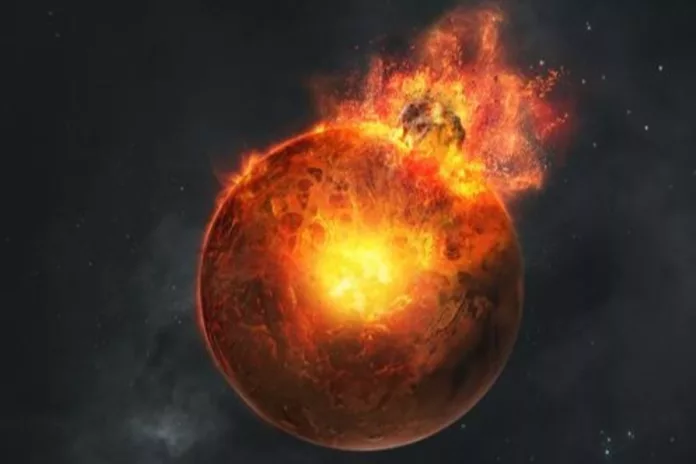
Mars and the other rocky planets formed approximately 4.5 billion years ago, as dust and rock orbiting the young Sun gradually clumped together under the influence of gravity. But once Mars had largely taken shape, it endured a series of massive collisions with planet-sized objects, the kind of impacts that likely formed Earth’s Moon.
These colossal impacts unleashed enough energy to melt large portions of the young planet, creating vast oceans of magma. As these oceans cooled and crystallized, they left behind distinct chunks of material. Scientists now believe these are the very fragments being detected by InSight.
Early collisions on Mars broke apart and mixed pieces of its original crust and mantle- along with possible debris from the impactors- into the planet’s molten interior. As Mars gradually cooled, these varied materials got stuck in its slowly moving mantle. The mixing wasn’t strong enough to make everything uniform.
Unlike Earth, which constantly recycles its crust and mantle through plate tectonics, Mars developed a solid outer layer early on. This stopped further mixing and preserved its inner structure, making it a geological time capsule.
Dr Charalambous said, “Most of this chaos likely unfolded in Mars’s first 100 million years. The fact that we can still detect its traces after four and a half billion years shows just how sluggishly Mars’s interior has been churning ever since.”
NASA’s InSight lander recorded seismic data from eight clear marsquakes, two of which were caused by recent meteorite impacts that created large craters about 150 meters wide. These quakes sent seismic waves through Mars’s mantle, and scientists noticed something unusual: the higher-frequency waves took longer to arrive at the sensors.
This delay suggests that the waves were getting scattered or slowed down, which points to a mantle that’s uneven or “chunky” inside, rather than smooth.
Dr Charalambous said, “These signals showed clear signs of interference as they travelled through Mars’s deep interior. That’s consistent with a mantle full of structures of different compositional origins, leftovers from Mars’s early days.”
“What happened on Mars is that, after those early events, the surface solidified into a stagnant lid. It sealed off the mantle beneath, locking in those ancient chaotic features, like a planetary time capsule.”
Unlike Earth, where tectonic plates constantly shift and recycle surface material into the mantle, as seen at the Cascadia subduction zone, Mars’s interior has remained essentially unchanged since its early days. Seismic data from Mars reveals a pattern in its mantle: a few large fragments, up to 4 kilometers wide, surrounded by many smaller ones.
Professor Tom Pike, who worked with Dr Charalambous to unravel what caused these chunks, said: “What we are seeing is a fractal’ distribution, which happens when the energy from a cataclysmic collision overwhelms the strength of an object. You see the same effect when a glass falls onto a tiled floor as when a meteorite collides with a planet: it breaks into a few big shards and a large number of smaller pieces. Remarkably, we can still detect this distribution today.”
This discovery could help scientists better understand how other rocky planets, such as Venus and Mercury, developed over time. Mars’s untouched interior gives us a rare look into the deep history of planets that don’t have active tectonics.
Journal Reference:
- Constantinos Charalambous, W. Thomas Pike, Doyeon Kim et al. Seismic evidence for a highly heterogeneous martian mantle. Science. DOI: 10.1126/science.adk4292
Leave a Reply